John II Komnenos, who reigns from 1118 …
Years: 1132 - 1143
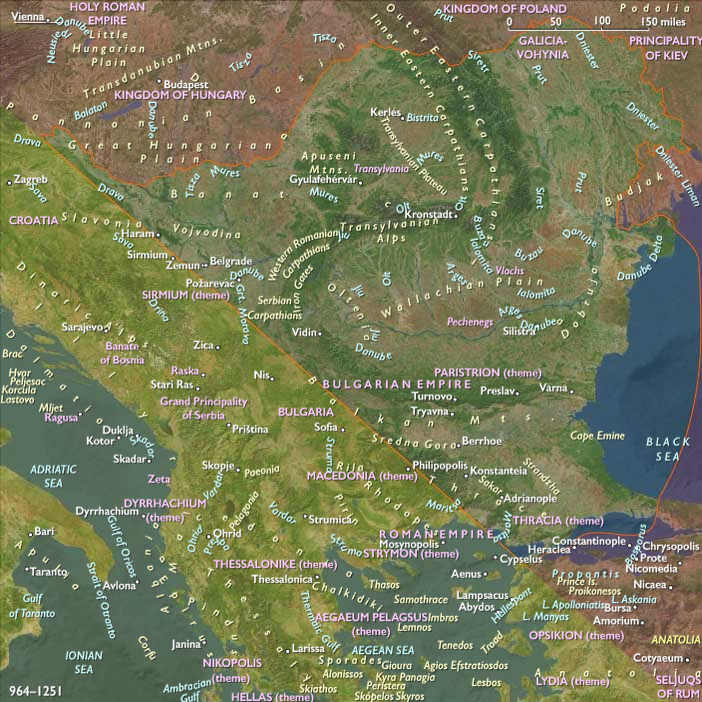
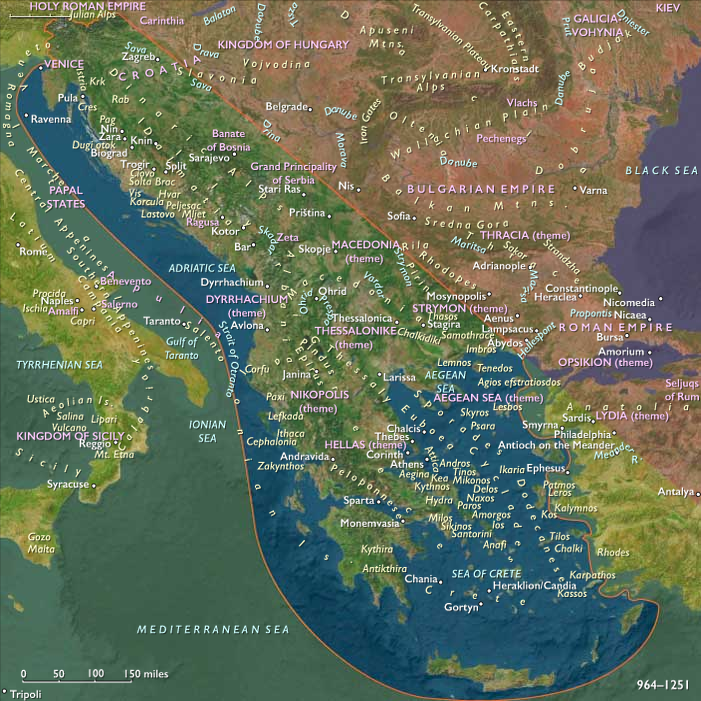
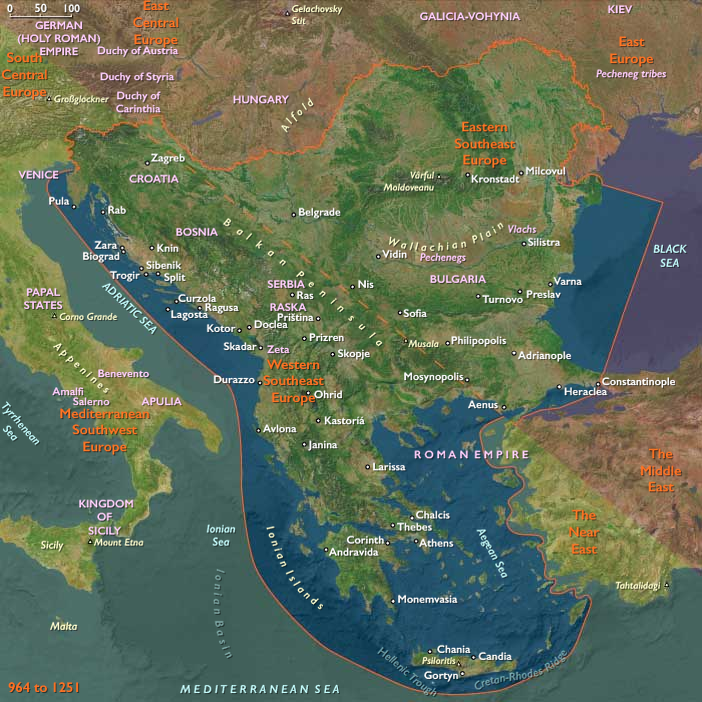
John II Komnenos, who reigns from 1118 to 1143, tries and fails to break what is becoming the Venetian monopoly of imperial trade, and he seeks to come to terms with the new kingdom of Hungary, to whose ruler he is related by marriage.
Alexios I had seen the importance of Hungary, lying between the western and eastern Roman empires, a neighbor of the Venetians and the Serbs.
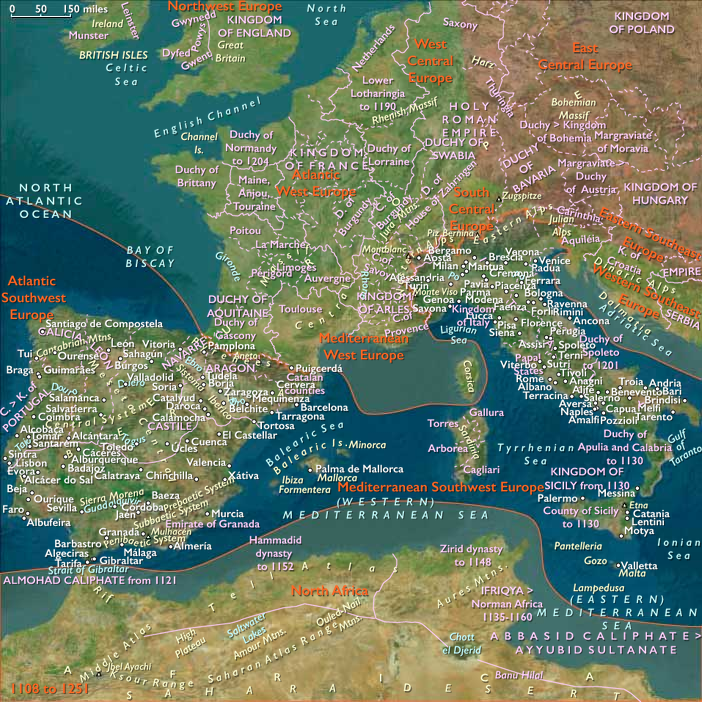
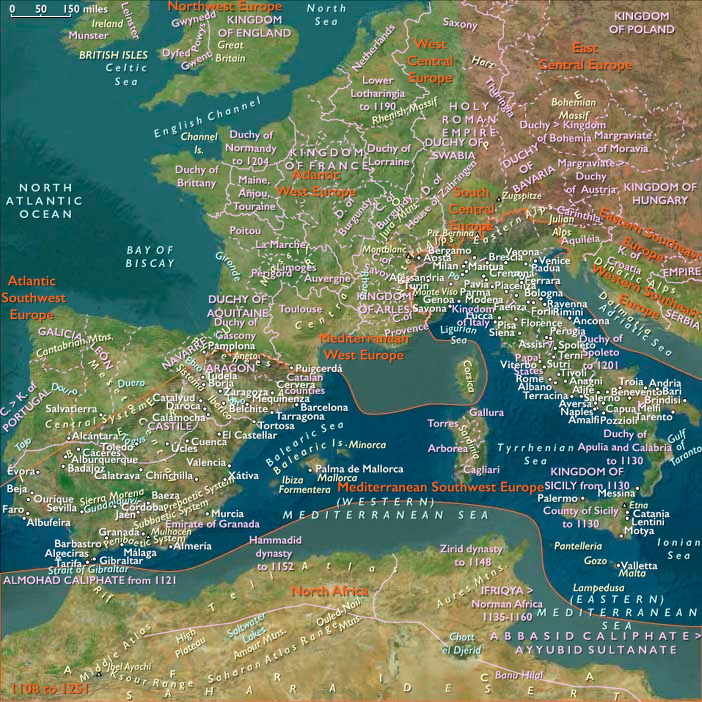
More ominous still had been the establishment in 1130 of the Kingdom of Sicily, but John astutely allies himself with the Western emperor, Germany’s Lothair II (or III), against the expansionist Norman state.
People
Groups
- Germans
- Hungarian people
- Greeks, Medieval (Byzantines)
- Venice, Duchy of
- Serbs (South Slavs)
- German, or Ottonian (Roman) Empire
- Hungary, Kingdom of
- Roman Empire, Eastern: Komnenos dynasty, restored
- Serbian Grand Principality
- Italians (Latins)
- Italo-Normans
- Sicily, Kingdom of
Topics
Subjects
Regions
Subregions
Related Events
Filter results
Showing 10 events out of 49196 total
The Jurchens try to conquer southern China in the 1130s, but become bogged down by a pro-Song insurgency in the north and a counteroffensive by the Song generals Yue Fei, Han Shizhong, and others.
The generals regain some territories but retreat on the orders of the Southern Song emperor, who supports a peaceful resolution to the war.
The Treaty of Shoaling in 1142 settles the boundary between the two empires along the Huai River, but conflicts between the two dynasties will continue until the fall of the Jin in 1234.
The wars engender an era of technological, cultural, and demographic changes in China.
Battles between the Song and Jin bring about the introduction of various gunpowder weapons.
The siege of De'an in 1132 is the first recorded appearance of the fire lance, an early ancestor of firearms.
There are also reports of battles fought with primitive gunpowder bombs like the incendiary huopao or the exploding tiehuopao, incendiary arrows, and other related weapons.
In northern China, the Jurchen tribes are the ruling minority of an empire that is predominantly inhabited by former subjects of the Northern Song.
Jurchen migrants settle in the conquered territories and assimilate with the local culture.
The Jin government institutes a centralized imperial bureaucracy modeled on previous Chinese dynasties, basing their legitimacy on Confucian philosophy.
Song refugees from the North resettle in southern China.
The North is the cultural center of China, and its conquest by the Jin diminishes the international stature of the Song dynasty.
The Southern Song quickly return to economic prosperity, however, and trade with the Jin is lucrative despite decades of warfare.
The Southern Song capital, Hangzhou, expands into a major city for commerce.
Northeast Europe (1132–1143 CE): Internal Struggles and Expansion of Christian Influence
Introduction
From 1132 to 1143 CE, Northeast Europe experienced significant internal political strife, further expansion of Christian missionary influence, and incremental urban growth. The period was marked by heightened dynastic rivalry, notably within Denmark and Sweden, alongside growing interactions—often conflictual—with neighboring Baltic populations.
Dynastic Struggles and Monarchical Consolidation
In Denmark, King Niels faced escalating internal opposition from rival claimants to the throne, particularly from his nephew, Erik Emune. The rivalry culminated in a destructive civil conflict, weakening central authority and contributing to internal instability that persisted throughout the era.
In Sweden, dynastic disputes intensified between the Sverker and Erik families. King Sverker I (ascended ca. 1130) sought to strengthen royal authority amid considerable internal tensions. His reign was characterized by efforts to unify disparate territories, thus laying foundations for subsequent stable rule.
Early Baltic Crusades and Christianization Efforts
Danish and Swedish missionary efforts intensified along the Baltic coasts during this period, serving as precursors to the later, full-scale crusades of the late twelfth and early thirteenth centuries. These missions primarily targeted pagan populations, notably in areas that would become Estonia and Finland. Initial contacts, though often hostile, gradually increased Scandinavian presence and cultural influence along Baltic shores.
Urban and Economic Development
The era witnessed further growth of emerging urban centers. Visby on Gotland continued to solidify its status as a pivotal Baltic trade hub, facilitating commerce between Scandinavia, the Baltic peoples, and the broader European continent. Similarly, towns such as Roskilde and early iterations of Stockholm and Lund saw modest but steady development, influenced by expanding regional trade networks and local artisan guilds.
Resistance and Fortification among the Baltic Tribes
Baltic tribes intensified defensive efforts against expanding Scandinavian incursions. Ancestors of the Estonians, Latvians, and Lithuanians fortified settlements and increasingly organized resistance. Early Scandinavian attempts to penetrate these regions, though limited in scope, fostered a tradition of fierce resistance among local populations, laying the groundwork for more structured resistance in subsequent decades.
Ecclesiastical Expansion and Cultural Influence
The growth of ecclesiastical institutions continued, particularly through monastic foundations such as Benedictine and early Cistercian monasteries. These institutions played central roles in local education, Latin literacy, and ecclesiastical governance. Christianity gradually permeated deeper into social life, influencing legal practices, cultural norms, and regional governance.
Legacy of the Era
The era from 1132 to 1143 CE significantly shaped Northeast Europe's future through intensified dynastic conflicts, preliminary missionary activities, and growing urban centers. It marked the gradual extension of Christian influence and set foundational precedents for intensified regional interactions, conflicts, and crusading efforts that would decisively shape the historical trajectory of the Baltic and Scandinavian lands.
East Central Europe (1132–1143 CE): Bolesław III’s Succession Crisis in Poland, Béla II’s Stabilization in Hungary, and Přemyslid Strengthening in Bohemia
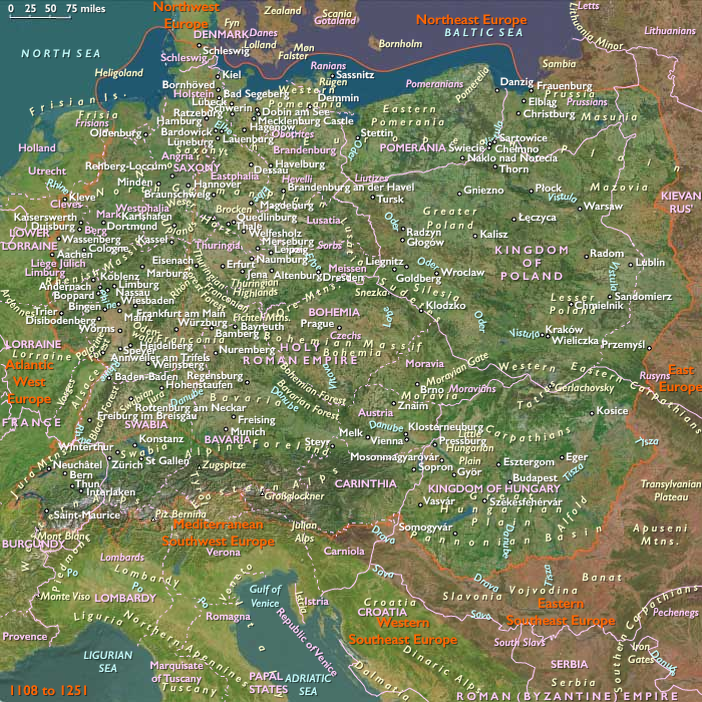
Between 1132 and 1143 CE, East Central Europe—encompassing modern-day Poland, Czechia, Slovakia, Hungary, and the eastern portions of Germany and Austria east of 10°E and north of the defined southeastern boundary—experienced significant dynastic transitions, political realignments, and shifts in regional power dynamics. Poland faced the beginnings of a critical succession crisis following the death of Bolesław III Wrymouth in 1138, Hungary experienced internal stabilization under Béla II, and Bohemia saw continued strengthening and dynastic authority under the Přemyslid ruler Soběslav I. These developments reshaped regional stability and set the stage for future political transformations.
Political and Military Developments
Poland’s Fragmentation after Bolesław III’s Death
-
Bolesław III Wrymouth (r. 1102–1138) died in 1138, initiating Poland’s seniorate system, dividing the kingdom among his sons and creating a senior-prince system that aimed at stability but resulted in fragmentation and ongoing dynastic conflict.
-
The division of Poland into principalities significantly weakened centralized royal power and set the stage for prolonged internal instability and aristocratic rivalry throughout the 12th century.
Hungary’s Internal Stabilization under Béla II
-
Béla II "the Blind" (r. 1131–1141) brought renewed internal stability to Hungary after inheriting a realm shaken by prior succession struggles. Assisted by his wife, Queen Helena, Béla consolidated royal authority, reasserted central administration, and decisively dealt with internal opponents (1132).
-
His effective rule ensured dynastic continuity and stability, strengthening Hungary’s administrative cohesion and internal peace.
Přemyslid Stability and Imperial Alliances in Bohemia
-
Bohemia, under Duke Soběslav I (r. 1125–1140), experienced a period of stable governance, military strength, and reinforced political authority. His victory against imperial forces at the Battle of Chlumec (1126) had earlier secured Bohemia’s regional autonomy within the Holy Roman Empire.
-
Soběslav strengthened Bohemia’s political institutions and alliances, ensuring continued Přemyslid stability and reinforcing Prague’s position as a regional center.
Imperial Influence under Lothair III and Conrad III
-
The Holy Roman Empire, under Lothair III (r. 1125–1137) and later Conrad III (r. 1138–1152), continued shaping East Central European politics, particularly in Bohemia and the eastern German territories, influencing regional alliances, dynastic successions, and political stability.
Economic and Technological Developments
Economic Stability and Urban Growth
-
Regional economies remained robust despite political transitions, supported by stable trade routes connecting the Baltic, Byzantine, and Western European markets. Urban centers in Hungary, Poland, and Bohemia expanded, benefiting from steady commerce and agricultural prosperity.
Agricultural Productivity and Technological Innovations
-
Agricultural productivity continued to grow due to the increased adoption of improved agricultural techniques, such as crop rotation, iron tools, and heavy plowing, sustaining population growth and economic expansion across the region.
Cultural and Artistic Developments
Ecclesiastical Patronage in Hungary under Béla II
-
Béla II, supported by Queen Helena, actively patronized ecclesiastical institutions and monastic foundations, furthering the expansion of Hungarian religious and cultural life and significantly enriching artistic and architectural developments.
Polish Cultural Continuity amid Political Fragmentation
-
Despite political fragmentation, Poland’s religious institutions, particularly monasteries and bishoprics, continued cultural and intellectual activities, preserving and advancing Latin Christian learning and local traditions.
Bohemian Cultural Flourishing under Soběslav I
-
Soběslav I’s reign saw continued Přemyslid patronage of cultural activities, including manuscript illumination, architectural projects, and monastic foundations, reinforcing Prague’s cultural prominence within Central Europe.
Settlement and Urban Development
Continued Urban Expansion in Poland and Hungary
-
Poland’s principalities continued developing urban centers, especially Kraków and Wrocław, despite internal divisions. Hungary’s Esztergom, Székesfehérvár, and other towns flourished, driven by stable governance and vibrant trade.
Bohemian Urban Fortification and Infrastructure
-
Prague and other Bohemian towns experienced steady fortification and infrastructure improvements under Soběslav I, enhancing their economic vitality, administrative efficiency, and defensive strength.
Social and Religious Developments
Consolidation of Christian Institutions
-
Christianity remained central to societal structures, particularly evident through continued ecclesiastical expansion and patronage by Hungarian royalty and Polish principalities. Religious institutions influenced governance, education, and regional culture.
Aristocratic Influence and Dynastic Authority
-
Aristocratic power and regional nobility played increasingly crucial roles in political governance, especially evident in Poland’s fragmentation. In Hungary and Bohemia, royal and ducal authority remained strong, with aristocratic classes integral to administration and military leadership.
Long-Term Consequences and Historical Significance
The era 1132–1143 CE significantly shaped the political trajectory of East Central Europe. Poland’s dynastic fragmentation after Bolesław III profoundly influenced its political landscape for generations, while Hungary’s internal stabilization under Béla II reinforced royal centralization and administrative effectiveness. Concurrently, Přemyslid Bohemia enjoyed continued political stability, regional autonomy, and cultural growth under Soběslav I. Collectively, these developments deeply affected regional governance, economic prosperity, cultural traditions, and societal structures, setting enduring patterns that defined East Central Europe’s medieval evolution.
Polish monarch Boleslaw Wrymouth makes complex arrangements intended to prevent fratricidal warfare and preserve the Polish state's formal unity.
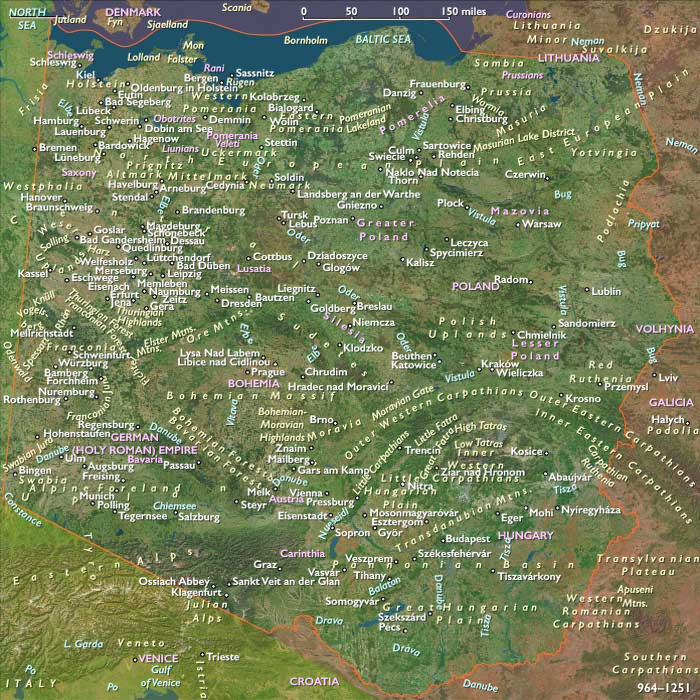
Following his concept of seniority, Boleslaw divides the country into five principalities: Silesia, Greater Poland, Mazovia, Sandomierz and Kraków.
The first four provinces are given to his four sons, who became independent rulers.
The fifth province, the Seniorate Province of Kraków, is to be added to the senior among the Princes who, as the Grand Duke of Kraków, is the representative of the whole of Poland.
The stability of the system is supposedly assured by the institution of the senior or high duke of Poland, based in Kraków and assigned to the special Seniorate Province that is not to be subdivided.
This principle breaks down within the generation of Boleslaw III's sons, when Wladyslaw II the Exile, Boleslaw IV the Curly, Mieszko III the Old and Casimir II the Just fight for power and territory in Poland, and in particular over the Kraków throne.
The external borders left by Boleslaw III at his death closely resemble the borders left by Mieszko I; this original early Piast monarchy configuration does not survive the fragmentation period.
For nearly two centuries, the Piasts will spar with each other, the clergy, and the nobility for the control over the divided kingdom.
Eastern Southeast Europe (1132–1143 CE): Strategic Alliances and Continued Economic Rivalry
Settlement and Migration Patterns
Stabilization of Roma Communities
From 1132 to 1143 CE, Roma communities became further integrated into Eastern Southeast Europe, expanding their presence from initial Balkan settlements into broader European regions. Their migration contributed to regional cultural diversity and introduced new socioeconomic dynamics.
Urban Consolidation
Cities such as Constantinople experienced continued stability and moderate urban growth. Infrastructure improvements persisted, with enhanced fortifications and civic projects ensuring sustained urban resilience.
Economic and Technological Developments
Persistent Venetian Trade Dominance
During his reign (1118–1143), Emperor John II Komnenos attempted but ultimately failed to break the growing Venetian monopoly on imperial trade. Venetian control continued to shape regional commerce significantly, despite imperial diplomatic and economic efforts to reduce their influence.
Continued Defensive Innovations
Technological advancements in military defense remained a priority, with ongoing improvements in fortifications, military logistics, and strategic preparedness. These developments were essential for maintaining security amidst economic rivalry and geopolitical tensions.
Cultural and Artistic Developments
Flourishing Byzantine Artistry
Cultural activities continued robustly, reflecting Byzantine artistic traditions. Religious art, public monuments, and architecture flourished, reinforced by imperial and local patronage, highlighting the enduring cultural richness of the region.
Intellectual Continuity
Educational institutions and intellectual endeavors actively preserved classical and theological traditions. Scholarly activities maintained regional cultural continuity, adapting effectively to evolving political and economic conditions.
Social and Religious Developments
Diplomatic Strategies of John II Komnenos
Emperor John II Komnenos pursued strategic diplomatic relations, notably with the newly influential Kingdom of Hungary, capitalizing on family ties by marriage. Recognizing Hungary’s geopolitical significance—lying between the Western and Eastern Roman empires, neighboring the Serbs and Venetians—John fostered diplomatic alliances aimed at counterbalancing the emerging threat posed by the newly established Kingdom of Sicily in 1130, ruled by Roger II. Additionally, the Serbian state under the Vukanović dynasty continued to consolidate its power, playing a crucial role as both a buffer and a rival to Byzantine interests in the Balkans.
Strengthening of Christianity
The role of Christianity further solidified in regional society, shaping cultural, political, and social norms. Expansion and enhancement of religious institutions continued, strengthening societal cohesion and spiritual community life.
Long-Term Consequences and Historical Significance
The period 1132–1143 CE was characterized by strategic diplomatic maneuvers, continued economic rivalry with Venice, and robust cultural and social development. The growing strength and strategic positioning of the Serbian state during this era further complicated regional geopolitics. These events had lasting impacts on Eastern Southeast Europe's regional stability and historical trajectory, significantly influencing the subsequent geopolitical and economic landscapes.
Anna Komnena’s “Alexiad” is a partial but valuable account of the reign of her father, the East Roman emperor Alexios I.
Histories are also written in this era in England, France, and Germany.
The Latin Kingdom of Jerusalem by about 1140 includes Palestine from the Gulf of Aqaba to Beirut and claims sovereignty over the other Crusader states to the north, the principality of Antioch and the counties of Tripoli and Edessa.
Increased Muslim-Christian Communication and the First Latin Translation of the Qur’an (Early 12th Century)
During the early 12th century, contact between Muslims and Christians increased dramatically, driven by a combination of trade, diplomacy, warfare, and intellectual exchange. While the Crusades had created a highly conflicted relationship between the two civilizations, they also fostered cross-cultural interactions, particularly in Spain, Sicily, and the Levant, where Christian and Muslim scholars exchanged ideas.
This period of heightened engagement culminated in the first Latin translation of the Qur’an, marking a significant intellectual milestone in Christian understanding of Islam.
Factors Leading to Increased Communication
-
The Reconquista and the Crusades
- As Christian forces expanded into Muslim territories in Spain and the Levant, they came into contact with Islamic knowledge, administration, and culture.
- Captured Muslim libraries provided access to scientific, philosophical, and theological works, including texts on astronomy, medicine, and mathematics.
-
The Translation Movement in Spain
- Cities such as Toledo, Seville, and Barcelona became major centers for the translation of Arabic texts into Latin.
- Jewish, Christian, and Muslim scholars worked together to translate philosophical and scientific works, including those of Aristotle, Avicenna (Ibn Sina), and Averroes (Ibn Rushd).
-
The Rise of Christian Curiosity About Islam
- With continued military and cultural engagement, European scholars and churchmen sought to better understand Islamic beliefs.
- Some viewed this as a way to refute Islam, while others approached it with scholarly interest.
The First Latin Translation of the Qur’an (c. 1143 CE)
- The first known Latin translation of the Qur’an was commissioned by Peter the Venerable, the abbot of Cluny, who saw the importance of understanding Islam through its sacred text.
- The translation was completed by Robert of Ketton, an English scholar active in Toledo, in 1143 CE.
- This "Lex Mahumet pseudoprophete" (The Law of Muhammad the False Prophet) became the primary source for European knowledge of the Qur’an for centuries.
- Although its purpose was largely polemical, seeking to refute Islam, the translation allowed European scholars to engage with Islamic theology and philosophy on a deeper level.
Impact of This Intellectual Exchange
- The translation of the Qur’an into Latin marked a turning point in European knowledge of Islam, shifting from purely military confrontation to theological and academic engagement.
- The broader translation movement introduced Greek and Arabic knowledge into Western Europe, fueling the 12th-century Renaissance and shaping medieval Scholasticism.
- Over time, these exchanges influenced Christian theology, philosophy, and science, bridging the intellectual traditions of East and West.
The early 12th-century era of intense Muslim-Christian contact was one of both conflict and learning, ultimately reshaping the intellectual landscape of medieval Europe.
Indian philosopher Ramanuja, in proposing a modified nondualism, or “vishishtadvaita,” argues for the reality of individual self (atman) and the world but claims that they are dependent on Brahman.
Greece has experienced a powerful economic upswing, certainly more so than Anatolia, during the eleventh and twelfth centuries.
Cities such as Thessalonica, ...
Years: 1132 - 1143
People
Groups
- Germans
- Hungarian people
- Greeks, Medieval (Byzantines)
- Venice, Duchy of
- Serbs (South Slavs)
- German, or Ottonian (Roman) Empire
- Hungary, Kingdom of
- Roman Empire, Eastern: Komnenos dynasty, restored
- Serbian Grand Principality
- Italians (Latins)
- Italo-Normans
- Sicily, Kingdom of