
Most of the Greek city-state governments begin …
Years: 765BCE - 622BCE
Most of the Greek city-state governments begin to be run by archons, state magistrates of the highest order.
Athens, initially, has three archons: one each to exercise civil, military, and religious authority.
The tenure of the three Athenian archons, typically ten years in the eighth century BCE is reduced to one year by 683.
The six junior archons (thesmotetai), or magistrates, are said by Aristotle to have been instituted in Athens after 683 BCE to record the laws.
Trade begins to flourish beginning in the eighth century BCE between the developing city-states of Greece and Italy, many of which, like Athens, are building states that include wider sectors of society in their political activity than had any previous society, laying the basis of democracy.
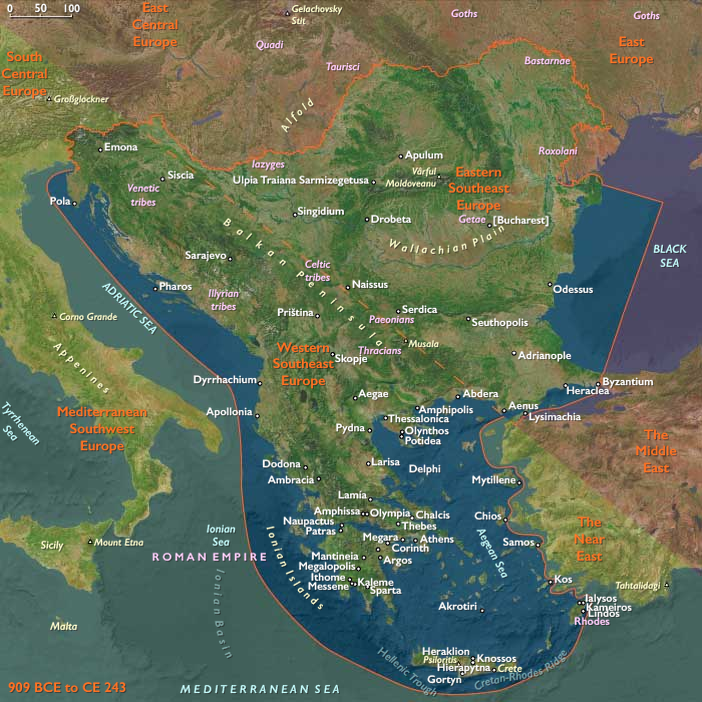
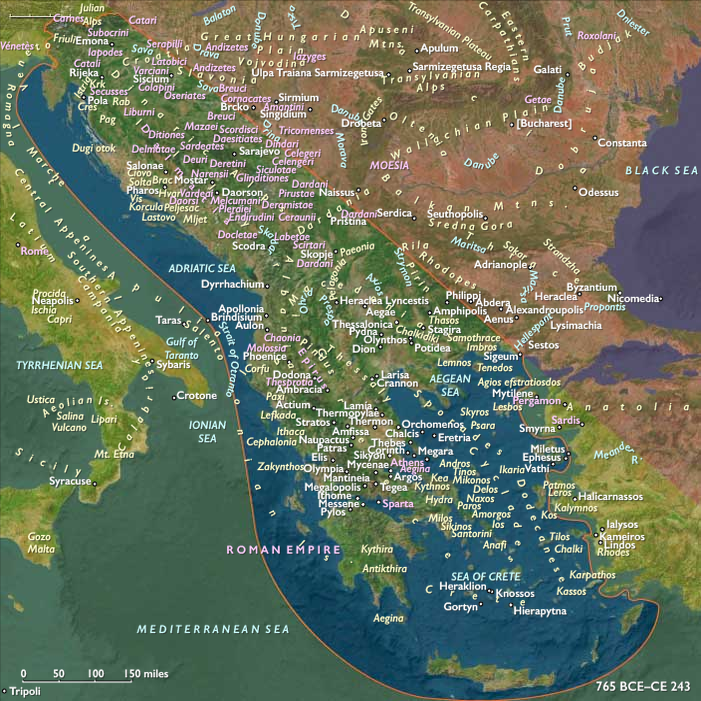
Athens becomes the largest polis, combining several regions of the peninsula of Attica; its huge size and favorable configuration makes it unusual by any standards among Greek poleis.
Its territory is far larger than that of Corinth or Megara; while Boeotia, though in control of a comparable area, resorts to the federal principle as a way of imposing unity.
Like Corinth but unlike Thebes (the greatest city of Classical Boeotia), Athens has a splendid acropolis (citadel) that has its own water supply, a natural advantage making for early political centralization.
Athens is, moreover, protected by four mountain systems offering a first line of defense.
Second, Attica has a very long coastline jutting into the Aegean, a feature that invites it to become a maritime power (one may contrast it with Sparta, whose port of Gythion is far away to the south).
This in turn is to compel Athens to import quantities of the shipbuilding timber it lacks, a major factor in Athenian imperial thinking.
Third, although Attica is rich in certain natural resources, such as precious metal for coinage—the silver of the Laurium mines in the east of Attica—and marble for building, its soil, suitable though it is for olive growing, is thin by comparison with that of Thessaly or Boeotia.
Athens, whose territory became more densely populated after the post-Mycenaean depopulation, which had affected all Greece, had had to look for sources of grain outside Attica: to secure those sources, it had to act imperialistically.
Locations
Groups
- Athens, City-State of
- Thebes, City-State of
- Greece, classical
- Sparta, Kingdom of
- Corinth, City-State of
Topics
- Younger Subboreal Period
- Iron Age, Near and Middle East
- Greek colonization
- Iron Age Cold Epoch
- Classical antiquity
Commodoties
- Weapons
- Water
- Domestic animals
- Grains and produce
- Ceramics
- Strategic metals
- Beer, wine, and spirits
- Lumber
- Land
- Money
Subjects
- Commerce
- Symbols
- Watercraft
- Engineering
- Sculpture
- Painting and Drawing
- Environment
- Government
- Custom and Law
Regions
Subregions
Years: 765BCE - 622BCE
Locations
Groups
- Athens, City-State of
- Thebes, City-State of
- Greece, classical
- Sparta, Kingdom of
- Corinth, City-State of
Topics
- Younger Subboreal Period
- Iron Age, Near and Middle East
- Greek colonization
- Iron Age Cold Epoch
- Classical antiquity
Commodoties
- Weapons
- Water
- Domestic animals
- Grains and produce
- Ceramics
- Strategic metals
- Beer, wine, and spirits
- Lumber
- Land
- Money
Subjects
- Commerce
- Symbols
- Watercraft
- Engineering
- Sculpture
- Painting and Drawing
- Environment
- Government
- Custom and Law
Regions
Subregions