Angkor ceases to be the capital city …
Years: 1226 - 1226
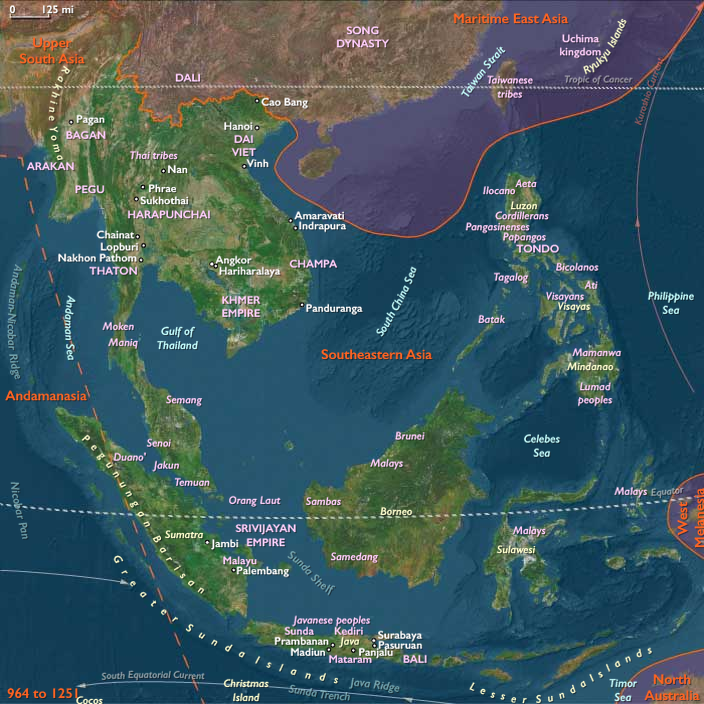
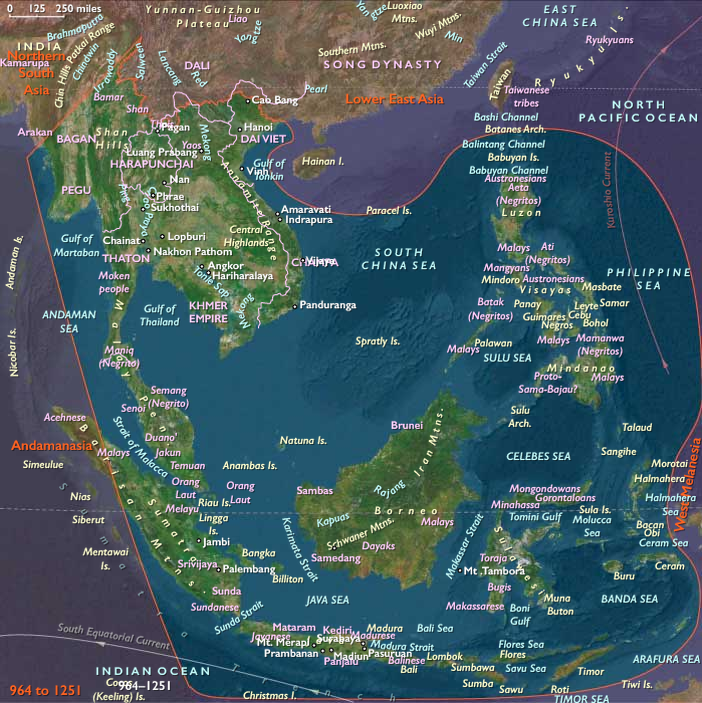
Angkor ceases to be the capital city of the Khmer empire after about 1225.
Locations
Groups
Subjects
Regions
Subregions
Related Events
Filter results
Showing 10 events out of 47112 total
Genghis now moves to Ganzhou, the hometown of his general Chagaan.
Chagaan's father still commands the city garrison, so Chagaan attempts negotiations with him.
However, the second-in-command of the city stages a coup, kills Chagaan's father, and refuses to surrender.
The city takes five months to subdue, and though the now furious Genghis threatens vengeance, Chagaan convinces him to kill no more than the thirty-five conspirators who had killed Chagaan's father.
Genghis escapes the heat in August 122 by residing in the Qilian Mountains while his troops approach Wuwei, the second-largest city of the Western Xia empire.
As no relief comes from the capital, Wuwei decides to surrender and avoid certain destruction.
At this point, Emperor Xianzong dies, leaving Mozhu to deal with a collapsing state as the Mongols encroach on the capital.
In autumn, Genghis rejoins his troops, takes Liangchow, crosses the Helan Shan desert, and …
…in November lays siege to Lingwu, a mere thirty kilometers from Yinchuan.
Here, in the Battle of Yellow River, Western Xia leads a counterattack with an estimated force of over three hundred thousand troops, engaging Mongol forces along the banks of the frozen river and canal systems.
The Mongols destroy the Western Xia troops, supposedly counting three hundred thousand bodies of Western Xia soldiers after the battle.
Genghis Khan, after defeating Khwarezm in 1221, had prepared his armies to punish Western Xia for their betrayal.
Meanwhile, Emperor Shenzong had stepped down from power in 1223, leaving his second son Lǐ Déwàng, in his place.
As Emperor Xianzong, Lǐ Déwàng reverses his father’s policy and decides to ally with Jin.
However, the Jin Empire is under attack by the Mongol Empire and is unable to help out Western Xia.
When Genghis Khan returns from his campaign, Xianzong pleads with him, but the general Aša-gambu challenges the Mongol ruler.
After taking Khara-Khoto, the Mongols have begun a steady advance southward, attacking with a force of approximately one hundred and eighty thousand.
Aša-gambu, commander of the Western Xia troops, cannot afford to meet the Mongols as it would involve an exhausting westward march from the capital Yinchuan through five hundred kilometers of desert.
Enraged by Western Xia's fierce resistance, Genghis subjects the countryside to annihilative warfare and orders his generals to systematically destroy cities and garrisons as they go.
With no army to meet them in pitched battle, the Mongols pick the best targets for attack and as each city falls the Mongols draw on prisoners, defectors, supplies, and weapons to take the next one.
The Western Xia armies, exhausted by the long and incessant wars against the Jin, are unable to beat back the Mongol assaults.
Two months after taking Khara-Khoto, the Mongols reach a point where the Qilian Mountains force the Etsin River eastward, about three hundred kilometers south of Khara-Khoto.
Here, Genghis divides his army, sending general Subutai to subdue the westernmost cities, while the main force moves east into the heart of the Western Xia Empire.
Genghis lays siege to the Suzhou district, which falls after five weeks.
Konrad, the Polish duke of Mazovia, hopes to strengthen Polish Latin-rite Christianity and Poland’s position in regard to its neighbors.
Konrad is the youngest son of High Duke Casimir II the Just of Poland and Helen of Znojmo, daughter of the Přemyslid duke Konrad II of Znojmo (ruler of the Znojmo Appanage in southern Moravia, part of Duchy of Bohemia).
His maternal grandmother was Maria of Serbia, apparently a daughter of the pre-Nemanjić župan Uroš I of Rascia.
After his father's death in 1194, Konrad had been brought up by his mother, who had acted as regent of Masovia.
He had received Masovia in 1199 and in 1205 also the adjacent lands of Kuyavia.
In that year, he and his brother, Duke Leszek I the White of Sandomierz, had had their greatest military victory at the Battle of Zawichost against Prince Roman the Great of Galicia–Volhynia.
The Ruthenian army had been crushed and Roman had been killed in battle.
The Rurik princess Agafia of Rus became his wife.
In order to enlarge his dominions, Konrad had unsuccessfully attempted to conquer the adjacent pagan lands of Chelmno in Prussia during a 1209 crusade with the consent of Pope Innocent III.
The monk Christian of Oliva had in 1215 been appointed a missionary bishop among the Old Prussians; his residence at Chelmno had been devastated by Prussian forces the next year.
Several further campaigns in 1219 and 1222 had failed, involving Konrad in a long-term border quarrel with the Prussian tribes.
The duke's ongoing attempts on Prussia have been answered by incursions across the borders of his Masovian lands, while Prussians are in the process of gaining back control over the disputed Chelmno Land and even threaten Konrad's residence at Plock Castle.
Subjected to constant Prussian raids and counter-raids, Konrad now wants to stabilize the north of his Duchy of Masovia in this fight over the border area of Chełmno.
Thus in 1226, Konrad, having difficulty with constant raids over his territory, invites the religious military order of the Teutonic Knights to fight the Prussians, as they already had supported the Kingdom of Hungary against the Cuman people in the Transylavanian Burzenland from 1211 to 1225.
When the Knights notified Hungary that the Order was firstly responsible to the pope, they had been expelled by the Hungarian king Andrew II.
Thus, in return for the Order's service, Grand Master Hermann von Salza wants to have its rights documented beforehand, by a deal with Konrad that is to be confirmed by the Holy Roman Emperor and the Roman Curia.

Seljuq sultan 'Ala' ad-Din Kayqubad has meanwhile built on the accomplishments of his father and brother, having conquered most of the Mediterranean littoral up to the frontiers of Syria from 1221 to 1225.
Philip II of Courtenay partakes in the Albigensian Crusade of Louis VIII of France and the siege of Avignon in 1226.
The city falls, but epidemics have ravaged the army.
Philip dies near Saint-Flour in the Auvergne.
As he is unmarried, the margraviate goes to his brother Henry.
The eldest son of the Peter II of Courtenay and Yolanda of Flanders, Philip had inherited Namur as the designated heir on the death of his maternal uncle Philip the Noble, in 1212.
He had had to fight the descendants of Henry IV of Luxembourg, who have not given up their claim to Namur.
When Cunigunda, a daughter of Frederick I, Duke of Lorraine and the wife of Waleran III, Duke of Limburg, died in 1214, Waleran had soon wed Ermesinda of Luxembourg, and became count jure uxoris there.
Ermesinda claimed Namur and Waleran had added a crown to his coat of arms to symbolize this claim.
In 1223, Waleran had again tried to take Namur from Philip II, but had failed and signed a peace treaty on February 13 in Dinant.
When Philip's father died in 1217, Philip had refused the crown of the Latin Empire of Constantinople and it had fallen to his brother Robert.
Louis VIII, as king, returns in 1226 to pacify the Languedoc, capturing most of it and suppressing the Albigenses.
The Carmelite religious order had been founded during the twelfth century by a group of hermits on Mount Carmel (in present Israel).
They were apparently inspired by the prophets Elijah and Elisha, who had lived there, but much of their early history is unknown.
Early in the thirteenth century, the Carmelites had migrated to Europe, where they have become friars.
Because their habit is a brown tunic and scapular with an ample white cape and hood, they become known as "white friars."
Pope Honorius III approves the Carmelites as a new religious order in 1226.
Francis of Assisi had in 1221 established another branch of his order for lay people, called the Third Order.
As day-to-day organization is not among Francis’ strengths, he heeds the influence of more practical men, such as Cardinal Ugolino and Brother Elias.
Francis has retired from the government of the order to a life of contemplation, during which he reportedly receives the stigmata, the imprint of the wounds of Christ on his own body, and composes a celebrated poem, the “Canticle of Brother Sun.”
He dies at forty-four on October 3, 1226, by which time the Franciscan order, approved in 1223 by Pope Honorius III, has spread from Italy to England, the Holy Land, and all of Europe.
The friars, known as the people's preachers, wear a gray tunic with a white cord at the waist; hence, their English name Grey Friars.