Angevin king Henry II of England, eager …
Years: 1159 - 1159
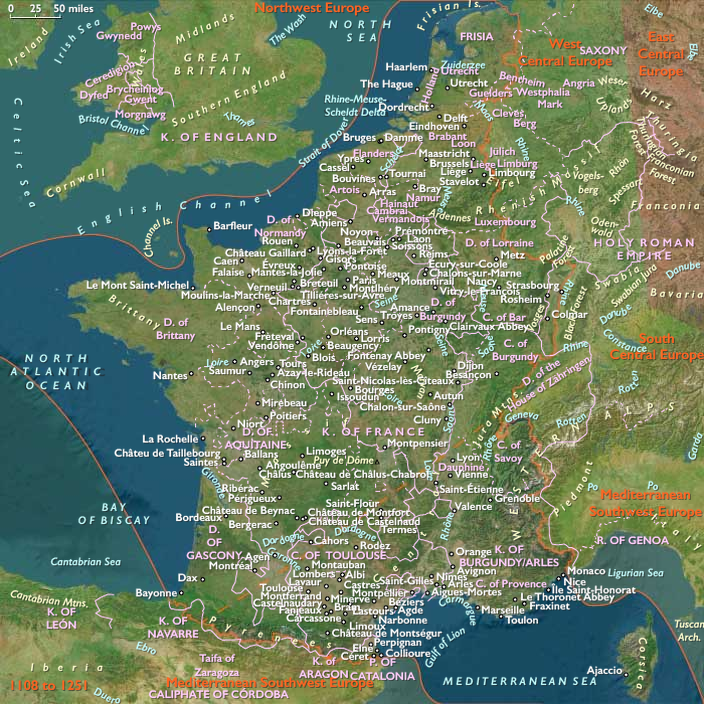
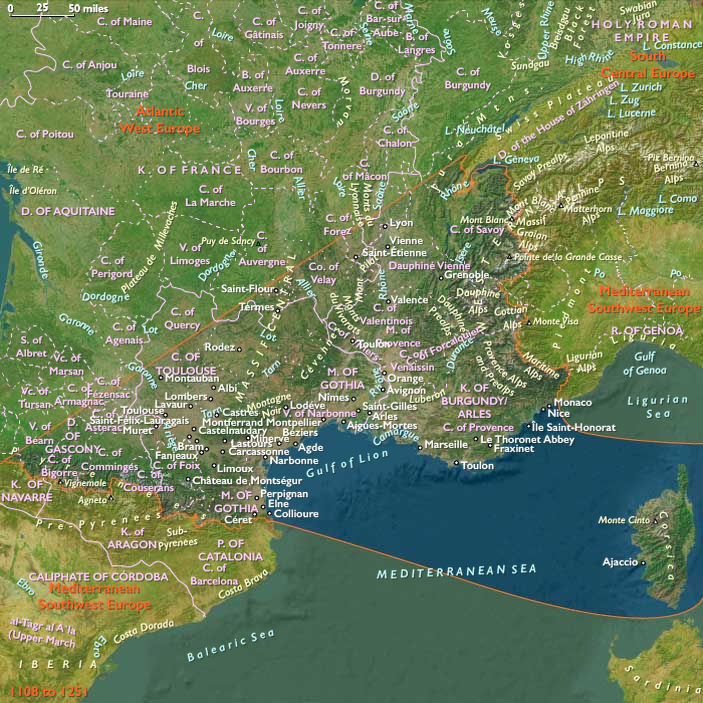
Angevin king Henry II of England, eager to press a claim to Toulouse, invades in 1159 with an English army.
Finding French king Louis VII already there, and unwilling to attack his feudal superior, Henry orders his troops to withdraw, making peace but vowing revenge.
Locations
People
Groups
Topics
Commodoties
Subjects
Regions
Subregions
Related Events
Filter results
Showing 10 events out of 48546 total
News of the advance of the imperial army soon reaches Antioch.
Realizing that he has no hope of defeating Manuel, Raynald also knows that he cannot expect any help from king Baldwin III of Jerusalem.
Baldwin does not approve of Raynald's attack on Cyprus, and in any case has already made an agreement with Manuel.
Thus isolated and abandoned by his allies, Raynald decides that abject submission is his only hope.
He appears before the Emperor, dressed in a sack and with a rope tied around his neck, and begs for forgiveness.
Manuel at first ignores the prostrate Raynald, chatting with his courtiers; William of Tyre commented that this ignominious scene continued for so long that all present were "disgusted" by it.
Eventually, Manuel forgives Raynald on condition that he become a vassal of the Empire, effectively surrendering the independence of Antioch to Constantinople.
Manuel's dramatic recovery of Antioch causes the crusaders to treat the Emperor with a new respect.
The once-powerful empire of the Palas, who are followers of Mahayana Buddhism, begins to disintegrate in the twelfth century under the attacks of the Hindu Sena dynasty, which appears to have originated in Karnataka in southern India.
Balall Sena, the third ruler of the Sena dynasty of Bengal, is widely believed to have constructed the famous Dhakeshwari Temple, located in the modern city of Dhaka in Bangladesh, but it is more likely the work of his predecessor, Vijay Sen (1096-1159).
The name of the city may have been coined after this temple.
(The current architectural style of the temple cannot be dated to this period because of numerous repairs, renovations and rebuilding that took place over time.
The original statue will last for eight hundred years until its destruction by the invading Pakistani army during the 1971 War of Independence.
The temple will suffer further damage during the Muslim mob attacks of 1989–90.)
Tunis had gained importance with the rise of the Zirid dynasty in the late tenth century, but the Sunni population had tolerated Shi'ite rule less and less, and had carried out massacres against the Shi'ite community.
In 1048, the Zirid ruler Al-Muizz ibn Badis had rejected his city's obedience to the Fatimids and reestablished Sunni rites throughout all of Ifriqiya.
This decision had infuriated the Shi'ite Fatimid caliph Al-Mustansir Billah.
To punish the Zirids, he unleashed the Banu Hilal Arab tribe on Ifriqaya; a large part of the country was put to fire, the Zirid capital Kairouan was razed in 1057, and only a few coastal towns, including Tunis and Mahdia, had escaped destruction.
Exposed to violence from the hostile tribes that had settled around the city, the population of Tunis had repudiated the authority of the Zirids and had sworn allegiance to the Hammadid prince El Nacer ibn Alennas, who was based in Béjaïa, in 1059.
The governor appointed by Béjaïa, having reestablished order in the country, had not hesitated to free himself from the Hammadids to found the Khourassanid dynasty with Tunis as its capital.
This small independent kingdom has picked up the threads of trade and commerce with other nations, and brought the region back to peace and prosperity.
The Almohad 'Abd al-Mumin takes Tunis in 1159, overthrows the last Khourassanid leader and installs a new government in the kasbah of Tunis.
The Almohad conquest marks the beginning of the dominance of the city in Tunisia.
Having previously played a minor role behind Kairouan and Mahdia, Tunis is promoted to the rank of provincial capital.

Peter Lombard: The Master of the Sentences and Bishop of Paris (c. 1100–1160 CE)
Peter Lombard, one of the most influential medieval theologians, earned the title “Master of the Sentences” for his monumental work, The Four Books of Sentences (1148–1158). This treatise systematically organized Christian doctrine by drawing upon Scripture and the teachings of the Church Fathers, becoming the standard theological textbook of the Middle Ages.
The Four Books of Sentences: Structure and Theological Controversy
Peter Lombard’s Sentences follows the articles of the Creed, structuring Christian theology into four books:
- Book 1: The Trinity – Discusses the nature of God as Father, Son, and Holy Spirit.
- Book 2: Creation and Sin – Examines the origins of the world, humanity, and the fall of man.
- Book 3: The Incarnation and the Virtues – Focuses on Christ’s role in salvation, moral virtues, and ethical living.
- Book 4: The Sacraments and the Four Last Things – Covers baptism, the Eucharist, and the Last Judgment (death, purgatory, heaven, and hell).
- Though it became the primary theological textbook for centuries, the Sentences faced opposition from traditionalists.
- Walter of Saint-Victor, a conservative critic, listed Peter among the “four pests of France”, blaming him for promoting scholasticism.
Despite this, Peter’s Sentences was widely adopted and served as the foundation for theological studies in the medieval universities, influencing thinkers such as Thomas Aquinas and Bonaventure.
Bishop of Paris and Accusations of Simony
- Peter Lombard was ordained as a priest sometime before 1156 and was elected bishop of Paris in 1159.
- His election, however, was not without controversy:
- Walter of Saint-Victor accused him of obtaining the bishopric through simony, though this claim lacks evidence.
- The more accepted version is that Philip, the younger brother of King Louis VII and archdeacon of Notre-Dame, had been elected by the cathedral canons but declined in favor of Peter, his teacher.
- Peter Lombard was consecrated as bishop on July 28, 1159, on the Feast of Saints Peter and Paul.
Final Years and Legacy
- Peter Lombard’s tenure as bishop was brief, as he died on either July 21 or 22, 1160.
- His administrative style and objectives as bishop remain largely unknown, as few episcopal acta survive from his time in office.
- He was succeeded by Maurice de Sully, the bishop responsible for beginning construction of the Cathedral of Notre-Dame in Paris.
Despite his short-lived episcopacy, Peter Lombard’s impact on Christian theology endured for centuries, as his Sentences shaped medieval scholasticism and defined theological education for generations to come.
The Cremaschi refuse an ultimatum sent to Crema by Frederick on February 2, 1159, asking the destruction of their walls, then settle into their city to hold against a siege.
The siege is marked by several episodes of brutality.
The Germans hang some Cremaschi prisoners to their siege machines, hoping the defenders will not fire against their fellows.
However, this expedient does not work, and turns the battle into a slaughter.
As Barbarossa has killed his prisoners, so the Cremaschi hack their prisoners to pieces in front of their comrades.
The besieging troops are formed mostly by Barbarossa's imperial contingents, part of which are led by his brother, Conrad, and by the latter's son Frederick; by Bavarian troops under duke Henry the Lion; and by communal troops, mostly belonging to the main imperial allies, Cremona (under bishop Oberto of Dovara) and Pavia.
Cardinals in the Roman Catholic Church are given the right to elect the Pope.
Prior to this, the pope had been elected by the clergy and congregation of the church.
Pope Adrian IV, involved in the continuing reform of the papal financial administration and in the reclaiming of lands usurped by the Italian nobility, dies on September 1, 1159; Italian cardinal Orlando Bandinelli, a former professor at Bologna renowned for his knowledge of theology and canon law, is elected pope six days later and assumes the papacy as Alexander III.
Alexander inherits his predecessor’s war with Emperor Frederick I over the conflicting claims of the German monarchy and the papacy to political and ecclesiastical overlordship in north and central Italy.
The imperial besiegers of Crema had set in their final positions in the October 1159; starting from the following December, they use a "cat" (a mobile roof), followed by a siege tower, to cover their siege engineers who are mining under the walls.
This leads to the Cremaschi also digging tunnels to start underground warfare.
Kings of the Khmer Empire during this era reign briefly and are violently overthrown by their successors.
Yasovarman II succeeds his uncle Dharanindravarman as ruler of the Khmer Empire.
Dharanindravarman's son Jayavarman acquiesces to his cousin's succession and goes into exile in neighboring Champa.
The forces of Jaya Harivarman, ruler of the kingdom of Champa, fight rebellious Chams centered in Panduranga for five years, finally achieving victory in 1160 and ending a decade-long period of civil warfare.
Eric is murdered as he leaves the church in Uppsala on May 18, 1160.
He is said to have been murdered by Emund Ulvbane, an assassin who was hired by people working for the Sverker dynasty, in order for them to regain the control of the kingdom, or alternatively by Magnus Henriksson, another claimant, who is said in some sources to have succeeded him briefly as king.
Swedes believe a miracle occurred at Eric's death: a fountain is said to have sprung from the earth where the king's head fell after being chopped off.
Eric is soon worshiped as a saint, becoming known as Eric the Saint or Eric the Holy.
Though never formally canonized by the pope, he will eventually become the patron saint of Sweden.