Andriscus’ conquest of Thessaly and alliance with …
Years: 148BCE - 148BCE
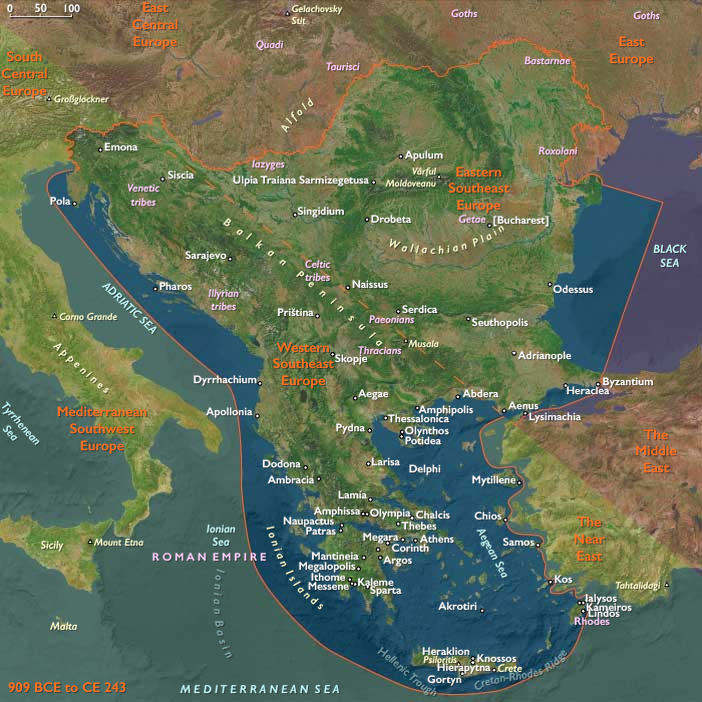
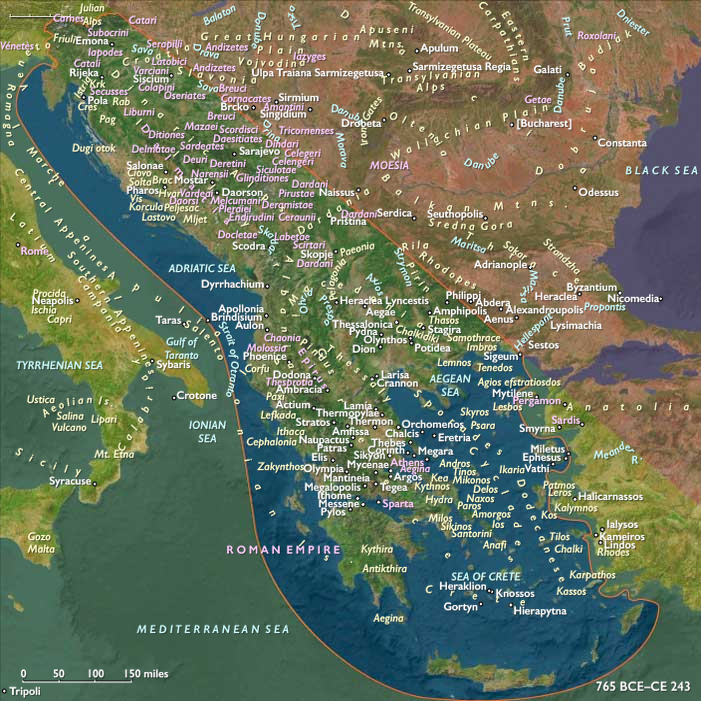
Andriscus’ conquest of Thessaly and alliance with Carthage makes the Macedonian situation dangerous.
A second Roman army under the praetor Quintus Caecilius Metellus in 148 defeats the pretender in the Second Battle of Pydna with relative ease and crushes the rebellion.
Andriscus, his brief reign marked by cruelty and extortion, flees to Thrace, whose prince gives him up to Rome.
Locations
People
Groups
Topics
Commodoties
Subjects
Regions
Subregions
Related Events
Filter results
Showing 10 events out of 17 total
East Central Europe (1276–1287 CE): Fall of Ottokar II, Rise of the Habsburgs, Continued Hungarian Turmoil, Polish Duchies' Independence, and Strengthening Thuringian and Saxon Influence
Between 1276 and 1287 CE, East Central Europe experienced transformative shifts following the dramatic fall of Bohemia's powerful ruler, Ottokar II Přemysl, the consequent rise of the Habsburg dynasty in Austria, continued fragmentation in Poland, persistent internal instability in Hungary, and strengthened regional influence of Saxon and Thuringian principalities. This period redefined political alignments, setting critical foundations for subsequent medieval geopolitical and cultural developments.
Political and Military Developments
Ottokar II’s Fall and the Habsburg Rise
-
In 1278, at the decisive Battle on the Marchfeld, Ottokar II Přemysl of Bohemia was defeated and killed by Rudolf I of Habsburg. This battle dramatically shifted regional dominance, ending Přemyslid authority over Austria, Styria, and Carinthia.
-
The victory secured Austria for the emerging Habsburg dynasty, establishing a territorial foundation crucial for their subsequent centuries-long dominance in Central European politics.
Instability and Succession Conflicts in Bohemia
-
Ottokar's son, Wenceslaus II (r. 1278–1305), ascended as a minor, triggering internal instability and noble infighting within Bohemia. Royal authority significantly weakened, necessitating regency councils and external diplomatic interventions.
Hungarian Continued Aristocratic Fragmentation
-
Hungary remained troubled by aristocratic factionalism and regional conflicts following the brief reigns of Stephen V (r. 1270–1272) and his son Ladislaus IV "the Cuman" (r. 1272–1290). Royal authority struggled against powerful nobles, significantly weakening Hungary’s ability to assert regional influence.
Polish Duchies and Continued Fragmentation
-
Polish territories remained fragmented into multiple independent Piast duchies, notably in Silesia, Greater Poland, and Mazovia. Despite political division, economic prosperity continued, driven by growing urbanization, Hanseatic trade, and local autonomy.
Thuringian Consolidation and Wettin Influence
-
Following their triumph in the Thuringian Succession War (ending 1264), the Wettin family solidified their authority over Thuringia, expanding their regional influence. Thuringia's stability allowed it to exert political and cultural influence within the eastern German sphere.
Saxon Territories and Emerging Dynastic Influence
-
The Saxon duchies and principalities, especially the Wettin-controlled territories and the emerging power of Saxe-Wittenberg, increasingly asserted influence within East Central Europe, fostering economic growth, urban expansion, and political stability.
Brandenburg Expansion and Consolidation
-
Under the House of Ascania, Brandenburg continued territorial consolidation eastward into former Slavic lands. Their settlements strengthened economic and demographic integration into broader Central European networks.
Economic and Technological Developments
Urban and Commercial Growth
-
Economic prosperity continued across East Central Europe, driven by robust Hanseatic League trade, connecting Baltic markets to broader European economies. Cities such as Lübeck, Rostock, Toruń, Kraków, and Wrocławflourished economically, becoming vibrant urban centers.
Agricultural Productivity Enhancements
-
Improved agricultural techniques and tools, including more efficient plows and extensive use of the three-field rotation system, increased productivity and regional population growth, fueling urban development.
Cultural and Artistic Developments
Bohemian Cultural Continuity Despite Political Instability
-
Although politically weakened, Bohemia maintained a thriving cultural life centered on Prague. Gothic architecture, manuscript illumination, and literature continued flourishing, influenced by earlier Přemyslid patronage.
Regional Artistic Flourishing in Polish Duchies and Hungary
-
Silesian and Polish duchies retained cultural dynamism, evident in ecclesiastical architecture, monasteries, and manuscript production, notably in Wrocław and Kraków.
-
Despite political turmoil, Hungarian ecclesiastical institutions continued fostering cultural and artistic patronage, maintaining religious and intellectual continuity.
Settlement and Urban Development
Continued Urban Expansion and Fortification
-
Urban growth and fortifications expanded significantly throughout Austria, Bohemia, Poland, and Saxon territories, bolstering regional economic prosperity, political influence, and demographic stability.
Intensified Germanic Settlement (Ostsiedlung)
-
Ongoing Germanic colonization in Brandenburg, Mecklenburg, Silesia, and Lusatia profoundly influenced demographic patterns, urban development, and agricultural innovation, reshaping local economies and identities.
Social and Religious Developments
Increased Ecclesiastical Influence
-
Ecclesiastical institutions, notably the Archbishopric of Salzburg and bishoprics of Bamberg, Passau, and Regensburg, expanded their social and cultural influence, promoting education, religious life, and artistic patronage.
Aristocratic Autonomy and Feudal Structures
-
Aristocratic and noble autonomy strengthened significantly, especially in Hungary, Bohemia, and Polish duchies. Local noble authority increasingly dominated political and economic governance, setting firm foundations for regional identities and power structures.
Long-Term Consequences and Historical Significance
The era 1276–1287 CE profoundly reshaped East Central Europe. The fall of Ottokar II and rise of the Habsburgs fundamentally altered regional power dynamics, setting the stage for long-term Austrian dominance. Continued Hungarian aristocratic factionalism weakened royal centralization, while Polish fragmentation deepened local autonomy. Wettin-controlled Thuringia and Saxon territories expanded their regional influence, significantly shaping future political developments. Economically, intensified trade, urbanization, and agricultural innovation brought lasting prosperity and cultural flourishing. Collectively, these transformations firmly established the geopolitical and cultural framework for subsequent medieval developments throughout East Central Europe.
Ottokar II campaigns in 1278 against Austria, supported by Duke Henry I of Lower Bavaria, who had switched sides.
Ottokar first lays siege to the towns of Drosendorf and Laa an der Thaya near the Austrian border, while Rudolph decides to leave Vienna and to face the Bohemian army in an open pitched battle in the Morava basin north of the capital, where the Cuman cavalry of King Ladislaus can easily join his forces.
Compelled to make terms with German king Rudolf I in 1275 but embarrassed by his extensive losses and his forced recognition of Rudolf’s suzerainty over Bohemia and Moravia, Ottokar rebels in 1278 and assembles an army in Prague.
Spurning Rudolf’s efforts to negotiate, Ottokar advances on Vienna.
Rudolf, his army reinforced with Alsatian and Swabian troops and aided by King Ladislas IV of Hungary, engages his opponent in the Battle of the Marchfield, near Durnkrut, on August 26, 1278, in a match of over eighty thousand men and the largest battle of knights in the Middle Ages.
After three hours of continued fighting on a hot summer day, Ottokar's knights in their heavy armor are exhausted, many of them suffering from circulatory failure and unable to move.
At noon Rudolph orders a fresh heavy cavalry regiment he had concealed behind nearby hills and woods to attack the right flank of Ottokar's troops.
Such ambushes are commonly regarded as dishonorable in warfare and Rudolph's commander Ulrich von Kapellen apologizes to his own men in advance.
Nevertheless, the attack prevails in splitting and stampeding the Bohemian troops.
Ottokar realizes the surprise attack and tries to lead a remaining reserve contingent in the rear of von Kapellen's troops, a maneuver that is misinterpreted as a rout by the Bohemian forces.
The following collapse results in a complete victory of Rudolph and his allies.
Ottokar's camp is plundered, and he himself is found slain on the battlefield.

Rudolph has Ottokar's body displayed in Vienna to demonstrate his victory.
The "poor count" from Swabian Habsburg Castle assures his possession of the Duchies of Austria and Styria, the heartland and foundation of the rise of the House of Habsburg.
Rudolph acts cautiously in Bohemia and reaches an agreement with the nobility and Ottokar's widow Kunigunda of Slavonia on the succession of her son Wenceslaus II to the throne.
On the same occasion he reconciles with the Brandenburg margraves, ceding them the guardianship over the minor heir apparent.
Rudolph installs his sons Albert and Rudolf II as Austrian dukes at the 1282 Diet of Augsburg; their Habsburg descendants will hold the ducal dignity until 1918.
The Habsburgs had taken up residence in Vienna following Ottokar's rebellion and battle death in 1278.
Rudolf gives most of the new territory wrested from Bohemian control-the duchies of Austria, Styria, and Carinthia, and the March of Carniola—to his sons Albert and Rudolph in 1282, thus raising the Habsburg family to the rank of a major German dynasty.
He cements his conquest through strategic marriage contracts for his children.
Rudolf grants his son Albrecht (Albert) the duchies of Austria and …
…Styria, making these possessions hereditary fiefs that will constitute the territorial nucleus of the future Habsburg power.
The Mongol Golden Horde, led by Nogai Khan, attacks Hungary a second time.
King Stephen Dragutin of Serbia receives from Ladislaus IV of Hungary Belgrade, Syrmia, and other territories from Hungary, when his son Vladislav marries a cousin of the Hungarian king.
Dragutin will rule the area of Macva with Belgrade, and the Bosnian areas Soli and Usora, until 1316, establishing family relations with Bosnian ban Stephen I Kotromanić.
His new state is named the Kingdom of Srem.
The first capital of his state is Debrc (between Belgrade and Šabac); he soon moves his residence to Belgrade, to become the first of the Serb rulers to rule from this capital.
Nogai Khan and Talabuga Khan invade Hungary with Mongol and Cuman troops in 1284-1285, but, unlike Subutai forty years earlier, they are defeated.
The Mongols ravage Transylvania, but are beaten by the Hungarian royal army under Ladislaus IV of Hungary near Pest, and the retreating Mongol forces are ambushed by the Szekely.