
Andres Celsius had traveled frequently in the …
Years: 1741 - 1741
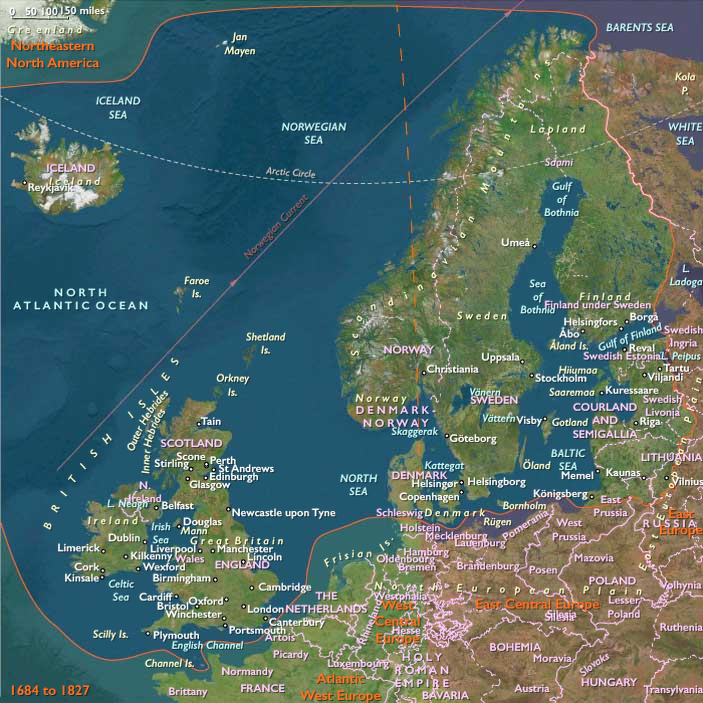
Andres Celsius had traveled frequently in the early 1730s, including to Germany, Italy, and France, visiting most of the major European observatories.
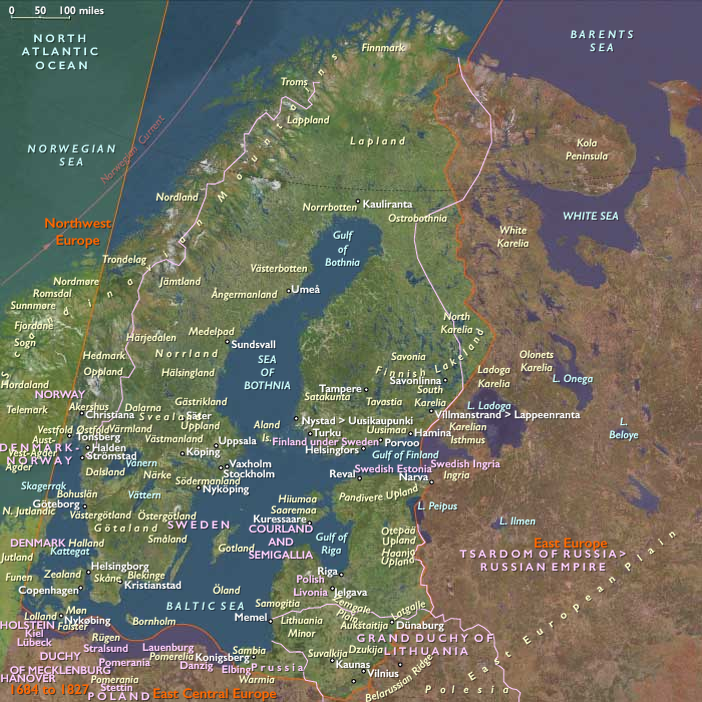
In Paris, he had advocated the measurement of an arc of the meridian in Lapland.
He had in 1736 participated in the expedition organized for that purpose by the French Academy of Sciences, led by the French mathematician Maupertuis to measure a degree of latitude.
The aim of the expedition was to measure the length of a degree along a meridian, close to the pole, and compare the result with a similar expedition to Peru, today in Ecuador, near the equator.
The expeditions had confirmed Isaac Newton's belief that the shape of the earth is an ellipsoid flattened at the poles.
He had in 1738 published the De observationibus pro figura telluris determinanda (Observations on Determining the Shape of the Earth).
Celsius' participation in the Lapland expedition has won him much respect in Sweden with the government and his peers, and plays a key role in generating interest from the Swedish authorities in donating the resources required to construct a new modern observatory in Uppsala.
He is successful in the request, and Celsius founds the Uppsala Astronomical Observatory in 1741.
The observatory is equipped with instruments purchased during his long voyage abroad, comprising the most modern instrumental technology of the period.
In astronomy, Celsius begins a series of observations using colored glass plates to record the magnitude (a measure of brightness) of certain stars.
This is the first attempt to measure the intensity of starlight with a tool other than the human eye.
He makes observations of eclipses and various astronomical objects and publishes catalogues of carefully determined magnitudes for some three hundred stars using his own photometric system (mean error=0.4 mag).
Celsius is the first to perform and publish careful experiments aiming at the definition of an international temperature scale on scientific grounds.
In his Swedish paper "Observations of two persistent degrees on a thermometer" he reports on experiments to check that the freezing point is independent of latitude (and of atmospheric pressure).
He determines the dependence of the boiling of water with atmospheric pressure which is accurate even by modern day standards.
He further gives a rule for the determination of the boiling point if the barometric pressure deviates from a certain standard pressure.
He proposes the Celsius temperature scale in a paper to the Royal Society of Sciences in Uppsala, the oldest Swedish scientific society, founded in 1710.
His thermometer is calibrated with a value of 100° for the freezing point of water and 0° for the boiling point. (In 1745, a year after his death, the scale will be reversed by Carl Linnaeus to facilitate more practical measurement.)
Celsius originally calls his scale centigrade, derived from the Latin for "hundred steps".
For years it will be referred to simply as the Swedish thermometer.
Celsius conducts many geographical measurements for the Swedish General map, and is one of earliest to note that much of Scandinavia is slowly rising above sea level, a continuous process which has been occurring since the melting of the ice from the latest ice age.
However, he wrongly poses the notion that the water is evaporating.
Locations
People
Groups
Subjects
Regions
Subregions
Years: 1741 - 1741
Locations
People
Groups
Subjects
Regions
Subregions