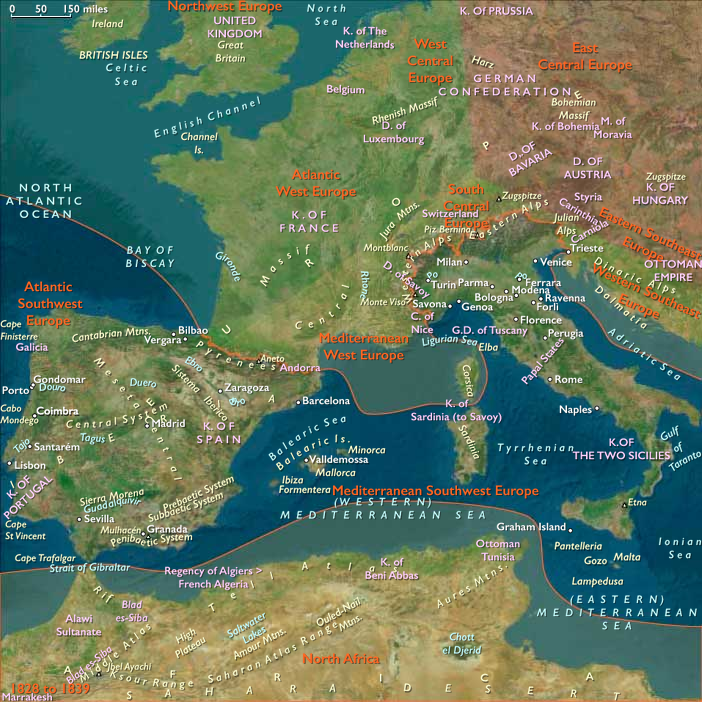
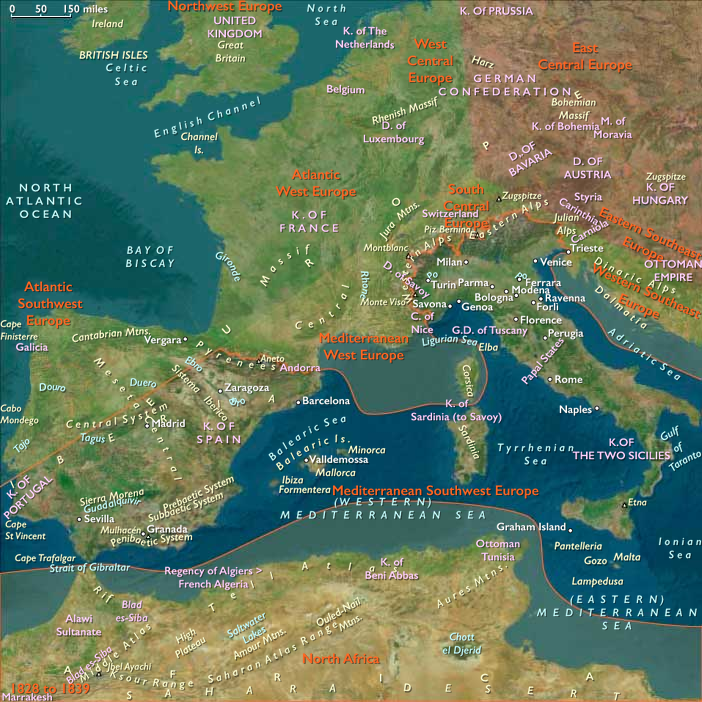
...Madrid. In response, Maria Christina, as …
Years: 1836 - 1836
August
...Madrid.
In response, Maria Christina, as regent for her daughter Isabella II, restores the Constitution of 1812 and appoints a progressive ministry on August 10, 1836.
Florida Territorial governor John Eaton becomes ambassador to Spain in this year.
Locations
People
Groups
Topics
Subjects
Regions
Subregions
Related Events
Filter results
Showing 10 events out of 18452 total
General Sir Richard Bourke, an Irish-born British Army officer who has served as Governor of New South Wales from 1831, declares the city today known as Melbourne the administrative capital of the Port Phillip District of New South Wales, and will commission the first plan for the Hoddle Grid, named after its designer, in 1837.
Later in 1836 the settlement is named Melbourne after the British Prime Minister William Lamb, 2nd Viscount Melbourne, who resides in the village of Melbourne in Derbyshire. (Melbourne is today the second most populous city in Australia and the capital of Victoria.)
English colonist, farmer, and businessman John Batman, a leading member of the Port Phillip Association, had been one of the first settlers of the Melbourne area, having in May and June 1835 explored the area that is now central and northern Melbourne.
Batman, after negotiated a transaction for six hundred thousand acres (twenty-four hundred square kilometers) of land from eight Wurundjeri chiefs, had selected a site on the northern bank of the Yarra River, declaring that "this will be the place for a village", and returned to Launceston in Van Diemen's Land.
However, by the time a settlement party from the Association arrived to establish the new village, a separate group led by John Pascoe Fawkner had already arrived aboard the Enterprize and established a settlement at the same location, on August 30, 1835.
The two groups ultimately agreed to share the settlement.
Batman's Treaty with the Aborigines is annulled by the New South Wales government (then governing all of eastern mainland Australia), which compensated the Association.
Although this meant the settlers were now trespassing on Crown land, the government had reluctantly accepted the settlers' fait accompli and allowed the town (known at first by various names, including 'Bearbrass') to remain.
From 1833, following the suspension of transportation to New South Wales, all transported convicts have sent to Van Diemen's Land, where British Arctic explorer Rear Admiral Sir John Franklin begins service as governor in 1836.
Male convicts serve their sentences as assigned labor to free settlers or in gangs assigned to public works.
Only the most difficult convicts are sent to the Tasman Peninsula prison known as Port Arthur, mostly re-offenders.
Female convicts are assigned as servants in free settler households or sent to a female factory (women's workhouse prison), of which there are five in Van Diemen's Land.
The detention of a Russian philosopher, Pyotr Chaadayev, who is critical of the regime, in 1836, is the first recorded case of psychiatry to suppress dissent in Russia.
English chemist John Walker had invented the first “friction match” in 1827.
Robert Boyle had done early work in the 1680s with phosphorus and sulfur, but his efforts had not produced useful results.
Walker discovered a mixture of antimony(III) sulfide or stibnite, potassium chlorate, gum, and starch could be ignited by striking against any rough surface.
Walker called the matches congreves, but Samuel Jones patented the process and the matches were sold as lucifer matches.
The early matches had a number of problems: the flame was unsteady and the initial reaction was disconcertingly violent; additionally, the odor produced by the burning match was unpleasant.
It is described as a firework odor.
Lucifers reportedly could ignite explosively, sometimes throwing sparks at a considerable distance.
(In the Netherlands, matches are still called lucifers.)
In 1830, Frenchman Charles Sauria had added white phosphorus to remove the odor.
These new matches had to be kept in an airtight box but were popular.
Unfortunately, those involved in the manufacture of the new matches were afflicted with phossy jaw and other bone disorders, and there was enough white phosphorus in one pack to kill a person.
There was a vociferous campaign to ban these matches once the dangers became known.
The Hungarian János Irinyi, who is a student of chemistry, invents the noiseless match in 1836.
An unsuccessful experiment by his professor, Meissner, had given Irinyi the idea to replace potassium chlorate with lead dioxide in the head of the phosphorus match.
He liquefied phosphorus in warm water and shook it in a glass foil, until it became granulated.
He mixed the phosphorus with lead and gum arabic, poured the paste-like mass into a jar, and dipped the pine sticks into the mixture and let them dry.
When he tried them that evening, all of them lit evenly.
Irinyi thus invented the noiseless match and sold the invention to István Rómer, a match manufacturer.
Rómer, a rich Hungarian pharmacist living in Vienna, buys the invention and production rights from Irinyi, the poor student, for sixty forints.
The production of matches is now fully underway.
István Rómer will become richer off Irinyi's invention, and Irinyi himself will go on to publish articles and a textbook on chemistry and found several match factories.

The Egyptians capture Faisal after he fails to reach an accord with Khurshid Pasha in 1836, and send him to Cairo for a second period of incarceration.
The second Saudi period, compared to the First Saudi State, is to be marked by less territorial expansion and less religious zeal, although the Saudi leaders continue to go by the title of Imam and still employ Wahhabist religious scholars.
It will also be marked by severe internal conflicts within the Saudi family, eventually leading to the dynasty's downfall in 1891.
Faisal ibn Turki, who will eventually return to power, will be remembered as one of the greatest of all Saudi leaders, and although the infighting among his four sons will eventually destroy the state, this branch of the family, which includes the present King of Saudi Arabia, is still technically referred to as the Al Faisal (House of Faisal).
The downfall of the Oyo Empire had begun in around 1789, when Alaafin Abiodun had been killed; his son and successor, Awole, was the suspected murdered.
A series of constitutional upheavals, dynastic intrigues, and local particularism had followed, weakening the empire.
In an Illorin-centered revolt initiated by Afonja, the Are Ona Kakanfo, the government had in 1796 ousted Alaafin Awole.
At his rejection by the council, Awole said to have cursed the empire as he prepared to commit suicide.
The revolt had led to the secession of Ilorin, a Yoruba state that is to play a crucial role in the destruction of Oyo.
When Dahomey's King Gezo had ascended the throne in 1818, he had offered only a tiny piece of cloth and 2 bags of cowries to the Oyo tax collector, saying that anything else would be disproportionate to Dahomey's wealth.
When four more envoys were sent from Oyo, Gezo had had them beheaded.
An Oyo army had been deployed and decisively defeated, ending Oyo's hegemony over Dahomey.
After gaining its independence, Dahomey had begun raiding the Egbado Corridor southwest of Yorubaland.
After Awole's rejection, Afonja, now master of Illorin, had invited an itinerant Fulani scholar of Islam called Alim al-Salih into his ranks.
By doing this, he hoped to secure the support of Yoruba Muslims (mainly slaves taking care of the Empire's horses) and volunteers from the Hausa-Fulani north in keeping Ilorin independent.
Torn by internal struggle, Oyo could not defend itself against the Fulani Empire, which had razed oyo-Ile.
After the Fulani kill Afonja, the Oyo empire collapses in 1836. (Up to this day, the Illorin traditional ruler is an emir, whereas in the rest of Yoruba towns the kings are called oba or baale; Baale or Baba Onile meaning "father of the land" or "lord of the land".)
Ljudevit Gaj, a Slovenian journalist and linguist has, with tacit Austrian approval, promoted a South Slavic literary language and devised a Latin-based script.
In 1836, he founds an anti-Hungarian journal that calls for Illyrian cultural and political unity.
Hungary fears the Illyrian movement and bans even public utterance of the word "Illyria."
The replacement of Cardinal Tommaso Bernetti by Cardinal Luigi Lambruschini in 1836 does not mend matters between conservatives and liberal in central Italy.
Pope Gregory and Lambruschini oppose basic technological innovations such as gas lighting and railways, believing that they will promote commerce and increase the power of the bourgeoisie, leading to demands for liberal reforms that would undermine the monarchical power of the Pope over central Italy.
Gregory in fact bans railways in the Papal States, calling them chemins d'enfer (literally "ways of hell," a play on the French for railroad, chemin de fer, literally "iron road").
Nikolai Gogol moves to Rome in 1836, publishing in this year one of his great masterpieces, The Inspector General, a comic drama that ridicules petty officialdom and, by extension, contemporary Russian society.
The work will evoke harsh criticism from conservative elements at its first performance in Saint Petersburg.
The soldier-politician Bertrand Clauzel and others, soon after the conquest of Algiers, had formed a company to acquire agricultural land and, despite official discouragement, to subsidize its settlement by European farmers, triggering a land rush.
Clauzel had recognized the farming potential of the Mitidja Plain and envisions the production here of cotton on a large scale.
As governor general from 1835 to 1836, he is using his office to make private investments in land and has encouraged army officers and bureaucrats in his administration to do the same.
Government officials are thus keen to promote greater French involvement in Algeria.
Commercial interests with influence in the government also begin to recognize the prospects for profitable land speculation in expanding the French zone of occupation.
They create large agricultural tracts, build factories and businesses, and exploit cheap local labor.