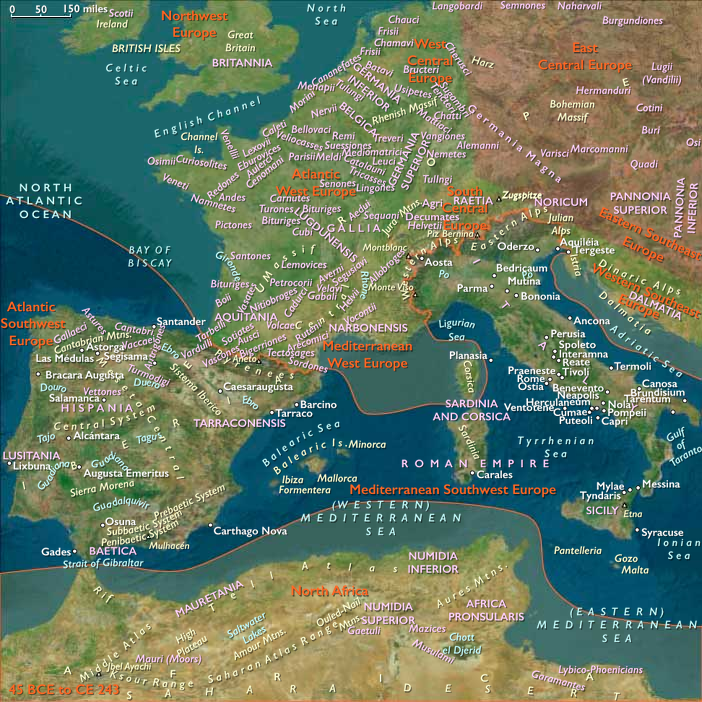
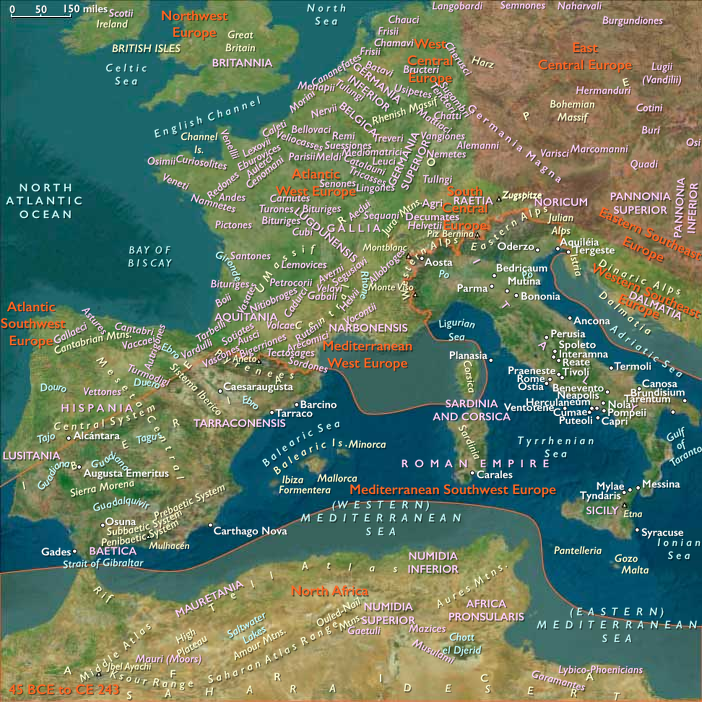
Ancona, taken by Rome during the second …
Years: 115 - 115
Ancona, taken by Rome during the second century BCE, becomes a flourishing port after Trajan enlarges the harbor, which is of considerable importance in imperial times, as the nearest to Dalmatia.
Trajan constructs the north quay with his Syrian architect Apollodorus of Damascus.
At the beginning of it stands the marble triumphal arch with a single archway, and without bas-reliefs, erected in his honor in 115 by the Senate and Roman people.
Locations
People
Groups
Topics
Commodoties
Subjects
- Commerce
- Architecture
- Engineering
- Labor and Service
- Conflict
- Faith
- Government
- Scholarship
- Technology
Regions
Subregions
Related Events
Filter results
Showing 10 events out of 61243 total
The real power had remained in Empress Dowager Deng's hands after Emperor Ān ascended the throne in 106, and his parents Prince Qing and Consort Gěng (who is sent by Empress Dowager Deng to join her husband in the Principality of Qinghe, in modern central Héběi) appear to have no influence on the administration.
Empress Dowager Deng is generally a capable ruler, and while there are natural disasters and wars with the Qiang and the Southern Xiōngnú, she generally copes with these emergencies well.
She also carries out many reforms of criminal law.
During her regency, Emperor Ān appears to have had minimal input into the affairs of state, meanwhile becoming heavily personally influenced by the eunuchs Jiāng Jīng and Lǐ Rùn, and even more so by his wet nurse Wáng Shèng.
He also is heavily influenced by his favorite, Yán Jī, whom he creates empress in 115—even though she had poisoned to death one of his other consorts, Consort Li, who had in the same given birth to his only son Liú Bǎo.
While these individuals lack real power as long as Empress Dowager Deng lives, they have long planned to take power as soon as she is no longer alive.
Empress Dowager Deng is somewhat aware of these plans and is offended; she is also disappointed that Emperor Ān, who had been considered a precocious and intelligent child, had neglected his studies and has become interested only in drinking and women.
It is suspected that at some point, she even considered replacing the emperor with his cousin Liú Yì, the Prince of Pingyuan, but then decides against it.
The chronology of Trajan’s War against Parthia after 114 is uncertain, but it is generally believed that early in 115, Trajan turned south into the core Parthian hegemony, taking the Northern Mesopotamian cities of Nisibis and …
…Batnae.
Trajan commands the eastern campaign against the Parthian Empire in 115.
The invasion has been prompted by the imposition of a pro-Parthian king on the throne of Armenia after a Parthian invasion of that land, over which the two empires had shared hegemony since the time of Nero some fifty years earlier.
Trajan's army advances victoriously through Mesopotamia, while Jewish rebels in its rear begin attacking the small garrisons left behind.
A revolt in far-off Cyrenaica soon spreads to Egypt and then Cyprus, inciting revolt in Judaea.
A widespread uprising centered at Lydda threatens grain supplies from Egypt to the front.
The Jewish insurrection swiftly spreads to the recently conquered provinces.
Cities with substantial Jewish populations—Nisibis, Edessa, Seleucia, Arbela—join the rebellion and slaughter their small Roman garrisons.
Lukuas, leader of the rebel Jews in Cyrenaica, moves towards Alexandria, enters the city, which had been abandoned by the Roman troops in Egypt under the leadership of governor Marcus Rutilius Lupus, and set fire to the city.
The pagan temples and the tomb of Pompey are destroyed.
A devastating Zealot-influenced Jewish revolt, perhaps aided and abetted by Parthia, interrupts the prosperity of ungarrisoned Roman Cyrene, home to both a large Greek and large Jewish population, while Trajan is occupied in 115 in fighting the Armenians and the Parthians.
The rebels, led by one named either Lukuas or Andreas, mocked by the Romans as “king of the Jews,” burn buildings and kill or injure a great number of Greeks and Romans, perceiving the Romans to be even worse oppressors than the Greeks.
Lukuas’s group destroyed many temples, including those to Hecate, Jupiter, Apollo, Artemis, and Isis, as well as the civil structures that are symbols of Rome, including the Caesareum, the basilica, and the thermae.
Dio Cassius states of Jewish insurrectionaries: "'Meanwhile the Jews in the region of Cyrene had put one Andreas at their head and were destroying both the Romans and the Greeks.
They would cook their flesh, make belts for themselves of their entrails, anoint themselves with their blood, and wear their skins for clothing.
Many they sawed in two, from the head downwards.
Others they would give to wild beasts and force still others to fight as gladiators.
In all, consequently, two hundred and twenty thousand perished.
In Egypt, also, they performed many similar deeds, and in Cyprus under the leadership of Artemio.
There, likewise, two hundred and forty thousand perished.
For this reason no Jew may set foot in that land, but even if one of them is driven upon the island by force of the wind, he is put to death.
Various persons took part in subduing these Jews, one being Lusius, who was sent by Trajan."
(Dio Cassius, Roman History, Volume V., Book 68, paragraph 32) The Jewish Encyclopedia says this about the Cyrene massacres: "By this outbreak Libya was depopulated to such an extent that a few years later new colonies had to be established there (Eusebius, "Chronicle" from the Armenian, fourteenth year of Hadrian).
Bishop Synesius, a native of Cyrene in the beginning of the fifth century, speaks of the devastations wrought by the Jews ("Do Regno," p.
2)."
(Cyrene".
JewishEncyclopedia.com.)
The Jewish Encyclopedia also says that Dio Cassius's accounts are most likely embellished: "For an account of the Jewish war under Trajan and Hadrian, Dion is the most important source (lxviii.
32, lxix.
12–14), though his descriptions of the cruelties perpetrated by the Jews at Cyrene and on the island of Cyprus are probably exaggerated."
(Dion Cassius".
JewishEncyclopedia.com.)
The revolt, possibly messianic in origin and marked by bloody violence and destruction (Dio Cassius, writing fifty years after the event, claims that the rebels practiced cannibalism and killed two hundred and twenty thousand people), spreads to Jews in Asia Minor, Cyprus, Egypt, Judaea and Mesopotamia.

The Jewish revolt, having spread from the mainland cities to Cyprus, badly damages the city of Salamis.
The rebels slaughter all non-Jews (two hundred and forty thousand are said to have been killed) and sack the city, but the Romans finally suppress the revolt, killing every one of the thousands of Jews on the island. (From this time forward, the Romans will never allow Jews to land on the island. Even if a Jew was shipwrecked, he will be killed on site.)
Although Salamis had ceased to be the capital of Cyprus from the Hellenistic period onward when it was replaced by Paphos, its wealth and importance have not diminished.
The city is particularly favored by the Roman emperors Trajan and Hadrian, who restore and establish its public buildings.
Trajan marches from Armenia to Mesopotamia following his successful Roman military campaign against Parthia in present-day Iraq, and in 116 establishes the new Roman province of Assyria, one of three provinces (with Armenia and Mesopotamia) he has created.
Coins are issued announcing that Armenia and Mesopotamia have been put under the authority of the Roman people.
Despite Rome's military victory, Trajan's new province is plagued with difficulties from the start.
A Parthian prince named Sanatruces, the son of Mithridates IV (mentioned as an ephemeral Parthian king in CE 115 by sixth-century writer John Malalas, in his Chronographia), organizes an armed revolt by the natives in the new Roman provinces.
Roman garrisons in Assyria and Mesopotamia are driven from their posts, and a Roman general is killed as his army tries unsuccessfully to stop the rebellion.
While many sources cite the creation of a province named Assyria during Trajan's Parthian campaign, some disagreement exists regarding its exact location.
Theodore Mommsen wrote that it was located north of the Roman Mesopotamia province, stretching into western Persia (in an area called Media Atropatene) in present northwestern Iran, but some modern scholars argue that the Assyria Provincia was located between the Tigris and Euphrates Rivers, in present-day central Iraq, a location that is corroborated by the text of the fourth-century Roman historian Festus.
However, other sources contend that the province was located near Armenia and east of the Tigris, in a region formerly known as Adiabene, which had long before been a Neo-Assyrian kingdom.
In early 116, however, Trajan began to toy with the conquest of the whole of Mesopotamia, an overambitious goal that will eventually backfire on the results of his entire campaign: One Roman division crosses the Tigris into Adiabene, sweeping south and capturing the fortress of Adenystrae (location most uncertain), the principle stronghold of Adiabene’s ruler Mebarsapes, forcing Mebarsapes to flee; …
…a second follows the river south, capturing Babylon; while …
…Trajan himself sails down the Euphrates, then drags his fleet overland into the Tigris, capturing Seleucia and finally, the Parthian capital of Ctesiphon.
Years: 115 - 115
Locations
People
Groups
Topics
Commodoties
Subjects
- Commerce
- Architecture
- Engineering
- Labor and Service
- Conflict
- Faith
- Government
- Scholarship
- Technology