Ancient Cirta, the prosperous capital of Numidia, …
Years: 313 - 313
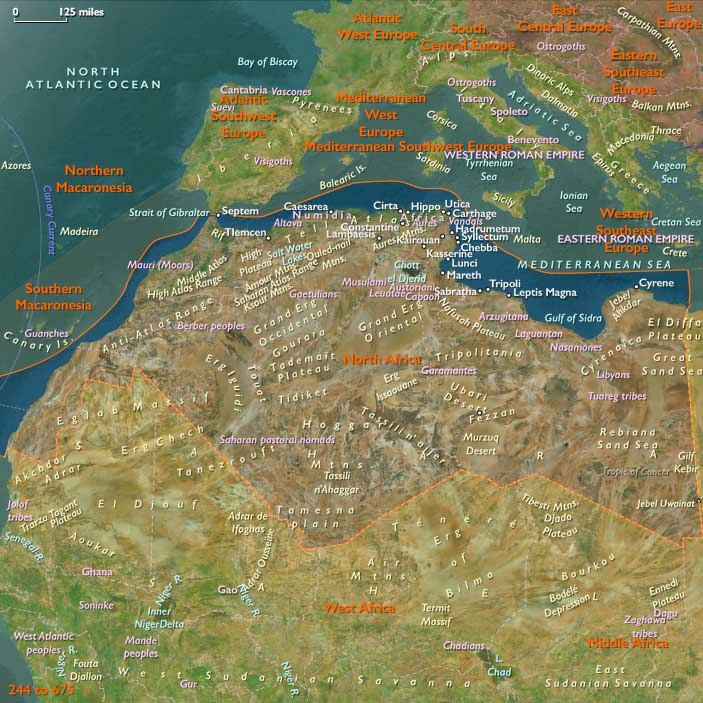
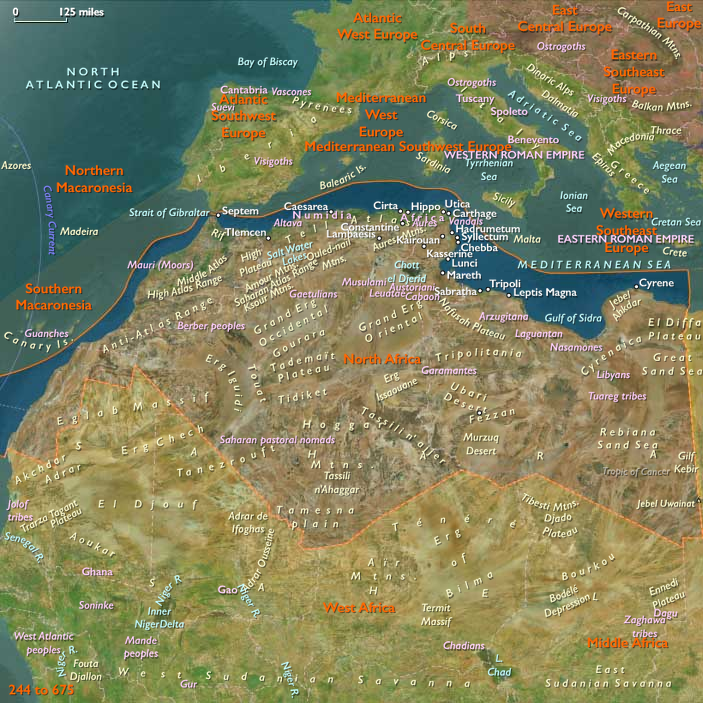
Ancient Cirta, the prosperous capital of Numidia, destroyed during the civil war between Maxentius and the usurper Domitius Alexander (former governor of Africa), is renamed in 313 for Constantine, who rebuilds it.
Locations
People
Groups
Topics
- Roman Age Optimum
- Late Antiquity
- Diocletianic Persecution
- Civil wars of the Tetrarchy
- Roman Civil War of 313
Commodoties
Subjects
Regions
Subregions
Related Events
Filter results
Showing 10 events out of 59967 total
The southern Manchurian-based Korean kingdom Goguryeo extends its reach into the Liaodong peninsula, and Micheon of Goguryeo destroys the last Chinese prefecture, at Lelang, in 313, ending more than four hundred years of Chinese colonial presence.
The Three Kingdoms—Goguryeo, Baekje, and Silla—now dominate the Korean Peninsula.
Maximinus, angling for control of the entire Roman East, crosses the Bosporus with an army in 313 and attacks Licinius’ dominions in Thrace but, defeated at Tzurulum, east of Adrianople, is forced to retreat into Asia Minor, where he soon dies of disease.
Constantine goes far beyond the joint policy agreed upon at Mediolanum, however.
He has seemingly lived until now as a tolerant pagan, uncommitted to any one deity, but now begins gradually to adopt the Christian God as his protector.
By 313, he has already donated to the Bishop of Rome the imperial property of the Lateran, where a new cathedral, the Basilica Constantiniana (now S. Giovanni in Laterano), will soon rise.
The Church of St. Sebastian is also probably begun at this time.
Throughout his life, Constantine will ascribe his success to his conversion to Christianity and the support of the Christian God.
The triumphal arch erected in his honor at Rome after the defeat of Maxentius ascribes the victory to the “inspiration of the Divinity” as well as to Constantine's own genius.
A statue set up at the same time shows Constantine himself holding aloft a cross and the legend “By this saving sign I have delivered your city from the tyrant and restored liberty to the Senate and people of Rome.” The three-centuries long career of the privileged, politically influential Praetorian Guard ends when Constantine disbands it in 313.
A colossal head of Constantine, executed around 313, features blocklike facial planes and bulging eyes, whose off-center pupils gaze heavenward; the hair is a schematic cap.
Miltiades, pope from 311, had become the first pope after the edicts of toleration by the Roman emperors Galerius (ending the persecution of Christians), Maxentius (restoring church property to Miltiades), and Constantine (favoring Christianity).
Concurrently, however, dissension within the church has been caused by the Donatists, North African schismatics who contest the election of Caecilian as bishop of Carthage, championing the election and ordination of their bishop, the theologian Donatus.
At the Lateran Council of 313, Miltiades supports Caecilian and condemns the Donatists, who refuse to submit.
Constantine then orders the Council of Arles (Arelate), the first representative meeting of Christian bishops in the Western Roman Empire, but Miltiades dies before the council convenes.
(The modern Roman Catholic Church considers him a martyr because of earlier sufferings under the Roman emperor Maximian.)

Constantine, having conquered Italy and secured his regime as Emperor in 312, has begun promoting Christianity.
It is in these early years of Constantine’s reign that he begins issuing laws conveying upon the church and its clergy fiscal and legal privileges and immunities from civic burdens.
As he writes in a letter of 313 to the proconsul of Africa, secular offices should not distract the Christian clergy from their religious duties “… for when they are free to render supreme service to the Divinity, it is evident that they confer great benefit upon the affairs of state.” In another such letter, directed to the Bishop of Carthage, Constantine mentions the Spanish bishop Hosius.
Consecrated bishop of Córdoba around 295, Hosius had attended the Council of Elvira and from 312 has acted as Constantine’s ecclesiastical adviser.
Since he may well have been with Constantine in Gaul before the campaign against Maxentius, Hosius is possibly instrumental in the conversion of the Emperor to Christianity.
The Edict of Toleration, by which Constantine and his co-emperor Licinius officially recognize Christianity in 313, authorizes the toleration of different religions in the Roman Empire yet gives supremacy to Christianity.
Constantine annexes those portions of the empire ruled by the defeated Maxentius, then meets Licinius at Mediolanum to confirm a number of political and dynastic arrangements.
A product of this meeting, the way to legalizing Christianity having been opened by Maxentius, will become known as the Edict of Milan, which extends toleration to the Christians and restores any personal and corporate property that had been confiscated during the persecution.
The extant copies of this decree are actually those posted by Licinius in the eastern parts of the empire.
Licinius adds the entire eastern half of the empire to his dominion.
In the same year, he marries Constantine's half sister Constantia.
During the campaign against Maximinus, Licinius has made his army use a monotheistic form of prayer closely resembling that will later be imposed by Constantine.
On June 5, 313, he issues an edict granting toleration to the Christians and restoring church property.
Hence, his contemporaries, Lactantius and Eusebius, hail him as a convert.
Around 305, after Diocletian began persecuting Christians, Lactantius had resigned his post as teacher of rhetoric at Nicomedia and begun a scholarly work on a systematic Latin summary of Christian teaching, Divinae institutiones (“Divine Institutions”), which he completes in about 313.
He now becomes tutor to Constantine’s son Crispus.
The Donatists, who establish their own communities, appoint bishops, and convene church councils, vigorously resist opposition from both the traditional church and the Roman state.
The rigoristic Donatist teachings proclaim that only the sinless can belong to the true church, that sacraments conferred by sinful ministers are invalid, and that only baptism conferred by a Donatist is valid.
Because the Donatists had denied the representative character of two earlier synods, at Rome and in Africa, at which they had been condemned, Constantine convenes the first representative meeting of Christian bishops in the Western Roman Empire at Arles in southern Gaul in August 314.
Attended by representatives of forty-three bishoprics, the Donatists are again condemned, but they reject the decisions reached by the council and again appeal to Constantine to review their case.
Licinius and Constantine now control both halves of the empire.
When Licinius attempts in 314 to foment a revolt against Constantine, the latter responds by leading twenty thousand men into the eastern empire.
After fighting the inconclusive Battle of Cibalae in southern Pannonia on October 8, 314, the two rulers conclude a truce.
The Roman Church proselytizes and derogates Jews, but tolerates them so that they may witness the return of the Messiah, i. e. Jesus.
Constantine begins issuing edicts against the Jews, denouncing them as Christ killers.
The Code of Constantine, issued in 315, limits the rights of non-Christians.
The Arch of Constantine, commissioned by the Senate in Rome to mark his victory at the Milvian Bridge and constructed near the Coliseum in around 315, bears an inscription that attributes Constantine's success to the "prompting of a deity."
The deity is unnamed by the Senate, who probably picture a pagan god, but Rome’s Christians view this deity as their own god.
The Arch’s relief decoration, carved in Carrara marble, bears stylistic correspondences to Christian sarcophagi of the age.
The provincial and folk art roots of the sculptural reliefs indicate a new trend in artistic taste, a reflection of the humble origins of most of Rome’s Christians.
Jin forces have been completely driven out of North China by 317.
An attempt to recover the Central China plain under general Zu Tì is initially successful in recovering all of Henan and Shandong but ends with Zu's death in 321.
Years: 313 - 313
Locations
People
Groups
Topics
- Roman Age Optimum
- Late Antiquity
- Diocletianic Persecution
- Civil wars of the Tetrarchy
- Roman Civil War of 313