The first known system of taxation appears …
Years: 3069BCE - 2926BCE
The first known system of taxation appears in Egypt around 3000 BCE to 2800 BCE: the pharaoh appears before his people in a biennial event, the "Following of Horus," and collects taxes, revenues due to him in his dual role, as the head of state and the incarnation of the god Horus.
Locations
People
Groups
Topics
Subjects
Regions
Subregions
Related Events
Filter results
Showing 10 events out of 68685 total
Canal systems and other public works lead to the development of government and the growth of bureaucracy in Egypt and Mesopotamia.
Archaeological evidence at various levels of development throughout the world indicates that society is becoming more complex, elite groups are forming, and social organization is shifting from tribal groupings to chiefdoms and from chiefdoms to kingships.
The development of leavened bread can probably be traced to prehistoric times.
Yeast spores occur everywhere, including the surface of cereal grains, so any dough left to rest will become naturally leavened.
Although leavening is likely of prehistoric origin, the earliest archaeological evidence is from ancient Egypt, where baking developed into one of the first large-scale food production industries.
Scanning electron microscopy has detected yeast cells in some ancient Egyptian loaves.
However, ancient Egyptian bread was made from emmer wheat and has a dense crumb.
In cases where yeast cells are not visible, it is difficult, by visual examination, to determine whether the bread was leavened.
As a result, the extent to which bread was leavened in ancient Egypt remains uncertain.
Agricultural cultivation using horse collar leveraged plows (at about 3000 BCE) is one of the first innovations that increase productivity.
Wheat has by this time reached England and Scandinavia.
Technological advances in soil preparation and the placement of seed, the use of crop rotation and fertilizers to improve plant growth, and advances in harvesting methods have all combined to promote wheat as a viable crop.
The Beaker culture, a high-status burial rite widely adopted by local elites in most of western, central, and northern Europe in the late third millennium, produces geometrically patterned ceramic ware while disseminating early metal technology.
The disparities in wealth that are visible from typical Beaker graves marks an emergence of social ranking not evident in the more egalitarian Neolithic societies.
The Cape Denbigh Flint Complex, a prehistoric tool industry at Iyatayet, along Norton Sound on the west coast of Alaska, initiates the development of one the earliest Eskimo cultures in Alaska, when its members begin the transition from inland hunting to coastal life about 3000 BCE at Cape Krusenstern, north of Kotzebue in northwest Alaska.
Characterized by small, well-made flint implements, including tiny blades, or microliths, some, the burins (engraving tools) in particular, show affinities with late Paleolithic and Mesolithic industries of the Old World.
Others are more typical of flint-working techniques of North American Paleo-Indian groups and reflect the adaptation to coastal life.
The Denbigh Flint Complex is probably a late offshoot of pre-Eskimo tool industries brought from Siberia to Alaska during the last period of the Bering Land Bridge.
The Angono Petroglyphs, the oldest known work of art in the Philippines, comprise one hundred and twenty-seven human and animal figures engraved on the rockwall dating back to 3000 BCE.
These inscriptions clearly show stylized human figures, frogs, and lizards along with other designs that may have depicted other interesting figures but erosion may have caused the images to become indistinguishable.
The earliest Korean art appears in the form of Neolithic pottery impressed with simple geometric decoration around 3000 BCE.
Yangshao artisans create fine white, red, and black painted pottery with human facial, animal, and geometric designs.
Unlike the later Longshan culture, the Yangshao culture does not use pottery wheels.
Excavations found that children were buried in painted pottery jars.
The distinctive feature of the Longshan culture is the high level of skill in pottery making, including the use of pottery wheels.
The Longshan culture is noted for its highly polished black pottery (or egg-shell pottery).
This type of thin-walled and polished black pottery, which marks a great technical advance, has also been discovered in the Yangzi River valley and as far as today's southeastern coast of China.
It is a clear indication that Neolithic agricultural subgroups of the greater Longshan Culture had spread out across ancient boundaries of China.
Japan’s Jomon culture continues, with its proto-Japanese members living mainly by hunting and fishing and by gathering edible nuts and roots.
The Early Jōmon is the first stage in the Jomon era of Japanese prehistory.
The Jomon period itself ranges from 10,000 to 300 BCE, with the first stage lasting from 4000 to 3000 BCE.
The Early Jomon is characterized by high sea level (two to three meters higher than the present day) and a significant population increase.
This period has seen a rise in complexity in the design of pit houses, the most commonly used method of housing at this time.
The so-called Proto-Indo-European language (the earliest reconstructible ancestor of the now widespread Indo-European languages) is probably spoken north of the Black and Caspian seas about 3000 BCE.
Merheleva Ridge is site of an Eneolithic temple and burial complex consisting primarily of four large stone mounds or kurgans situated near Perevalsk, Luhansk oblast, Ukraine, about 30 km to the west-to-southwest of the city of Luhansk.
Built in about 4000 BCE and corresponding to the Dnieper-Donets or early Yamna culture, it is to remain in use throughout the Bronze Age and well into the Iron Age, until the Sarmatian culture of the fifth century BCE.
Discovered in 2004 and officially announced on September 7, 2006, it is believed much of the site was constructed about five millennia ago, at the time of the early Bronze Age.
The site is believed to be a complex of temples and sacrificial altars topping a hill with sides sculpted into steps.
Archaeologists have confirmed that evidence of graves has been found at the Luhansk site, which they believe to have been the result of human sacrifice, rather than due to its use as a burial ground.
Retainer sacrifices seem to have been common in early Indo-European religion.
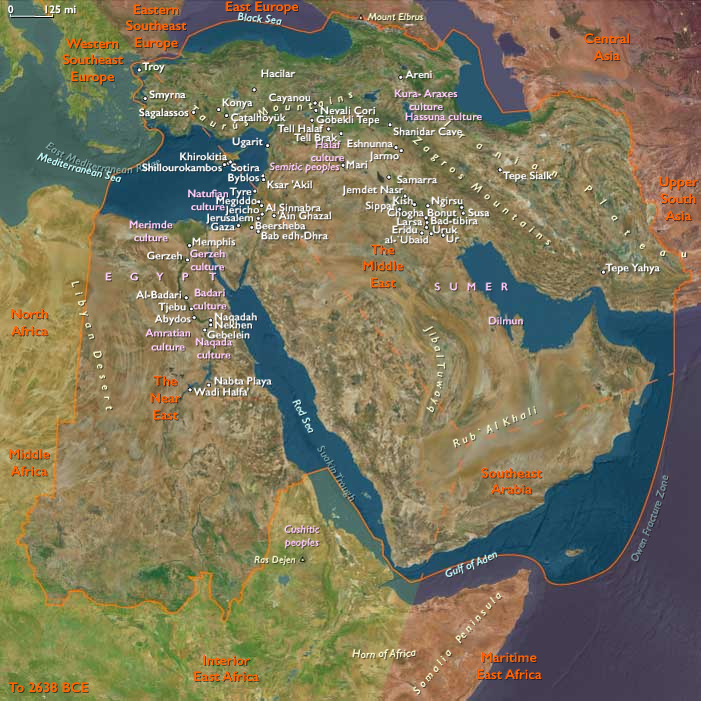
The Middle East (3069–2926 BCE): Urban Expansion, Technological Advances, and Cultural Interaction
Early Settlement at Konya and Tepe Yahya
Between 3069 and 2926 BCE, the area around modern Konya (ancient Iconium), situated on a plateau at approximately 1,027 meters above sea level, experienced its first settlement. Concurrently, the site of Tepe Yahya in Iran, inhabited intermittently since 4500 BCE, flourished significantly from 3100 to 2900 BCE as a critical hub for commerce and overland trade. Notably, Tepe Yahya became renowned for exporting chlorite, used primarily in textile processing.
Byblos and Canaanite Civilization
Around 3000 BCE, Byblos (biblical Gebal), which had roots dating back to Neolithic times, transformed into a dynamic seaport and trade center. Evidence from this era includes well-built, uniform housing, marking the rise of urban life and early stages of Canaanite civilization. Byblos developed prosperous trading relationships, notably with Egypt, exporting products such as cedar, olive oil, and wine, while importing luxury items from the Nile Valley.
Phoenician Cities and Maritime Trade
The region now identified as Lebanon, first appearing prominently in historical records around 3000 BCE, featured coastal cities inhabited by the Canaanites—later known as Phoenicians due to their famed purple dye. Each city-state, such as Tyre, Sidon, Byblos (Gubla), and Beirut (Berytus), emerged as specialized and independent centers of maritime trade, religion, and commerce.
Greater Syria: Early Historical Context
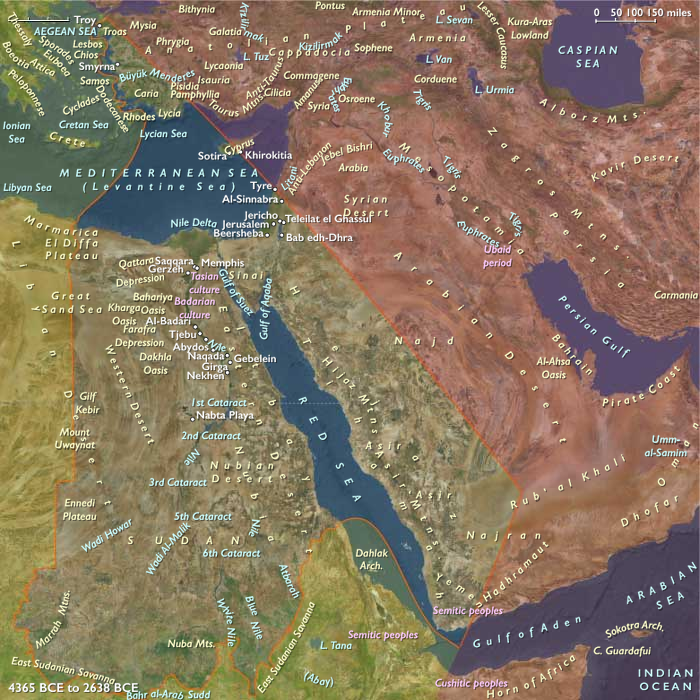
The broader geographical region historically known as "Greater Syria" encompassed modern-day Syria, Lebanon, Jordan, and Israel. Ancient Egyptian records from the fourth millennium BCE mention expeditions to the region, particularly for valuable timber resources from the Ammanus and Lebanon mountain ranges, illustrating early economic and cultural interactions.
Innovations in Metallurgy and Transportation
Sumerians of this period advanced significantly in metallurgy, refining techniques to smelt copper and produce bronze alloys, initially using arsenic bronze and later developing tin bronze, first evident around 3000 BCE at Susa. Simultaneously, the earliest known animal-drawn wheeled vehicles appeared, revolutionizing transport and replacing earlier sledges. Clay tablets from Uruk (circa 3200–3100 BCE) depict these early wheeled carts, underscoring this critical technological advancement.
Proto-Elamite Script and Urban Developments
Proto-Elamite culture in southwestern Iran, contemporary with Sumer, transitioned from pictographic to hieroglyphic script around 3000 BCE. Despite remaining undeciphered, this writing represents an important early communication system, showing possible connections to contemporary Mesopotamian scripts.
Religious Architecture and Urban Complexity in Uruk
In Uruk, the White Temple dedicated to the god Anu, constructed around 3000 BCE, became a striking symbol of political and religious authority. Built atop an elevated, artificial mound, it featured bright gypsum plaster surfaces intended to dominate the surrounding plain visually. Uruk's social and economic structures evolved significantly, aided by substantial agricultural surpluses and expanding trade networks, fostering specialization of labor, extensive pottery production, and early tablet writing.
Cultural and Societal Changes
By this period, Mesopotamian society showed clear class stratification, reflecting greater complexity in governance, religion, and economic life. City-states, each centered around temples dedicated to local deities, demonstrated diverse social roles, particularly influencing the status of women. Notably, the early use of the "shekel" emerged as both currency and a weight measurement, reflecting advanced economic systems.
Jemdet Nasr Period and Sumerian Urbanization
The Jemdet Nasr period (3100–2900 BCE) marked a transitional era characterized by continued urban development in south-central Iraq, with cities like Kish gaining prominence. Sumerian clay tablets from this time, notably those from Jemdet Nasr, represent the oldest clearly Sumerian texts, featuring stylus-written wedge-shaped cuneiform script, a significant evolution from pictographic predecessors.
Cultural Flourishing at Tepe Sialk and Loristan
Tepe Sialk near modern Kashan, Iran, demonstrated early urban structures dating to the early third millennium BCE. Similarly, in Loristan, distinctive and finely crafted painted pottery, some remarkably thin, began to emerge around 3000 BCE, reflecting vibrant regional cultures interconnected by trade and artistic exchange.
This age encapsulates transformative developments in urban life, cultural sophistication, technological innovation, and economic expansion, solidifying crucial foundations for the complex societies that characterized the ancient Middle East.

Konya (ancient Iconium), located on a plateau about three thousand three hundred and seventy feet (one thousand and twenty-seven meters) above sea level, is first settled at the beginning of the third millennium BCE.