
An important but unidentified Anglo-Saxon ruler is …
Years: 627 - 627
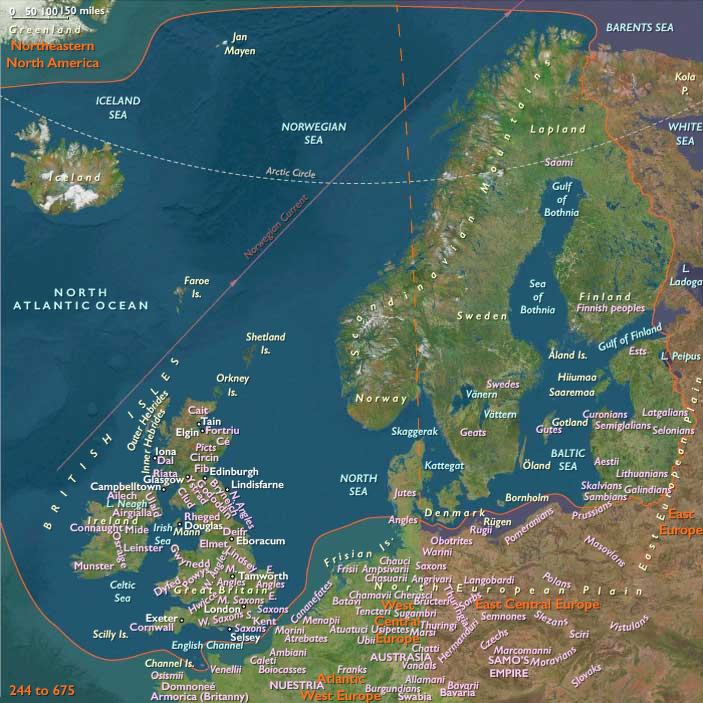
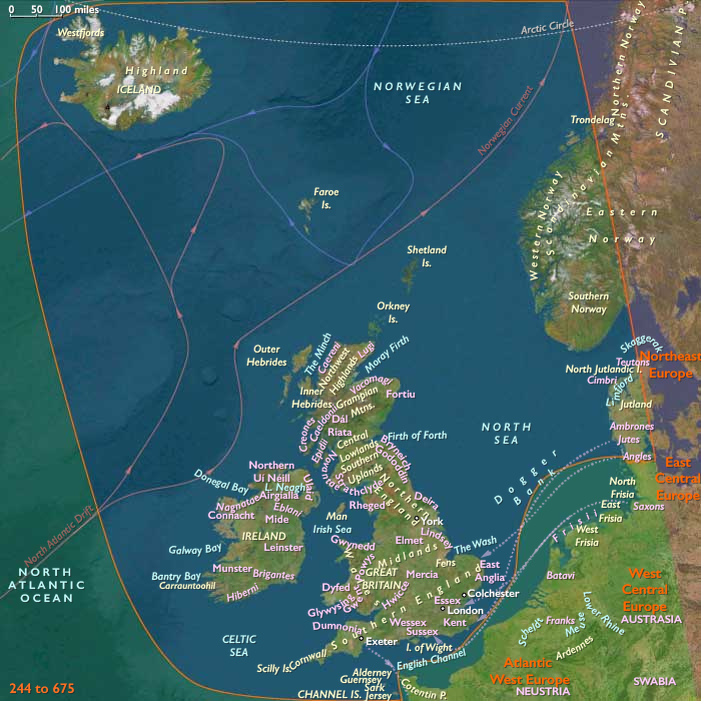
An important but unidentified Anglo-Saxon ruler is buried on a heath about eight miles (thirteen kilometers) northeast of present Ipswich in Suffolk, England.
His “coffin” is a clinker-built vessel approximately seventy-nine feet (twenty-four meters) long and eight feet (two-and-a-half meters) in the beam.
Thirty-seven Merovingian gold coins, probably accumulated between the years 620 and 630, suggest the date of interment; the tomb (according to arguments advanced by several experts) may be that of Raedwald, king of the East Angles and high king of the Anglo-Saxons, who dies in about 627, succeeded by his son Eorpwald.
Grave-goods include a Swedish helmet and shield, a sword and spears, cauldrons and bowls of Coptic as well as Celtic craftsmanship, a huge silver dish with stampings on it of Emperor Anastasius I, two Byzantine silver baptismal spoons bearing the names Paulos and Saulos, and numerous other jewelry items. (Modern archaeologists refer to this find as the Sutton Hoo ship burial.)
The grave may, alternately, be that of Eorpwald, who is murdered and succeeded by Ricberht, a member of the East Anglian elite, who will reestablish paganism during his rule.
Locations
People
Groups
- Polytheism (“paganism”)
- Franks
- Anglo-Saxons
- Christianity, Chalcedonian
- East Angles, Kingdom of the
- Britain, Medieval
- Roman Empire, Eastern: Heraclian dynasty
Topics
Commodoties
Subjects
- Commerce
- Products
- Watercraft
- Environment
- Decorative arts
- Faith
- Government
- Custom and Law
- Archaeology
- Movements
Regions
Subregions
Years: 627 - 627
Locations
People
Groups
- Polytheism (“paganism”)
- Franks
- Anglo-Saxons
- Christianity, Chalcedonian
- East Angles, Kingdom of the
- Britain, Medieval
- Roman Empire, Eastern: Heraclian dynasty
Topics
Commodoties
Subjects
- Commerce
- Products
- Watercraft
- Environment
- Decorative arts
- Faith
- Government
- Custom and Law
- Archaeology
- Movements
Regions
Subregions