
An entry in the chronicle of the …
Years: 719 - 719
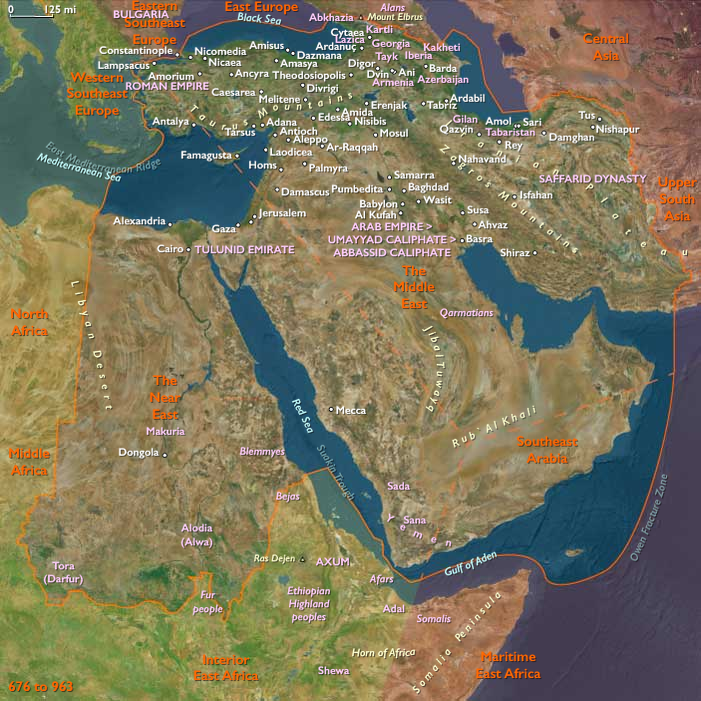
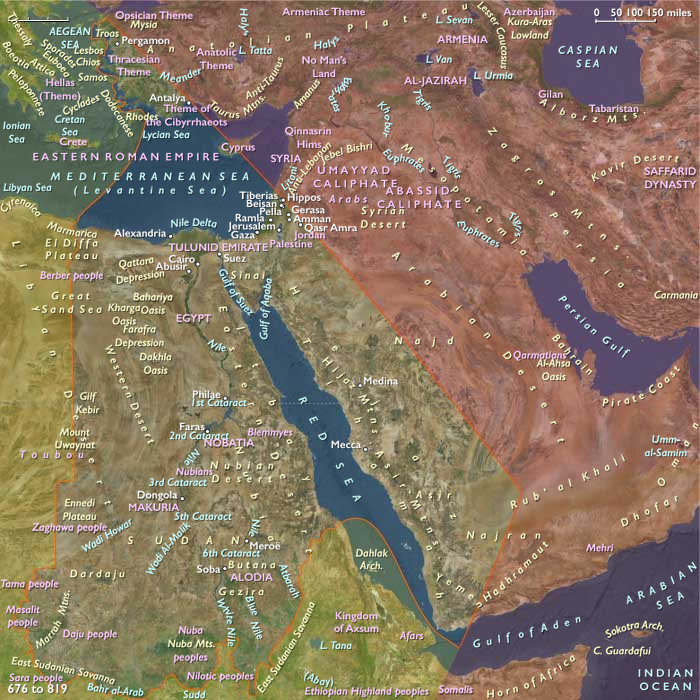
An entry in the chronicle of the Greek Orthodox Patriarch of Alexandria Eutychius states that the church of Nubia in 719 transferred its allegiance from the Greek to the Coptic Church.
Locations
Groups
- Nubians
- Makuria, Kingdom of
- Coptic Orthodox Church of Alexandria
- Christianity, Chalcedonian
- Alodia, or Alwa (Subah, or Soba), Kingdom of
Topics
Subjects
Regions
Subregions
Related Events
Filter results
Showing 10 events out of 55647 total
Vairocana, also called Mahavairocana (“Great Illuminator”), the supreme Buddha, as regarded by many Mahayana Buddhists of East Asia and of Tibet, Nepal, and Java, is given reverence by Buddhists of the Yogacara school in China and Japan, (which will lead to the foundation of the Shingon sect in Japan).
Legend claims that he transmitted to a supernatural personage, Vajrasattva, the Yoga doctrine, which is in turn introduced into China in 719 by Vajrabodhi.
Successive Agilolfing dukes, having gradually evolved into independent rulers in Bavaria, have for a century and a half resisted the inroads of the Slavs on their eastern frontier, and by the time of Duke Theodo I, who died in 717, have achieved complete independence from the feeble Frankish kings.
Theodo had divided his duchy among four of his five sons—Theodbert, Grimoald, Theobald, and Tassilo—sometime before 715.
As early as 702, Theodbert had been ruling from Salzburg and from 711 or 712, Theobald was co-reigning.
It is impossible to see if this division was territorial (as with the Merovingians) or purely a co-regency (as with the later princes of Benevento and Capua).
If so, Theodbert's capital was probably Salzburg and the Vita Corbiniani informs that Grimoald had his seat there.
References to Theobald and the Thuringii implies perhaps a capital at Regensburg and this leaves Tassilo at Passau.
After Theodo's death in 716, the four brothers war with each other, but all are dead by 719 save Grimoald, who hereafter rules alone.
It is not certain if the division of the duchy was territorial or a power-sharing scheme, but if the former, it seems most probable that Grimoald's capital was either Freising, which he will later favor as a diocesan seat, or …
…Salzburg, which he will later treat as a capital of sorts (Vita Corbiniani).
Anastasios heads a revolt in 719 against Leo the Isaurian, who had succeeded Theodosius as Leo III, receiving considerable support, including auxiliaries reportedly provided by Tervel of Bulgaria.
However the chronicler Theophanes the Confessor, who offers this information elsewhere, confuses Tervel with his eventual successor Kormesiy, so perhaps Anastasios was allied with the younger ruler.
In any case, the rebel forces advance on Constantinople.
The enterprise fails, and Anastasios falls into Leo's hands and is put to death by his orders.
Moorish attacks in 718 on Aquitaine, heretofore independent of Frankish rule, had prompted Odo, recognizing in Frankish king Charles an able protector, to submit to the suzerainty of Austrasia in 719.
In exchange for recognizing his dukeship, he surrenders the king and his treasures to Charles, who recognizes Chilperic’s kingship over all the Franks in return for legitimate royal affirmation of his mayoralty, likewise over all the kingdoms).
The deposed emperor Anastasios II, now residing in Sicily, foments a revolt by army officers and others to dethrone Leo, who promptly dispatches troops to the island in 719.
The imperial forces compel the rebels' surrender and capture Anastasios, who is put to death by Leo’s orders.
The Annexation of Frisia and the Support for Christian Missionaries
In 719, following the death of Radbod, Charles Martel swiftly seizes West Frisia without encountering significant resistance. The Frisians, long adversaries of the Franks, now find themselves under Frankish control, their new ruler, Aldegisel, proving more amenable to Frankish influence. Although Charles does not fully trust the pagan Frisians, Aldegisel’s acceptance of Christianity provides an opportunity to further integrate the region into the Frankish realm.
Willibrord and Boniface: The Christianization of Frisia and Germany
Seeking to solidify Frankish authority through religious conversion, Charles sends Willibrord, the eventual Bishop of Utrecht, to continue his missionary work. Willibrord, known as the “Apostle to the Frisians,” establishes churches, schools, and monasteries, ensuring that Christianity takes root in the newly conquered territory.
At the same time, Charles extends his support to Winfrid, the Anglo-Saxon missionary who will later be known as Saint Boniface, the “Apostle of the Germans.” After an unsuccessful earlier attempt in Frisia, Winfrid sets out again in 718, travels to Rome, and is formally commissioned in 719 by Pope Gregory II to evangelize the Germanic peoples. It is during this mission that he is given the name Boniface and tasked with reorganizing the church in Germany, ensuring that Frankish interests and Christian expansion go hand in hand.
With these developments, Frisia, up to the banks of the Vlie River, becomes firmly part of the Frankish Empire, further extending Charles Martel’s dominance and securing Christian influence in the region.
The Submission of Burgundy to Charles Martel
Having witnessed the military defeat of Neustria, Burgundy recognizes the futility of resistance and capitulates to the rule of Charles Martel. Rather than facing the same fate as the Neustrian forces, the Burgundian nobility chooses to submit, acknowledging Charles as the undisputed ruler of the Frankish realm.
With Burgundy’s peaceful submission, Charles consolidates his control over all three major Frankish territories—Austrasia, Neustria, and Burgundy—further strengthening his position as the de facto ruler of Francia. This diplomatic victory allows him to shift his focus toward external threats and the expansion of Frankish influence through both military conquest and Christianization.
The Death of Clothar IV and the Strengthening of Charles Martel’s Rule
In 719, Clothar IV, the Merovingian king installed by Charles Martel as a puppet ruler over Austrasia, dies in Soissons. His reign had been little more than a formality, serving as a tool for Charles to legitimize his rule while consolidating power over the Frankish realm.
With Clothar IV’s death, Charles is now free to determine the fate of the Merovingian monarchy. Rather than appointing another king of his choosing, he pragmatically reconciles with the former Neustrian king, Chilperic II, whom he had previously opposed in battle. This move helps unify the Frankish realm under a single nominal monarch, while Charles continues to wield absolute authority as Dux Francorum, the true ruler of Francia.
Charles Martel: De Facto Ruler of the Franks
By 719, after five years of civil war and military campaigns, Charles Martel is officially confirmed as Mayor of the Palace in Austrasia, securing his position as the undisputed leader of the Frankish realm. Though a Merovingian king nominally retains the hereditary title, Charles exercises absolute authority, effectively sidelining the monarchy.
In practice, Charles performs all the essential functions of a ruler:
- Leading the Frankish army in battle, ensuring military supremacy,
- Presiding over royal courts, consolidating his control over justice and governance, and
- Issuing decrees and managing administration, shaping the policies of the realm.
With this consolidation of power, Charles Martel lays the foundation for Carolingian rule, a dominance that will culminate in the eventual replacement of the Merovingian dynasty by his own descendants.
Years: 719 - 719
Locations
Groups
- Nubians
- Makuria, Kingdom of
- Coptic Orthodox Church of Alexandria
- Christianity, Chalcedonian
- Alodia, or Alwa (Subah, or Soba), Kingdom of
