An earthquake devastates the city of Latakia …
Years: 555 - 555
April
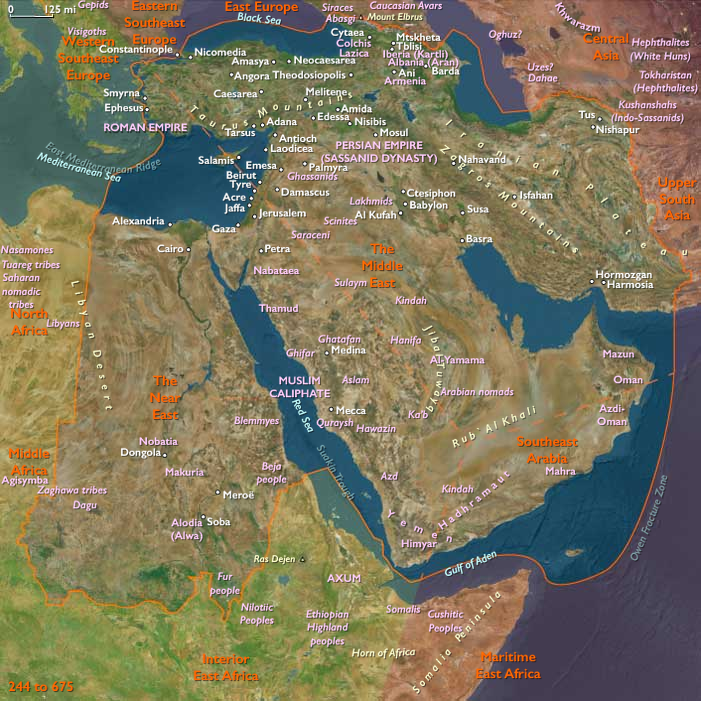
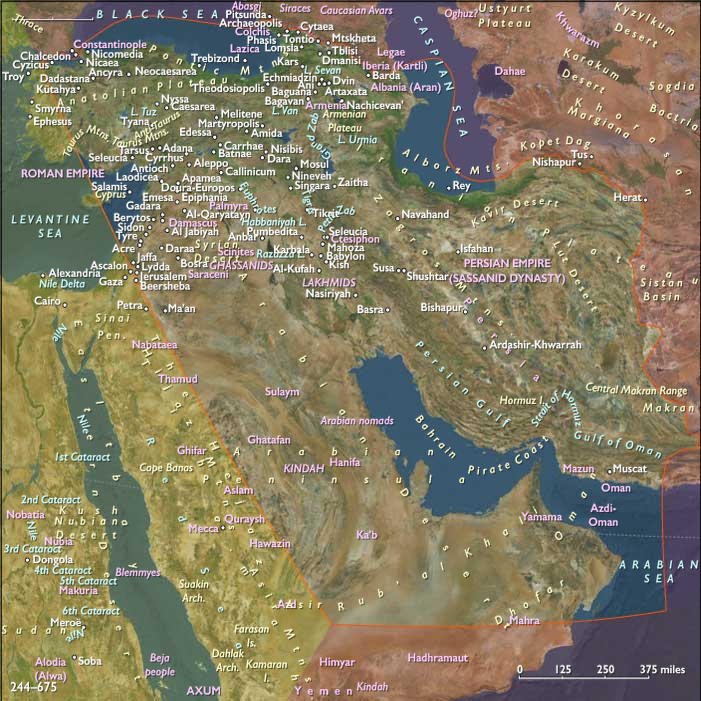
An earthquake devastates the city of Latakia (modern Syria) in 555.
Related Events
Filter results
Showing 10 events out of 57575 total
Jing, age twelve, succeeds his father Yuan and is declared emperor by general Chen Baxian.
The Göktürks behead three thousand Rouran in 555.
Some scholars claim that the Rouran then fled west across the steppes and became the Avars, though many other scholars contest this claim.
The remainder of the Rouran flee into China, are absorbed into the border guards, and disappear forever as an entity.
The last Rouran khagan flees to the court of Western Wei, but at the demand of the Gökturks, Western Wei executes him and the nobles that had accompanied him.
The Gökturk expansion also pushes against the Avars, who are driven toward the East Roman Empire and the Sassanid Empire and eventually toward the Danube.
Other tribes of Central Asia, such as the eastern Bulgars, are also displaced.
The Bavarians had emerged in a region north of the Alps originally inhabited by the Celts, which had been part of the Roman provinces of Raetia and Noricum.
The Bavarians speak Old High German but, unlike other Germanic groups, probably did not migrate from elsewhere.
Rather, they seem to have coalesced out of other groups left behind by Roman withdrawal late in the fifth century.
These peoples may have included the Celtic Boii, some remaining Romans, Marcomanni, Allemanni, Quadi, Thuringians, Goths, Scirians, Rugians, Heruli.
The name "Bavarian" ("Baiuvarii") means "Men of Baia" which may indicate Bohemia, the homeland of the Celtic Boii and later of the Marcomanni.
They first appear in written sources around 520.
By the sixth century, there is evidence of the foundation of a Bavarian stem duchy whose leadership is related to the ruling Frankish (and possibly Alemannic/Swabian) houses.
The dukes of Bavaria choose the site of a first century CE Roman camp (later called Regensburg) as their seat; it will remain the capital of Bavaria from about 530 to the first half of the thirteenth century.
From about 554, the house of Agilolfing rules the Duchy of Bavaria, subordinate to the Franks.
Three early dukes are named in Frankish sources: Garibald I may have been appointed to the office by the Merovingian kings and married the Lombard princess Walderada when the church forbade her to King Chlothar I in 555.

Justinian in the mid 550s pays the westward-migrating Avars, a tribe of northeast Asian origin—and reputedly an amalgamation of Huns and Mongols—to subjugate those Huns and Slavs who continue to raid the Balkan provinces.
Procopius of Caesarea probably retires to Constantinople in 548 after Belisarius’ disgrace.
In the “Wars,” he narrates Justinian's achievements to 553.
In “The Buildings” completed in 555, Procopius writes a further paean to Justinian for his public works.
In the posthumously published and highly scurrilous “Secret History,” Procopius claims to reveal information about the emperor's personality and policy that he could not present in the earlier books because he feared the emperor’s wrath.
He alleges that the emperor’s late wife, Theodora, was formerly and actress and a prostitute.
Liberius had returned to Constantinople by May 553 and it is likely that an imperial force from Italy, which had only recently been pacified after the Gothic War, lands at Cartagena in early March 555.
Their landing is violent.
The native population, which includes the family of Leander of Seville, is well disposed to the Visigoths and the imperial government of the city is forced to suppress their freedoms, an oppression that will last decades into their occupation.
Leander and most of his family flee and his writings preserve the strong anti-imperial sentiment.
The imperial force marches inland to …
…Baza (Basti) in order to join up with their compatriots near Seville.
The supporters of Agila, in fear of the Empire’s recent successes, turn on him and assassinate him in late March 555, making Athanagild the king of the Goths.
According to Isidore of Seville, Agila’s people realized the destruction Agila's wars to retain power had caused, but "fearing even more that Roman soldiers might invade Spain on the pretext of giving help".
Quickly the new king acknowledges the suzerainty of the Empire and tries to rid Spain of the imperial presence, but fails.
The imperial troops rapidly occupy many coastal cities in Baetica; this region is to remain an imperial province until its reconquest by the Visigoths barely seventy years later.
The war in Italy is not finished, despite Narses' great victories.
Seven thousand Goths hold out at Campsa, near Naples, until they capitulate in the spring of 555.
Chlothar I Expands His Rule: The Annexation of Metz and Reims (555 CE)
By 555 CE, Chlothar I, already one of the most powerful Merovingian rulers, consolidates even more territory after the death of his great-nephew Theudebald, who had ruled the Frankish kingdom of Austrasia from Metz. Theudebald's prolonged illness and eventual death allow Chlothar to seize Metz and Reims, expanding his dominion over the former Austrasian territories.
Years: 555 - 555
April
Locations
Groups
- East, Diocese of the
- East, or Oriens, Praetorian prefecture of
- Syria Prima (Roman province)
- Roman Empire, Eastern: Justinian dynasty