An Ayutthayan offensive in the north leads …
Years: 1452 - 1452
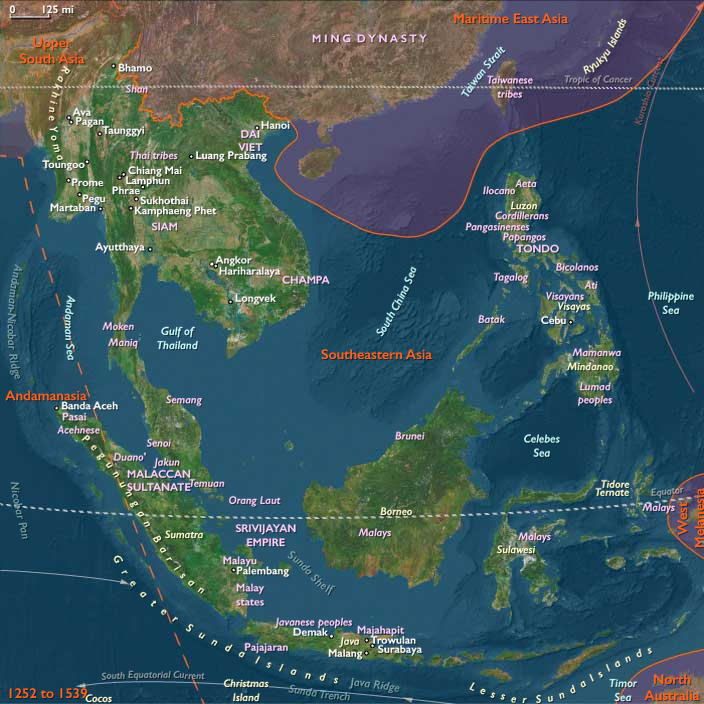
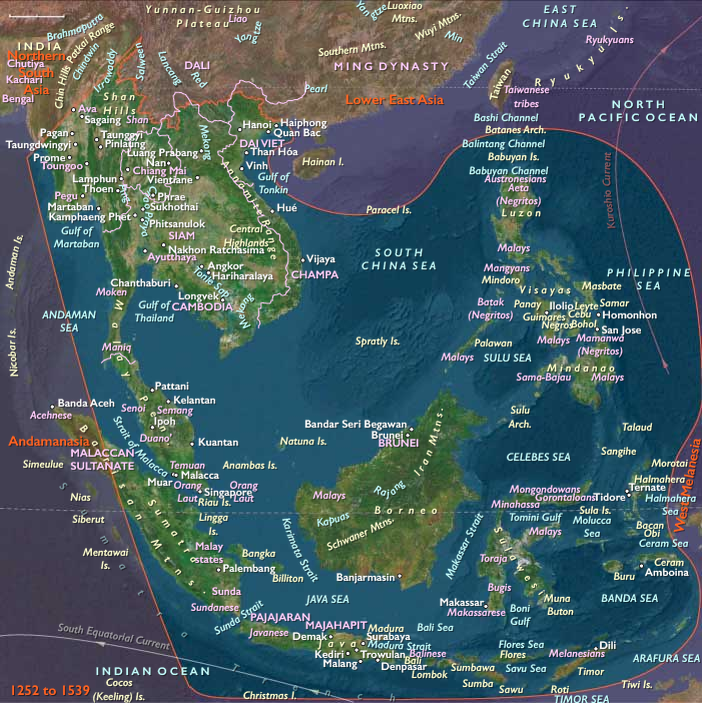
An Ayutthayan offensive in the north leads to the occupation of Chiang Mai in 1452, but the Ayutthayans are forced to withdraw and the Chiang Mais to defend themselves when Luang Prabang’s Laotian king, Sai Tia Kaphat, intervenes in the war.
Locations
Groups
- Tai peoples, or Thais
- Lao people
- Lanna, or Lan Na (Siam), Thai kingdom of
- Ayutthaya (Siam), Thai state of
- Lan Xang, Kingdom of
- Sukhothai (Siam), Thai vassal kingdom of
Topics
Commodoties
Subjects
Regions
Subregions
Related Events
Filter results
Showing 10 events out of 41498 total
Tongoa and Epi islands in present Vanuatu once formed part of a larger island called Kuwae.
Local folklore tells of a cataclysmic eruption that destroyed this island, leaving the two smaller islands and an oval-shaped twelve by six kilometer caldera in between (but the story tells of an eruption south of Tongoa).
Collapse associated with caldera formation may have been as much as eleven hundred meters.
Around thirty-two to thirty-nine cubic kilometers of magma is erupted, making the Kuwae eruption being one of the largest in the last ten thousand years.
In Antarctica and Greenland ice cores, a major eruption or series of eruptions is revealed as a spike in sulfate concentration showing that the release in form of particles was higher than any other eruption in the past seven hundred years.
Also, the ice core analyses are able to pinpoint the event to late 1452 or early 1453.
This volume of expelled matter is more than six times larger than that of the 1991 Pinatubo eruption and would have caused severe cooling of the entire planet the following three years.
The Bavarian dukes, Albert III and the late Louis VIII, influenced by Capistrano's agitations, had driven the Jews from their duchies; in some places in Bavaria, Jews are forced in 1452 to wear the degrading “Badge” on their coats.
The pressure of the Austrian estates to free Ladislaus had grown from 1450.
In 1451, Frederick had successfully faced an insurrection by Austrian nobles who demand possession of Ladislas, and had retained his regency over the boy.
The nobles enter into the Mailberg Confederation under the leadership of Ulrich, Baron of Eyczing, and Ulrich II, Princely Count of Celje.
After his coronation, in Rome, as Holy Roman Emperor in 1452, Frederick is surrounded in his capital at Wiener Neustadt, Austria, by sixteen thousand troops under Ulrich of Cilli, a cousin of Ladislas and a power in Austria.
Upon Frederick’s surrender of Ladislas, Ulrich takes the twelve-year-old monarch to Vienna.
Most of Persia is taken from the Timurids by 1452, with the exception of Abarquh, which is conquered by the Black Sheep in 1453.
While Kerman is temporarily conquered some time later and a few attempts will be made to seize Ray, Persia as a whole will never be never retaken by the Timurids.
The Ottoman governor of Thessaly, Turahan Bey, breaks through the Hexamilion wall for the fourth time and ravages the Peloponnese peninsula, to prevent the Despotate of the Morea from assisting Constantinople during the final Ottoman siege of the imperial capital, raiding from Corinth through the Argolid and Arcadia to Messenia.
Morea puts up little resistance after Hexamilion, although Turahan's son Ahmed is captured in an ambush at Dervenakia and imprisoned in Mistra.
The influx of African gold permits the minting of Portugal's first gold cruzado coins by 1452.
A cruzado is equal to four hundred reis at this time.
The d’Este family has ruled the city of Modena and Reggio Emilia for centuries.
Leonello d’Este, one of the three illegitimate sons of Niccolò d'Este III, Marquess of Ferrara, Modena and Reggio, and Stella de' Tolomei, had received a military education under the condottiero Braccio da Montone, and had been taught in letters by the humanist Guarino Veronese.
In 1425, after the execution of his elder brother Ugo Aldobrandino, he remained the sole heir of Niccolò.
In 1435, he had married Margherita Gonzaga, Margherita, who died in 1439 after giving birth to a child, Niccolò in 1438.
In 1441, Leonello had succeeded his father to his possession in northern Italy.
In 1444, Leonello had married Mary of Aragon, the illegitimate daughter of King Alfonso V of Naples.
Leonello, a skilled politician, is responsible of the construction of the first hospital of Ferrara, but he has distinguished himself chiefly as a man of culture.
Leon Battista Alberti has written his De Re Aedificatoria under Leonello's commission, and at the Ferrarese court work artists such as Pisanello, Iacopo Bellini, Giovanni da Oriolo, Andrea Mantegna, Piero della Francesca and the Netherlandish Rogier van der Weyden.
During his rule, the University of Ferrara gains prestige.
At Leonello’s death on October 1, 1450, his younger brother Borso d'Este, had succeeded to the marquisate.
On May 18, 1452, d’Este receives from Emperor Frederick III confirmation over his fiefs, as Duke of Modena and Reggio.
Lorenzo Ghiberti finishes, gilds, and installs the reliefs for his pair of doors for the Florence Baptistery by 1452.
Alesso Baldovinetti also designs and executes several stained-glass windows and creates ambitious wood-inlay (tarsia) panels and numerous mosaics, such as those he has produced in 1453-55 above Ghiberti's two bronze doors to the Florence Baptistery.
Benozzo Gozzoli, born Benozzo di Lese in the village of Sant'Ilario a Colombano around 1421, had moved with his family to Florence in 1427.
According to Giorgio Vasari, in the early part of his career he was a pupil and assistant of Fra Angelico: some of the works in the convent of San Marco of Florence were executed by Gozzoli from Angelico's design.
In 1444-1447, he had collaborated with Lorenzo Ghiberti and his studio on the Paradise Doors of the Battistero di San Giovanni.
Gozzoli had been in Rome with Fra Angelico on May 23, 1447 called by Pope Eugene IV to carry out the fresco decoration of a chapel in the Vatican Palace.
Later, the two had worked until June 1448 in the Cappella Niccolina for Nicholas V. From 1449 is a banner with Madonna and Child in the church of Santa Maria sopra Minerva, perhaps designed by Angelico.
In Rome he executed also, in Santa Maria in Aracoeli, a fresco of St. Anthony and Two Angels.
Benozzo's last collaboration with Angelico was the vault of the Duomo di Orvieto in Umbria.
He had left Angelico in 1449 and moved to Umbria.
From 1450 is an Annunciation in Narni, signed OPU[S] BENOT[I] DE FLORENT[IA].
In the monastery of San Fortunato, near Montefalco, he has painted a Madonna and Child with Saints and Angels, and three other works.
One of these, the altarpiece representing St. Thomas receiving the Girdle of the Virgin, is now in the Lateran Museum and shows the affinity of Benozzo's early style to Angelico's.
He next painted in the monastery of San Francesco, Montefalco, filling the choir with three registers of subjects from the life of the saint, with various accessories, including portrait heads of Dante, Petrarch and Giotto.
This work, completed in 1452, is still marked by the style of Angelico, crossed in places with a more distinctly Giottesque influence.
In the same church, in the chapel of Saint Jerome, is a fresco by Gozzoli of the Virgin and Saints, the Crucifixion and other subjects.

Piero della Francesca had been called to Arezzo in 1452, to replace Bicci di Lorenzo in painting the frescoes of the basilica of San Francesco.
The work is finished before 1466, probably between 1452-1456.
The cycle of frescoes, depicting the Legend of the True Cross, is generally considered among his masterworks and those of Renaissance painting in general.
The story in these frescoes derives from legendary medieval sources as to how timber relics of the True Cross came to be found.
These stories were collected in the "Golden Legend" of Jacopo da Varazze (Jacopo da Varagine) of the mid-thirteenth century.
Years: 1452 - 1452
Locations
Groups
- Tai peoples, or Thais
- Lao people
- Lanna, or Lan Na (Siam), Thai kingdom of
- Ayutthaya (Siam), Thai state of
- Lan Xang, Kingdom of
- Sukhothai (Siam), Thai vassal kingdom of