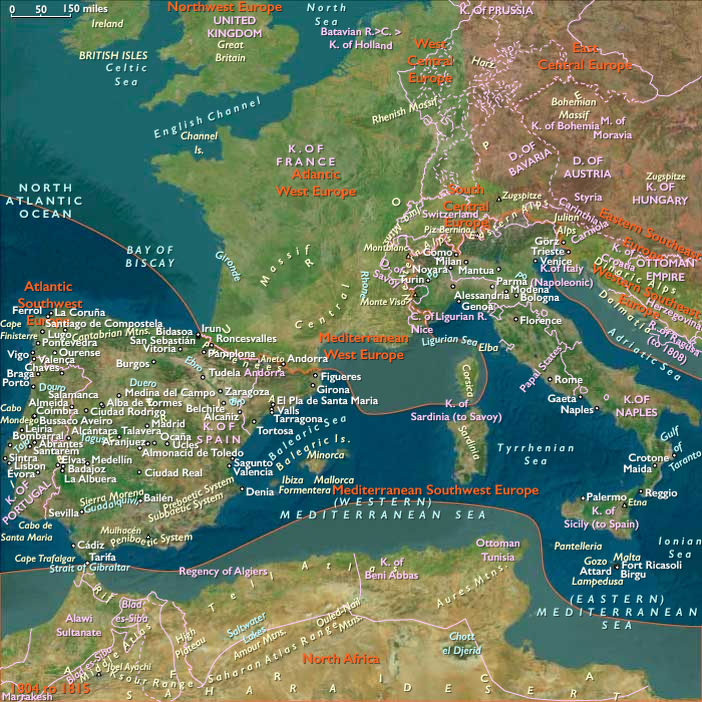
The French Army of Aragon under its …
Years: 1811 - 1811
January
Locations
People
Groups
- Britain (United Kingdom of Great Britain and Ireland)
- France, (first) Empire of
- Spain, Bonapartist Kingdom of
Topics
Subjects
Regions
Subregions
Related Events
Filter results
Showing 10 events out of 21496 total
William Bligh had arrived on October 25, 1810, in London, where he had successfully defended his actions, but he had not been restored to his governorship.
The following year, the trial's presiding officers had sentenced Johnston to be cashiered, a form of disgraceful dismissal that entailed surrendering his commission in the Royal Marines without compensation. (This is a comparatively mild punishment that enables Johnston to return, a free man, to New South Wales, where he can continue to enjoy the benefits of his accumulated private wealth.)
Bligh had received a backdated promotion to Rear Admiral soon after Johnston's trial had concluded.
He will be subjected to court martial twice again during his career.
Periodic drought and floods have alternately stricken the rich rice-producing areas of Korea, causing great famines.
Additionally, the Joseon rulers have hiked the taxes on farm crops and forced the starving peasants to perform more free labor.
As a consequence, anti-government and anti-landlord sentiment boils over into a violent uprising when Hong Gyeong-rae, an impoverished scholar-official, leads the peasants in the north in Pyeongyan Province into an armed rebellion and occupies the region for several months.
The Seoul government dispatches an army.
Johann Salomo Christoph Schweigger proposes the name halogen ("Latin: salt producing") for chlorine in 1811.
Of Kleist's other dramas, Die Hermannsschlacht (1809) is a dramatic work of anti-Napoleonic propaganda, written as Austria and France went to war.
In it he gives vent to his hatred of his country's oppressors.
This, together with the drama The Prince of Homburg (Prinz Friedrich von Homburg oder die Schlacht bei Fehrbellin), which is considered among his best works, will be first published by Ludwig Tieck in Kleist's Hinterlassene Schriften (1821).
Robert Guiskard, a drama conceived on a grand plan, is left a fragment.
Kleist is also a master in the art of narrative, and of his Gesammelte Erzählungen (Collected Short Stories) (1810–1811), Michael Kohlhaas, in which the famous Brandenburg horse dealer in Martin Luther's day is immortalized, is one of the best German stories of its time.
The Earthquake in Chile (Das Erdbeben in Chili) and St. Cecilia, or the Power of Music (Die heilige Cäcilie oder die Gewalt der Musik) are also fine examples of Kleist's story telling as is The Marquise of O (Die Marquise von O.).
His short narratives will influence those of Kafka and the novellas of the Austrian writer, Friedrich Halm.
He also writes patriotic lyrics in the context of the Napoleonic Wars.
Captivated by the intellectual and musical accomplishments of the terminally ill Henriette Vogel, Kleist, who is himself more disheartened and embittered than ever, agrees to do her bidding and die with her, carrying out this resolution by first shooting Vogel and then himself on the shore of the Kleiner Wannsee (Little Wannsee) near Potsdam, on 21, November 1811.
A special volunteer army of several thousand Bulgarians has been formed by 1811 in the hope that Russian success against the Turks will liberate Bulgaria.
The Russians do not aid the Bulgarians directly at this time, but Russia will remain crucial to Bulgarian foreign relations from this time to the late twentieth century.
The Al-Khalifa family, led by joint monarchs, cooperates in 1811 with the Omanis against the Wahabbis, and resumes control of Bahrain.
Ottoman sultan Mahmud III, appalled at the At-Ta'if slaughter and the Saudi capture of the holy cities but preoccupied in other directions, assigns the task of crushing the Wahhabi “heretics” to Muhammad (Mehmet) 'Ali Pasha, the virtually independent viceroy of Egypt.
Acknowledging the sovereignty of the Ottoman Sultan and at his command, Muhammad Ali dispatches an army of twenty thousand men (including two thousand horses) under the command of his son Tusun, a youth of seventeen; the Egyptians land on the Hejaz coast.
By the end of 1811, Tusun has received reinforcements and captured Medina after a prolonged siege.
The Wahhabi sack of Karbala in 1802 had resulted in five thousand deaths and the plundering of the Imam Husayn Shrine; by 1805, the Wahhabis controlled Mecca and Medina.
The Wahhabis also attack Ottoman trade caravans, which interrupts the Ottoman finances.
The Saudi amir has denounced the Ottoman sultan and called into question the validity of his claim to be caliph and guardian of the sanctuaries of the Hejaz.
The Ottoman Empire, suspicious of the ambitious Muhammad Ali, have instructed him to fight the Wahhabis, as the defeat of either would be beneficial to them.
Tensions between Muhammad Ali and his Albanian troops also prompt him to send them to Arabia and fight against the Wahhabi movement, where many die.
Muhammad Ali had been ordered as early as December 1807 by Sultan Mustafa IV to crush the Saudi state, but internal strife within Egypt had prevented him from giving full attention to the Wahhabis.
The Albanians are not able to recapture the holy cities until 1811.
Masséna’s Retreat and the Siege of Almeida and Badajoz (1811)
After the failed French invasion of Portugal (1810–1811) and the stalemate at the Lines of Torres Vedras, Marshal André Masséna was forced to retreat into Spain, suffering heavy losses from starvation, disease, and constant harassment by Anglo-Portuguese forces and guerrillas.
With Wellington’s army now on the offensive, the British and Portuguese pursued the retreating French forces, leading to the sieges of Almeida and Badajoz—two critical border fortresses.
Masséna’s Withdrawal from Portugal
- After months of failing to breach the Torres Vedras defenses, Masséna’s army was starving and losing discipline.
- By March 1811, Masséna had no choice but to withdraw, harassed by Portuguese militias and British troops.
- His army suffered heavy attrition during the retreat, with desertions and guerrilla attacks further weakening his forces.
The Sieges of Almeida and Badajoz (1811)
With the French retreating into Spain, Wellington pursued aggressively, leading to the sieges of two key fortresses on the Portuguese-Spanish border:
-
Siege of Almeida (April–May 1811)
- Almeida was a French-held stronghold on the Portuguese frontier.
- British and Portuguese forces laid siege to it, aiming to drive the French out permanently.
- The French garrison eventually attempted a breakout, leading to a dramatic battle before they were forced to surrender.
-
Siege of Badajoz (May–June 1811)
- Badajoz, a vital fortress in Spain, remained under French control, allowing them to threaten Portugal.
- British forces under Wellington besieged the city, engaging in several bloody assaults.
- Although the siege initially stalled, it set the stage for Wellington’s later, brutal storming of Badajoz in 1812.
Conclusion – The Allies Take the Initiative
- Masséna’s retreat from Portugal marked a turning point in the Peninsular War, as the French were now on the defensive.
- With Almeida and Badajoz under siege, the British-Portuguese army had successfully expelled the French from Portugal and was preparing to take the fight into Spain.
- The failure of the third French invasion of Portugal weakened Napoleon’s grip on Iberia, setting the stage for Wellington’s counteroffensive into Spain in 1812–1813.
This phase of the war marked the beginning of the end for French dominance in the Iberian Peninsula, with the Allies gaining momentum and pushing toward victory.
Years: 1811 - 1811
January
Locations
People
Groups
- Britain (United Kingdom of Great Britain and Ireland)
- France, (first) Empire of
- Spain, Bonapartist Kingdom of