An anti-Frankish reaction led by Ermeniard kills …
Years: 754 - 754
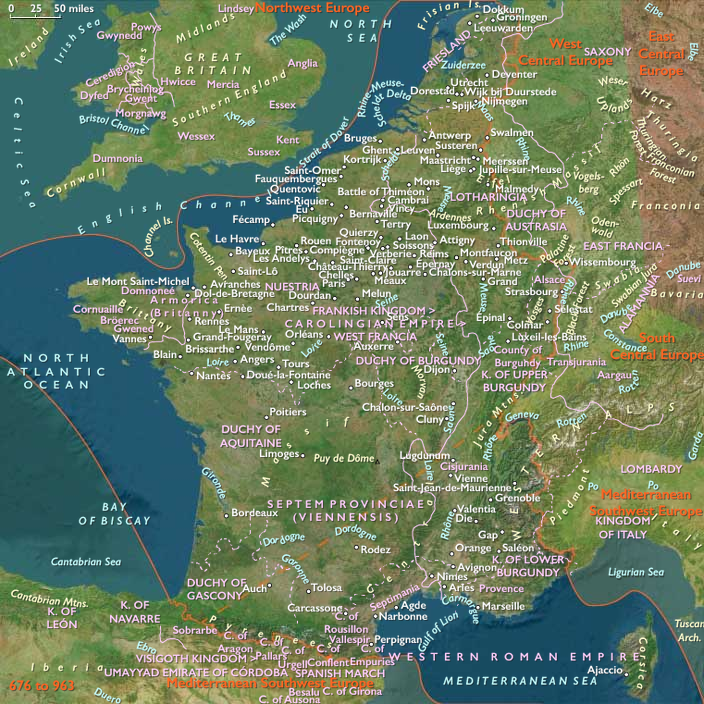
An anti-Frankish reaction led by Ermeniard kills Ansemund in 754, but the rebellion dies without success and one Radulf is designated as the new count by the Frankish king.
Locations
People
Groups
Topics
Commodoties
Subjects
Regions
Subregions
Related Events
Filter results
Showing 10 events out of 55245 total
The Tang government sends another Tang army against Nanzhao in 754, this time from the north, but it too is defeated, and the Tang will be unable to send another expedition due to the outbreak of the Anshi Rebellion in the following year.
Constantine's convocation, in 754, of a synod of bishops for the purpose of continuing and intensifying the policy of iconoclasm begun by his father, Leo III, further weakens the ties between Constantinople and Rome.
Constantine's position on Iconoclasm is clear: ...He cannot be depicted. For what is depicted in one person, and he who circumscribes that person has plainly circumscribed the divine nature which is incapable of being circumscribed. (Nikephoros, Antiherreticus I, P. 100, 301C; trans. Bryer & Herrin)
Constantine convenes a synod in February 754 at Hieria, which is attended entirely by Iconoclast bishops.
The council approves of Constantine's religious policy and secures the election of a new Iconoclast patriarch, but refuses to follow in all of Constantine's views.
The council confirms the status of Mary as Theotokos, or Mother of God, reinforces the use of the terms "saint" and "holy" as meet, and condemns the desecration, burning, or looting of churches in the quest to quench Iconophiles.
Abu al-'Abbas as-Saffah dies in 754, after only five years as caliph; the main burden of establishing the 'Abbasid caliphate thus falls upon his brother Abu Jafar al-Mansur.
Al-Mansur becomes the second caliph of the Abbasid dynasty and leader of the Asian and eastern Mediterranean Muslim community.
The Abbasid rulers reassert the theocratic concept of the caliphate and continuity with orthodox Islam as the foundation for unity and authority in the empire.
Abbasid leadership also renders Islam and the fruits of power accessible to non-Arabs; Iranians become prominent in the new caliphal government and administration.
Al-Mansur faces opposition, however, from Iran and from the Shiite Muslim sect.
Al-Mansur is largely responsible for cutting the 'Abbasids free from the movement that has brought them to power, and is involved in the murder of several leading personalities in that movement.
A danger to al-Mansur's caliphate comes from a number of revolts by ambitious army commanders.
The most serious of these is the revolt in 754 of al-Mansur's uncle, 'Abd Allah, who thinks he has better claims to the caliphate than his nephew.
The danger is only averted with the help of Abu Muslim.
Although the 'Abbasid's enthronement was largely due to Abu Muslim's military victories and political prowess, they have quickly become leery of a vassal with so much power and popularity.
With the accession of the morbidly suspicious al-Mansur, Abu Muslim's downfall is sealed.
After having Abu Muslim quell an uprising led by a rebellious uncle, al-Mansur strips away the governorship of Khorasan from him.
When Abu Muslim arrives at court, al-Mansur has him treacherously put to death, thus eliminating a potential rival for the throne.
The unavenged death of Abu Muslim, already a legendary hero to the population, inspires many later uprisings and revolts.
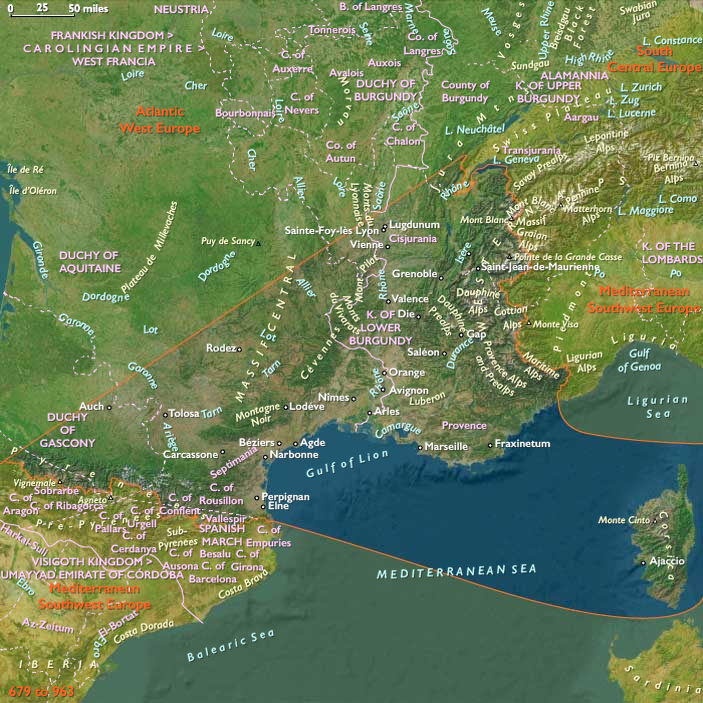
Not much is known of Waifer of Aquitaine for the first decade after accession to the ducal office, but there is a general standoff in the confrontation with the Frankish Pepin the Short.
Circa 754, we find Waifer attacking Pepin on his siege of Narbonne with an army of Basques.
The region that comes to be called the Papal States becomes a separate polity in 754.
The Reconsecration of Pepin and the Birth of the Papal States (754)
On January 6, 754, fulfilling his part of the Frankish-papal alliance, Pope Stephen II reconsecrates Pepin the Shortas King of the Franks in a lavish ceremony at the Basilica of St. Denis in Paris. This marks the first time a pope personally anoints a Frankish ruler, reinforcing Pepin’s legitimacy and further breaking ties between the Frankish kingdom and the Byzantine Empire.
The Title of Patricius Romanorum
During the ceremony, Stephen bestows upon Pepin the additional title of Patricius Romanorum (Patrician of the Romans). This title, traditionally associated with Byzantine-appointed governors in Italy, now signals Pepin’s role as the protector of Rome and the papacy—a function previously performed by the Eastern Roman Empire, but now assumed by the Franks due to Byzantium’s inability to defend the papal territories from the Lombards.
The Donation of Pepin and Its Lasting Impact
Pepin’s military commitment to reclaiming land from the Lombards, known as the Donation of Pepin, soon strengthens the claim of the popes to the de facto core of the Papal States. This agreement formally transfers former Byzantine territories in central Italy to papal control, laying the groundwork for a territorially independent Papal States that will endure for over a millennium.
However, this also creates an unintended consequence:
- The increased power of the popes as secular rulers invites Frankish and later imperial interference in papal elections, as rulers seek to control the selection of the pope to ensure he aligns with their political interests.
- The papacy’s growing reliance on the Franks deepens the West’s separation from Byzantium, setting the stage for the eventual rupture between the Latin and Greek churches.
Thus, the events of 754 mark a fundamental shift in European politics, strengthening Carolingian rule, securing papal independence, and redefining Frankish-papal relations—a dynamic that will shape medieval Europe for centuries to come.
Boniface’s Final Mission and Martyrdom (752–754)
By 752, Boniface, the Archbishop of Mainz and the leading missionary in the Frankish world, resigns his bishopric to return to active missionary work. Having spent decades Christianizing the Germanic tribes under Frankish protection, he now turns his attention once more to Frisia, a region still resistant to both Frankish rule and Christian conversion.
In 754, while traveling near Dokkum, in present-day Friesland (Netherlands), Boniface and his companions are ambushed by a Frisian mob. Despite his efforts to peacefully convert the local population, he and his entire retinue are slaughtered. According to tradition, Boniface refuses to take up arms in self-defense, meeting his fate as a martyr.
The Apostle of Germany and His Posthumous Fame
Following his death, Boniface is revered as the "Apostle of Germany", recognized for his role in firmly establishing Christianity among the Germanic tribes. His missionary efforts, combined with his reforms of the Frankish Church, ensure that his legacy endures far beyond his lifetime.
His remains are interred at Fulda, the monastery he founded, which becomes a major spiritual and educational center in the Carolingian world. Over time, Boniface’s martyrdom reinforces the idea of Christian sacrifice and missionary zeal, cementing his status as one of the most important figures in the Christianization of medieval Europe.
A number of revolts break out in caliphal territory in which some of the pre-Islamic religions of Iran are involved.
These are perhaps in reaction to the 'Abbasids' policy of disassociation from their “extremist” supporters.
In 755 in Khorasan, a certain Sunpadh, described as a magi (here probably meaning a follower of the Mazdakite heresy, not an orthodox Zoroastrian), revolts, demanding vengeance for the murdered Abu Muslim, his close friend.
Sunpadh also preaches a syncretism melding Islam and Zoroastrianism.
In combination with his unusual and heretical vow to advance towards the Hejaz and raze the Ka’aba, this leads to the belief that he was in fact a Zoroastrian, rather than a Muslim.
The enraged Sunpadh swears to march on Mecca and destroy the Kaaba.
Sunpadh further preaches that "Abu Muslim has not died, and when Mansur meant to slay him, he chanted God's great name, turned into a white dove and flew away. Now he is standing with Mahdi and Mazdak in a castle of copper and they shall emerge by and by."
His doctrine receives wide support among Persian Shi'i Muslims, Zoroastrians and Mazdakites and revolts occurre in Ray, Herat and Sistan.
Within only seventy days, Sunpadh's forces are however defeated by one of Caliph al-Mansur's generals, Juhar ibn Murad.
Sunpadh then flees to Khurshid of Tabaristan, but there he is murdered by one of Khurshid's cousins, because he had failed to show the man proper respect.
Constantinople’s successes in the east make it possible to pursue an aggressive policy in the Balkans, where the Bulgarians now dominate Thrace.
With the resettlement of Christian populations from Armenia and Syrian into Thrace, Constantine aims to enhance the prosperity and defense of the area, causing concern to the Empire's northern neighbor, Bulgaria, and leading the two states to clash in 755.
The reign of Kormisosh inaugurates a prolonged period of war with the Empire.
Kormisosh demands the payment of tribute, perhaps constituting an increase in the traditional payments.
Rebuffed, Kormisosh raids into Thrace, reaching the Anastasian Wall stretching between the Black Sea and the Sea of Marmara forty kilometers in front of Constantinople.
Constantine marches out with his army, defeats the Bulgarians and turns them to flight.
Abd al-Rahman and Bedr reach modern day Morocco near Ceuta.
Their next step will be to cross the sea to al-Andalus, where Abd al-Rahman cannot have been sure whether or not he would be welcomed.
Following the Berber Revolt of the 740s, the province is in a state of confusion, with the Muslim community torn by tribal dissensions among the Arabs and racial tensions between the Arabs and Berbers.
At this moment, the nominal ruler of al-Andalus, emir Yusuf ibn 'Abd al-Rahman al-Fihri (another member of the Fihrid family, and a favorite of the old Arab settlers (baladiyun), mostly of south Arabian or 'Yemenite' tribal stock) is locked in a contest with his vizier (and son-in-law) al-Sumayl ibn Hatim al-Qilabi, the head of the new settlers (shamiyum, the Syrian junds or military regiments, mostly of north Arabian Qaysid tribes, which had arrived only in 742).
Among the Syrian junds are contingents of old Umayyad clients, numbering perhaps five hundred, and Abd al-Rahman believes he might tug on old loyalties and get them to receive him.
Bedr is dispatched across the straits to make contact.
Bedr manages to line up three Syrian commanders—Obeid Allah ibn Uthman and Abd Allah ibn Khalid, both originally of Damascus, and Yusuf ibn Bukht of Qinnasrin.
The trio approach the Syrian arch-commander al-Sumayl (at this time in Zaragoza) to get his consent, but al-Sumayl refuses, fearing Abd al-Rahman will try to make himself emir.
As a result, Bedr and the Umayyad clients send out feelers to their rivals, the Yemenite commanders.
Although the Yemenites are not natural allies (the Umayyads are a Qaysid tribe), their interest is piqued.
The emir Yusuf al-Fihri has proven himself unable to keep the powerful al-Sumayl in check and several Yemenite chieftains feel their future prospects are poor, whether in a Fihrid or Syrian-dominated Spain, that they have a better chance of advancement if they hitch themselves to the glitter of the Umayyad name.
Although the Umayyads do not have a historical presence in the region (no member of the Umayyad family is known to have ever set foot in al-Andalus before) and there are grave concerns about young Abd al-Rahman's inexperience, several of the lower-ranking Yemenite commanders feel they had little to lose and much to gain, and agree to support the prince.
Bedr returns to Africa to tell Abd al-Rahman of the invitation of the Umayyad clients in al-Andulus.
Shortly thereafter, they set off with a small group of followers for Europe.
When some local Berber tribesmen learn of Abd al-Rahman's intent to set sail for al-Andalus, they quickly ride to catch up with him on the coast.
The tribesmen might have figured that they could hold Abd al-Rahman as hostage, and force him to buy his way out of Africa.
He does indeed hand over some amount of dinars to the suddenly hostile local Berbers.
Just as Abd al-Rahman launches his boat, another group of Berbers arrives.
They also try to obtain a fee from him for leaving.
One of the Berbers holds on to Abd al-Rahman's vessel as it makes for al-Andalus, and allegedly has his hand cut off by one of the boat's crew.