
Gregory of Neocaesarea holds a very prominent …
Years: 239 - 239
Gregory of Neocaesarea holds a very prominent place among those bishops of Asia Minor in high positions who build up the Christian Church, extend its influence, and strengthen its institutions.
Gregory Thaumaturgus was born at Neo-Caesarea (the capital of Pontus in Asia Minor) around 213.
Little is known of his pastoral work, and his surviving theological writings are in an incomplete state.
This lack of knowledge partially obscures his personality, despite his historical importance, and his immemorial title Thaumaturgus, "the wonder-worker" in Latinized Greek, casts an air of legend about him.
Nevertheless, the lives of few bishops of the third century are so well authenticated; the historical references to him permit a fairly detailed reconstruction of his work.
Originally he was known as Theodore ("gift of God"), not an exclusively Christian name.
His family had not converted to Christianity, and he was introduced to the Christian religion only at the age of fourteen, after the death of his father.
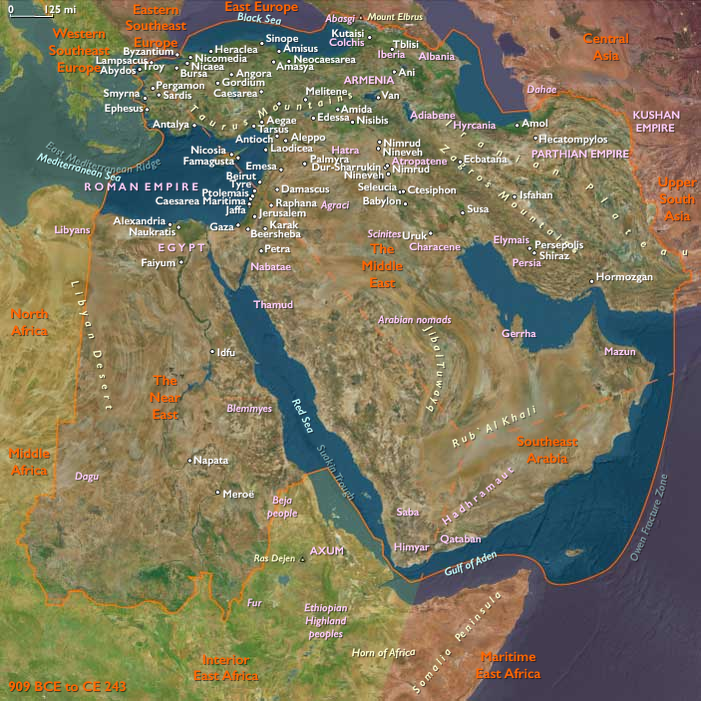
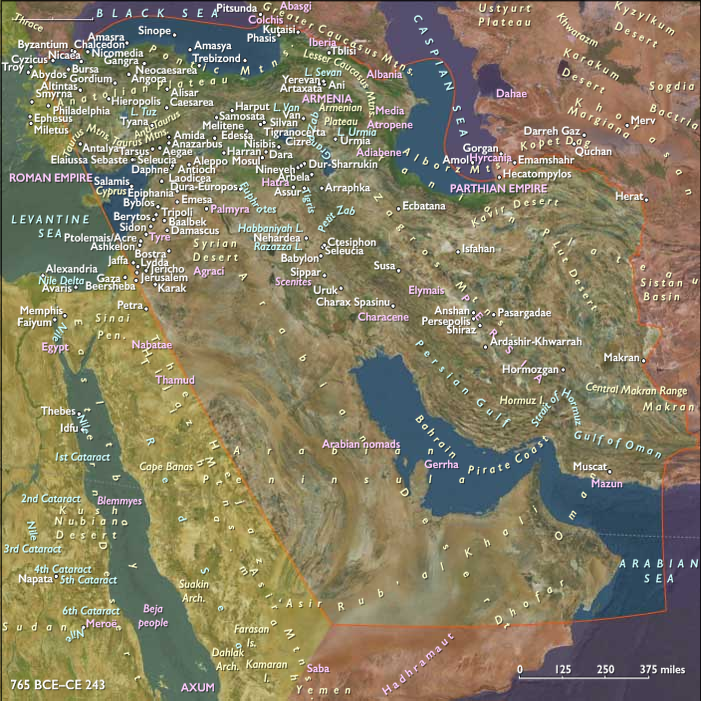
He had a brother Athenodorus, and on the advice of one of their tutors, the young men were eager to study law at the law-school of Berytus (Beirut), at this time one of the four or five famous schools in the Hellenic world.
Their brother-in-law had recently been appointed assessor (legal counsel) to the Roman Governor of Palestine; the youths had therefore an occasion to act as an escort to their sister as far as Caesarea in Palestine.
On arrival in that town, they had learned that the celebrated scholar Origen, head of the Catechetical School of Alexandria, resided there.
Soon both youths had forgotten all about Beirut and Roman law, and had given themselves up to the great Christian teacher, who gradually won them over to Christianity.
It may be supposed that despite the original abandonment of Beirut and the study of Roman law, Gregory had not entirely given up the original purpose of his journey to the East; as a matter of fact, he returns to Pontus seven or eight years later with the intention of practicing law.
His plan, however, is again laid aside, for he is soon consecrated bishop of his native Caesarea by Phoedimus, Bishop of Amasea and metropolitan of Pontus.
This fact illustrates in an interesting way the growth of the hierarchy in the primitive Church; the Christian community at Caesarea is very small, being only seventeen souls, and yet it is given a bishop.
Ancient canonical documents indicate that it was possible for a community of even ten Christians to have their own bishop.
When Gregory was consecrated he was forty years old, and he will rule his diocese for thirteen years.
Locations
People
Groups
Topics
Commodoties
Subjects
Regions
Subregions
Related Events
Showing 10 events out of 60529 total
Years: 239 - 239
Locations
People
Groups
Topics
Commodoties
Subjects
Regions
Subregions