
Many of the Roman provinces, graced with …
Years: 16BCE - 16BCE
Many of the Roman provinces, graced with new temples, are among the beneficiaries of the Augustan building boom.
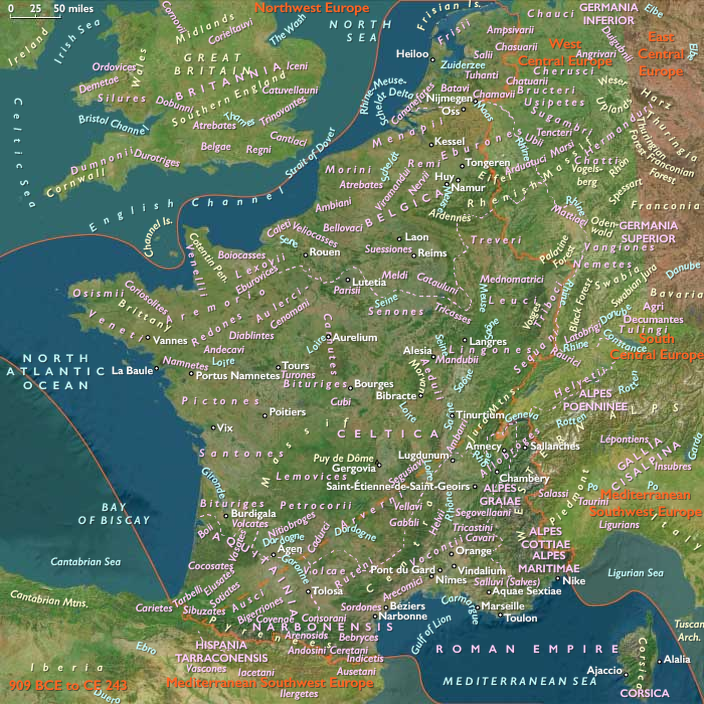
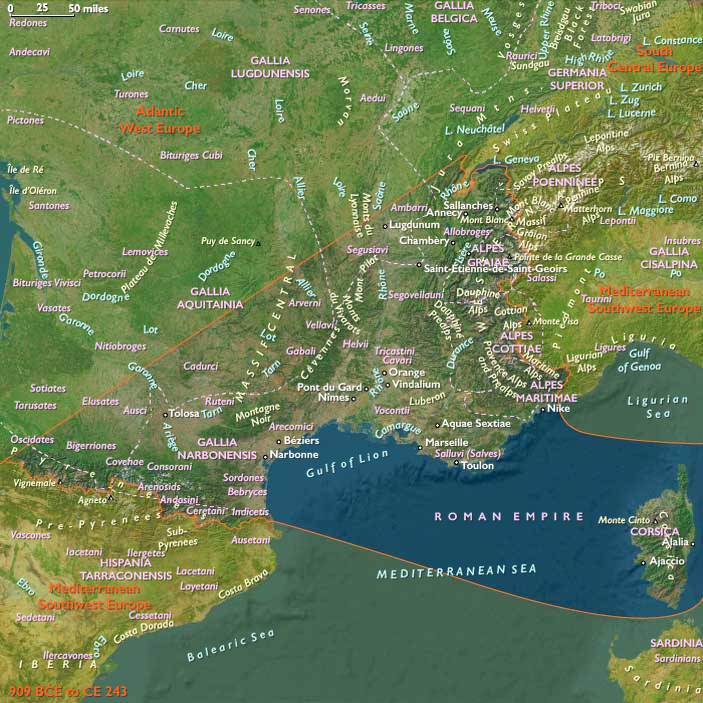
Agrippa donates to the city of Nîmes in 16 the Maison Carrée ("square house"), a hellenized Etrusco-Roman structure with six Corinthian columns under the Pediment at either end.
It is pseudoperipteral in that twenty engaged columns are embedded along the walls of the cella.
Above the columns, the architrave is divided by two recessed rows in three levels with ratios of 1:2:3.
Egg-and-dart decoration divides the architrave from the frieze.
The frieze is decorated with fine ornamental relief carvings of rosettes and acanthus leaves beneath a row of very fine dentils.
Raised on a 2.85 meter-high podium, the temple dominates the forum of the Roman city, forming a rectangle almost twice as long as it is wide, measuring 26.42 meters by 13.54 meters.
The façade is dominated by a deep portico or pronaos almost a third of the building's length.
A large door (6.87 meters high by 3.27 meters wide) leads to the surprisingly small and windowless interior, where the shrine was originally housed.
The temple owes its preservation to the fact that it was rededicated as a Christian church in the fourth century, saving it from the widespread destruction of temples that followed the adoption of Christianity as Rome's official state religion.
It subsequently became a meeting hall for the city's consuls, a canon's house, a stable for government-owned horses during the French Revolution and a storehouse for the city archives.
It became a museum after 1823.
Its French name derives from the archaic term carré long, literally meaning a "long square", or oblong—a reference to the building's shape.
The Maison Carrée is today one of the best preserved temples to be found anywhere in the territory of the former Roman Empire.
Locations
People
Groups
Topics
Commodoties
Subjects
- Commerce
- Architecture
- Environment
- Labor and Service
- Decorative arts
- Style
- Conflict
- Faith
- Government
- Technology
Regions
Subregions
Related Events
Showing 10 events out of 62154 total
Years: 16BCE - 16BCE
Locations
People
Groups
Topics
Commodoties
Subjects
- Commerce
- Architecture
- Environment
- Labor and Service
- Decorative arts
- Style
- Conflict
- Faith
- Government
- Technology
Regions
Subregions