
'Amman, located about twenty-five miles (forty kilometers) …
Years: 6525BCE - 6382BCE
'Amman, located about twenty-five miles (forty kilometers) north of the Dead Sea, will be inhabited by several civilizations throughout history.
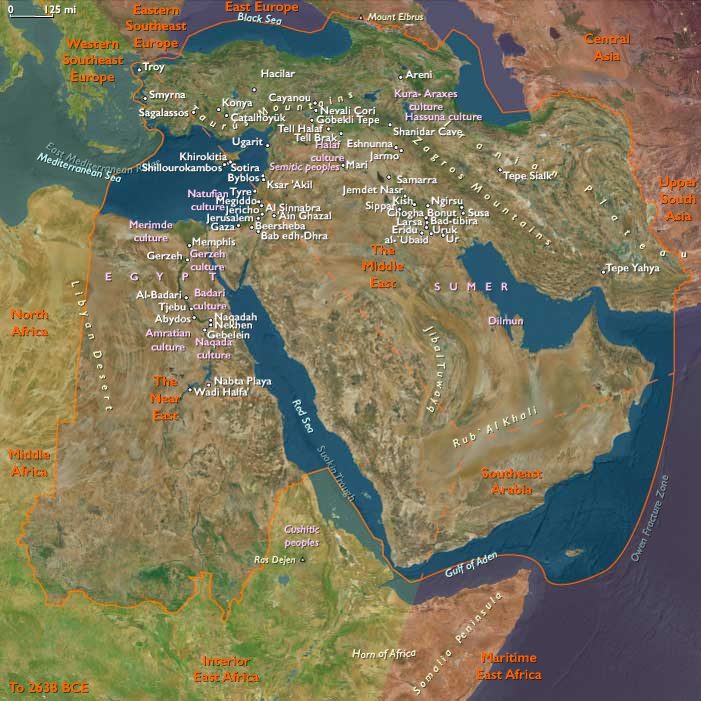
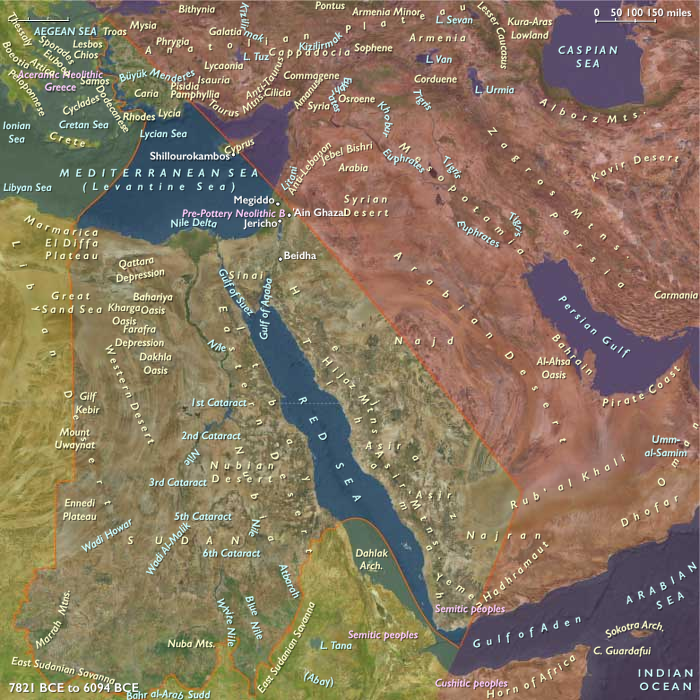
The first civilization on record is during the Late Neolithic period, around 6500 BCE, when archaeological discoveries in 'Ain Ghazal, located in eastern 'Amman, show evidence of not only a settled life but also the growth of artistic work, which suggests that a well-developed civilization inhabits the city at this time.
'Ain Ghazal people bury some of their dead beneath the floors of their houses, others outside in the surrounding terrain.
Of those buried inside, often later the head is retrieved and the skull buried in a separate shallow pit beneath the house floor.
Also, many human remains have been found in what appears to be garbage pits, where domestic waste was disposed, indicating that not every deceased was ceremoniously put to rest.
Why only a small, selected portion was properly buried and the majority just disposed of, remains unresolved.
'Ain Ghazal is renowned for a set of anthropomorphic statues found buried in pits in the vicinity of some special buildings that may have had ritual functions.
These statues are half-size human figures modeled in white plaster around a core of bundled twigs.
The figures have painted clothes, hair, and in some cases, ornamental tattoos or body paint.
The eyes are created using cowrie shells with a bitumen pupil.
In all, thirty-two of those plaster figures were found in two caches, fifteen of them full figures, fifteen busts, and two fragmentary heads.
Three of the busts were two-headed, the significance of the two-headed statues is not clear.
Locations
Groups
Topics
Subjects
Regions
Subregions
Years: 6525BCE - 6382BCE
Locations
Groups
Topics
Subjects
Regions
Subregions