
Americans had rushed to the gold strike …
Years: 1898 - 1898
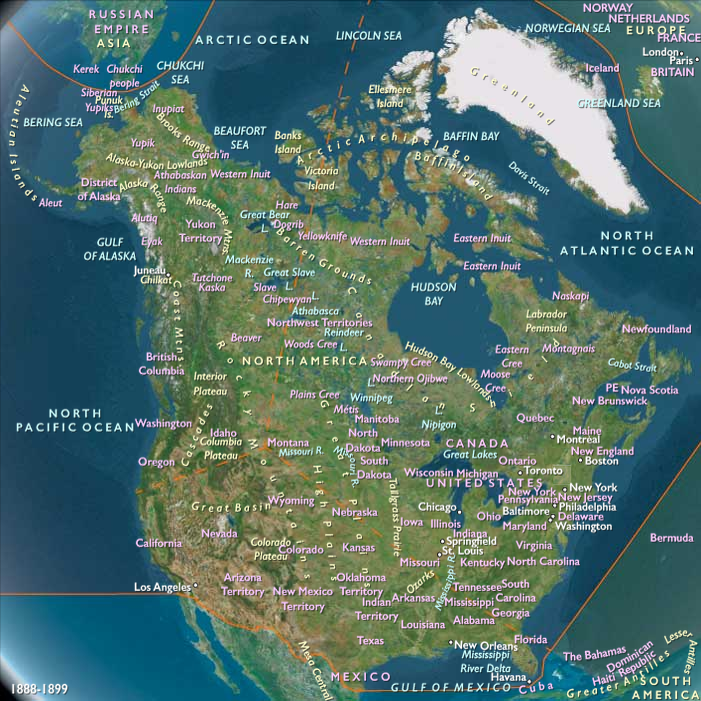
Americans had rushed to the gold strike in the Yukon Territory’s Klondike region in 1897.
Gold had been discovered there by local miners on August 16, 1896, and, when news reaches Seattle and San Francisco the following year, it triggers a stampede of prospectors.
Some will become wealthy, but the majority will go in vain.
The Klondike Gold Rush will be immortalized in popular culture, e.g., in artifacts, films, games, literature, and photographs.
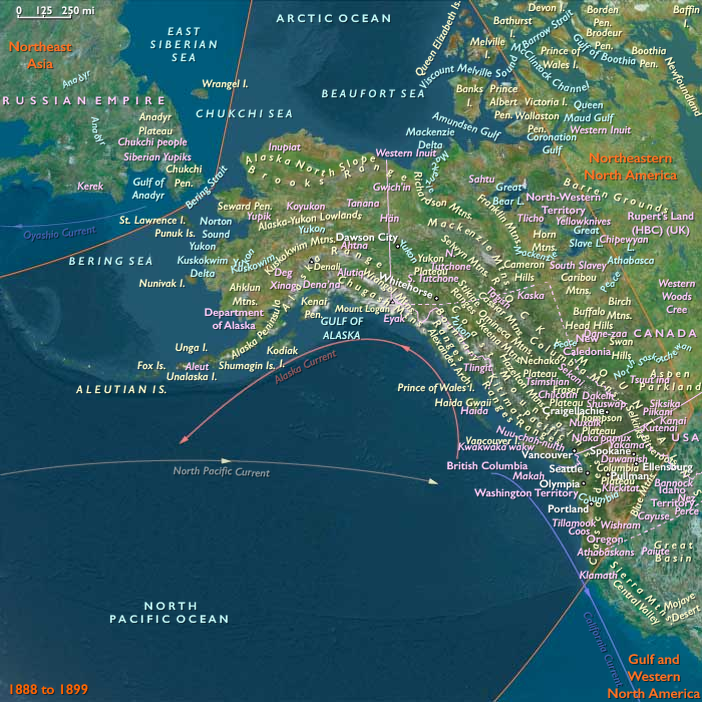
To reach the gold fields, most prospectors take the route through the ports of Dyea and Skagway, in Southeast Alaska.
Here, the Klondikers can follow either the Chilkoot or the White Pass trails to the Yukon River, and sail down to the Klondike.
The Canadian authorities require each of them to bring a year's supply of food, in order to prevent starvation.
In all, the Klondikers' equipment weighs close to a ton, which most carry themselves, in stages.
Performing this task, and contending with the mountainous terrain and cold climate, means those who persist do not arrive until summer 1898.
Once there, they find few opportunities, and many leave disappointed.
Mining is challenging, as the ore is distributed unevenly, and permafrost makes digging slow.
Consequently, some miners choose to buy and sell claims, build up huge investments, and let others do the work.
To accommodate the prospectors, boom towns spring up along the routes.
At their terminus, Dawson City is founded at the confluence of the Klondike and the Yukon Rivers.
From a population of five hundred in 1896, the town grows to house approximately thirty thousand people by summer 1898.
Built of wood, isolated, and unsanitary, Dawson suffers from fires, high prices, and epidemics.
Locations
Groups
Topics
Commodoties
Subjects
Regions
Subregions
Related Events
Showing 10 events out of 9205 total
Years: 1898 - 1898
Locations
Groups
Topics
Commodoties
Subjects
Regions
Subregions