
Amenhotep III had maintained extensive diplomatic contacts …
Years: 1353BCE - 1342BCE
Amenhotep III had maintained extensive diplomatic contacts with other Near Eastern states, especially Mitanni and Babylonia.
His humbly born wife Tiye, his Chief Queen, had been prominently associated with him during his long and peaceful reign over the Egyptian empire (now at its most powerful).
The couple’s younger son, who had not originally been designated as the successor to the throne until the untimely death of his older brother, Thutmose, had in 1353 or 1351 BCE succeeded his father as Amenhotep IV after the latter’s death at the end of his thirty-eight-year reign, possibly after a coregency lasting between either one to two or twelve years.
Amenhotep IV soon prohibits the worship of other gods, especially of the state god Amen, or Amon, of Thebes, and institutes Aton, represented by the solar disk, as the only god.
Amenhotep is thus the first to introduce a monotheistic religion.
His form of monotheism is tempered, however, by Amenhotep’s retention of divine status, if secondary to that of Aton, for himself.
His religious reformation appears to have begun with his decision to celebrate a Sed festival in his third regnal year—a highly unusual step, since a Sed-festival, a sort of royal jubilee intended to reinforce the Pharaoh's divine powers of kingship, was traditionally held in the thirtieth year of a Pharaoh's reign.
His Year Five marks the beginning of his construction of a new capital, Akhetaten ('Horizon of Aten'), at the site known today as Amarna.
Amenhotep IV in the same year officially changes his name to Akhenaten ('Effective Spirit of Aten') as evidence of his new worship.
Very soon afterward, he centralizes Egyptian religious practices in Akhetaten, though construction of the city seems to have continued for several more years.
In honor of Aten, Akhenaten also oversees the construction of some of the most massive temple complexes in ancient Egypt, including one at Karnak, close to the old temple of Amun.
In these new temples, Aten is worshipped in the open sunlight, rather than in dark temple enclosures, as had been the previous custom.
Akhenaten is also believed to have composed the Great Hymn to the Aten.
He had originally presented Aten as a variant of the familiar supreme deity Amun-Ra (itself the result of an earlier rise to prominence of the cult of Amun, resulting in Amun becoming merged with the sun god Ra), in an attempt to put his ideas in a familiar Egyptian religious context.
However, by Year Nine of his reign Akhenaten declares that Aten is not merely the supreme god, but the only god, and that he, Akhenaten, is the only intermediary between Aten and his people.
He orders the defacing of Amun's temples throughout Egypt, and in a number of instances inscriptions of the plural 'gods' are also removed.
Akhenaten fosters new styles in Egyptian literature.
Contemporary art exaggerates the physical abnormalities of Akhenaten, portraying the king as having swollen limbs and an elongated head.
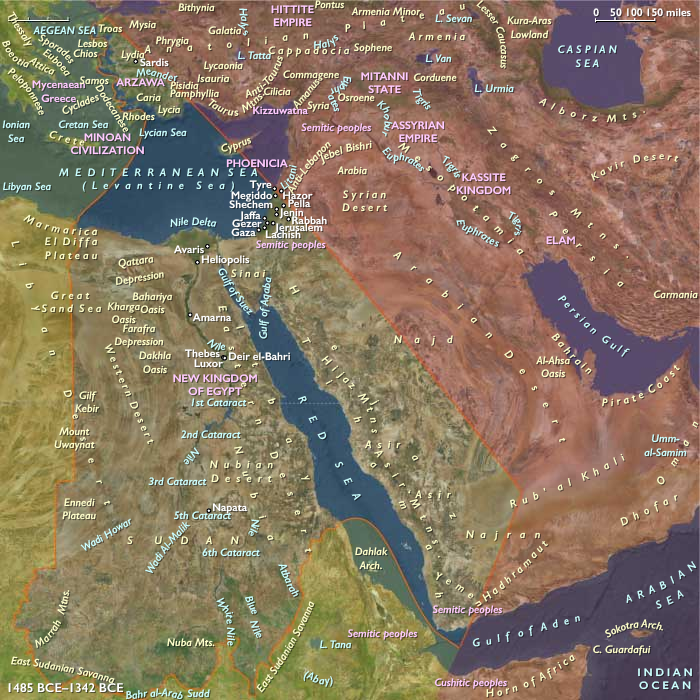
Akhenaten loses Egyptian-held territory in Syria and Canaan but maintains Egypt's status as a great power.
Locations
People
Groups
- Polytheism (“paganism”)
- Canaanite culture, ancient
- Egypt (Ancient), New Kingdom of
- Mitanni (Hanigalbat), Kingdom of
Topics
- Subboreal Period
- Portraits, Ancient Egyptian
- Late Bronze Age I and II A (Near and Middle East)
- Younger Subboreal Period
Subjects
Regions
Subregions
Years: 1353BCE - 1342BCE
Locations
People
Groups
- Polytheism (“paganism”)
- Canaanite culture, ancient
- Egypt (Ancient), New Kingdom of
- Mitanni (Hanigalbat), Kingdom of
Topics
- Subboreal Period
- Portraits, Ancient Egyptian
- Late Bronze Age I and II A (Near and Middle East)
- Younger Subboreal Period
Subjects
Regions
Subregions