
Filters:
Little is known about the original inhabitants …
Years: 1396 - 1539
Little is known about the original inhabitants of the present Ivory Coast.
Historians believe that they were all either displaced or absorbed by the ancestors of the present inhabitants.
The first recorded history is found in the chronicles of North African traders, who, from early Roman times, conducted a caravan trade across the Sahara in salt, slaves, gold, and other items.
The southern terminals of the trans-Saharan trade routes are located on the edge of the desert, and from there supplemental trade extend as far south as the edge of the rain forest.
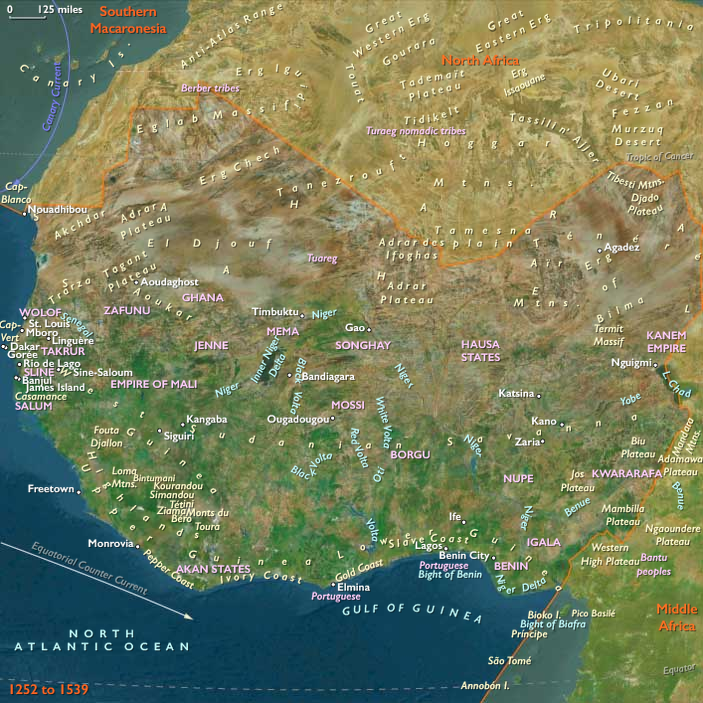
The more important terminals—Djenne, Gao, and Timbuctu—had grown into major commercial centers around which the great Sudanic empires developed.
By controlling the trade routes with their powerful military forces, these empires are able to dominate neighboring states.
The Sudanic empires also become centers of Islamic learning.
Islam had been introduced into the western Sudan by Arab traders from North Africa and spread rapidly after the conversion of many important rulers.
From the eleventh century, by which time the rulers of the Sudanic empires had embraced Islam, it spread south into the northern areas of contemporary Cote d'Ivoire.
Ghana, the earliest of the Sudanic empires, flourished in present-day eastern Mauritania from the fourth to the thirteenth century.
At the peak of its power in the eleventh century, its realms extended from the Atlantic Ocean to Timbuctu.
After the decline of Ghana, the Mali Empire grew into a powerful Muslim state, which reached its apogee in the early part of the fourteenth century.
The territory of the Mali Empire in Cote d'Ivoire is limited to the northwest corner around Odienne.
Its slow decline starting at the end of the fourteenth century follows internal discord and revolts by vassal states, one of which, Songhai, flourishes as an empire between the fourteenth and sixteenth centuries.
Songhai is also weakened by internal discord, which leads to factional warfare.
This discord spurs most of the migrations of peoples southward toward the forest belt.
Historians believe that they were all either displaced or absorbed by the ancestors of the present inhabitants.
The first recorded history is found in the chronicles of North African traders, who, from early Roman times, conducted a caravan trade across the Sahara in salt, slaves, gold, and other items.
The southern terminals of the trans-Saharan trade routes are located on the edge of the desert, and from there supplemental trade extend as far south as the edge of the rain forest.
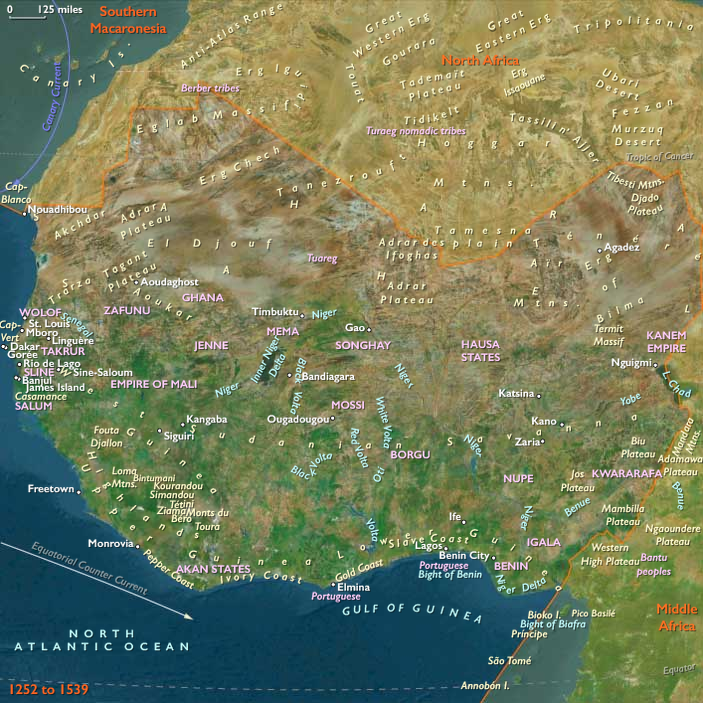
The more important terminals—Djenne, Gao, and Timbuctu—had grown into major commercial centers around which the great Sudanic empires developed.
By controlling the trade routes with their powerful military forces, these empires are able to dominate neighboring states.
The Sudanic empires also become centers of Islamic learning.
Islam had been introduced into the western Sudan by Arab traders from North Africa and spread rapidly after the conversion of many important rulers.
From the eleventh century, by which time the rulers of the Sudanic empires had embraced Islam, it spread south into the northern areas of contemporary Cote d'Ivoire.
Ghana, the earliest of the Sudanic empires, flourished in present-day eastern Mauritania from the fourth to the thirteenth century.
At the peak of its power in the eleventh century, its realms extended from the Atlantic Ocean to Timbuctu.
After the decline of Ghana, the Mali Empire grew into a powerful Muslim state, which reached its apogee in the early part of the fourteenth century.
The territory of the Mali Empire in Cote d'Ivoire is limited to the northwest corner around Odienne.
Its slow decline starting at the end of the fourteenth century follows internal discord and revolts by vassal states, one of which, Songhai, flourishes as an empire between the fourteenth and sixteenth centuries.
Songhai is also weakened by internal discord, which leads to factional warfare.
This discord spurs most of the migrations of peoples southward toward the forest belt.
The dense rain forest covering the southern half of the country created barriers to large-scale political organizations as seen farther north.
Inhabitants live in villages or clusters of villages whose contacts with the outside world are filtered through long-distance traders.
Villagers subsist on agriculture and hunting.
Locations
Groups
Topics
Commodoties
Subjects
Regions
Subregions
Years: 1396 - 1539
Locations
Groups
Topics
Commodoties
Subjects
Regions
Subregions