
The year 1760 brings yet more Prussian …
Years: 1760 - 1760
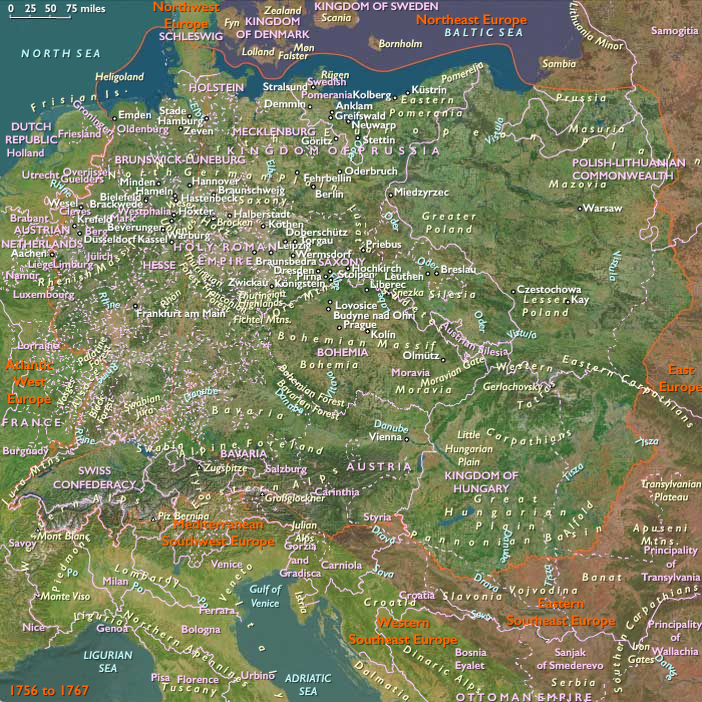
The year 1760 brings yet more Prussian disasters.
The general Fouqué is defeated by the Austrians in the Battle of Landshut.
The French capture Marburg, and the Swedes part of Pomerania.
The Hanoverians are victorious over the French at the Battle of Warburg, their continued success preventing France from sending troops to aid the Austrians against Prussia in the east.
Despite this, the Austrians, under the command of General Laudon, capture Glatz (now Kłodzko, Poland) in Silesia.
In the Battle of Liegnitz, Frederick scores a strong victory despite being outnumbered three to one.
The Russians under General Saltykov and Austrians under General Lacy briefly occupy his capital, Berlin, in October, but cannot hold it for long.
Still, the loss of Berlin to the Russians and Austrians is a great blow to Frederick's prestige as many point out that the Prussians have no hope of occupying temporarily or otherwise St. Petersburg or Vienna.
The end of this year sees Frederick once more victorious, defeating the able Daun in the Battle of Torgau; but he suffers very heavy casualties, and the Austrians retreat in good order.
Meanwhile, after the battle of Kunersdorf, the Russian army has been largely inactive due mostly to their tenuous supply lines.
Russian logistics were so poor that in October 1759, an agreement was signed under which the Austrians undertook to supply the Russians as the quartermaster's department of the Russian Army was badly strained by the demands of Russian armies operating so far from home.
As it is, the requirement that the Austrian quartermaster's department supply both the Austrian and Russian armies proves beyond its capacity, and in practice, the Russians receive little in the way of supplies from the Austrians.
At Liegnitz (now Legnica, Poland), the Russians arrive too late to participate in the battle.
They make two attempts to storm the fortress of Kolberg, but neither succeed.
The tenacious resistance of Kolberg allows Frederick to focus on the Austrians instead of having to split his forces.
The general Fouqué is defeated by the Austrians in the Battle of Landshut.
The French capture Marburg, and the Swedes part of Pomerania.
The Hanoverians are victorious over the French at the Battle of Warburg, their continued success preventing France from sending troops to aid the Austrians against Prussia in the east.
Despite this, the Austrians, under the command of General Laudon, capture Glatz (now Kłodzko, Poland) in Silesia.
In the Battle of Liegnitz, Frederick scores a strong victory despite being outnumbered three to one.
The Russians under General Saltykov and Austrians under General Lacy briefly occupy his capital, Berlin, in October, but cannot hold it for long.
Still, the loss of Berlin to the Russians and Austrians is a great blow to Frederick's prestige as many point out that the Prussians have no hope of occupying temporarily or otherwise St. Petersburg or Vienna.
The end of this year sees Frederick once more victorious, defeating the able Daun in the Battle of Torgau; but he suffers very heavy casualties, and the Austrians retreat in good order.
Meanwhile, after the battle of Kunersdorf, the Russian army has been largely inactive due mostly to their tenuous supply lines.
Russian logistics were so poor that in October 1759, an agreement was signed under which the Austrians undertook to supply the Russians as the quartermaster's department of the Russian Army was badly strained by the demands of Russian armies operating so far from home.
As it is, the requirement that the Austrian quartermaster's department supply both the Austrian and Russian armies proves beyond its capacity, and in practice, the Russians receive little in the way of supplies from the Austrians.
At Liegnitz (now Legnica, Poland), the Russians arrive too late to participate in the battle.
They make two attempts to storm the fortress of Kolberg, but neither succeed.
The tenacious resistance of Kolberg allows Frederick to focus on the Austrians instead of having to split his forces.
People
Groups
Topics
Subjects
Regions
Subregions
Related Events
Showing 10 events out of 26415 total
Years: 1760 - 1760
People
Groups
Topics
Subjects
Regions
Subregions