
Rome’s new calendar is much simpler than …
Years: 8 - 8
Rome’s new calendar is much simpler than the pre-Julian calendar, but the pontifices initially added a leap day every three years, instead of every four.
According to Macrobius, the error was the result of counting inclusively, so that the four-year cycle was considered as including both the first and fourth years; perhaps the earliest recorded example of a fence post error.
After thirty-six years, this has resulted in three too many leap days.
Augustus remedies this discrepancy by restoring the correct frequency.
He also skips three leap days over twelve years in order to realign the year.
Once this reform is complete, intercalation resumes in every fourth year and the Roman calendar is the same as the Julian proleptic calendar.
Ovid, in his beautifully told Metamorphoses, published in this year to immediate popularity, uses Greco-Roman mythology as his material and change as his theme.
He isolates, as the particular agent of change, love, now viewed in its more profound ethical dimensions.
A Latin poem in fifteen books that recounts a series of transformations, largely of humans into animals, plants, and mineral forms, the Metamorphoses range through history from the most distant mythic times to the foundation of the Empire.
Among the most famous of these tales is Apollo's pursuit of Daphne, who becomes a laurel tree; Echo's ill-starred love for the selfish Narcissus, who metamorphoses into a flower; and the hospitality of the devoted elderly couple Baucis and Philemon, who Zeus, in recompense, transforms into interlocking trees.
Ovid had proposed in the Fasti to deal wittily with the events (holidays, national heroes, seasonal changes) suggested by the Roman calendar, devoting one book to each month.
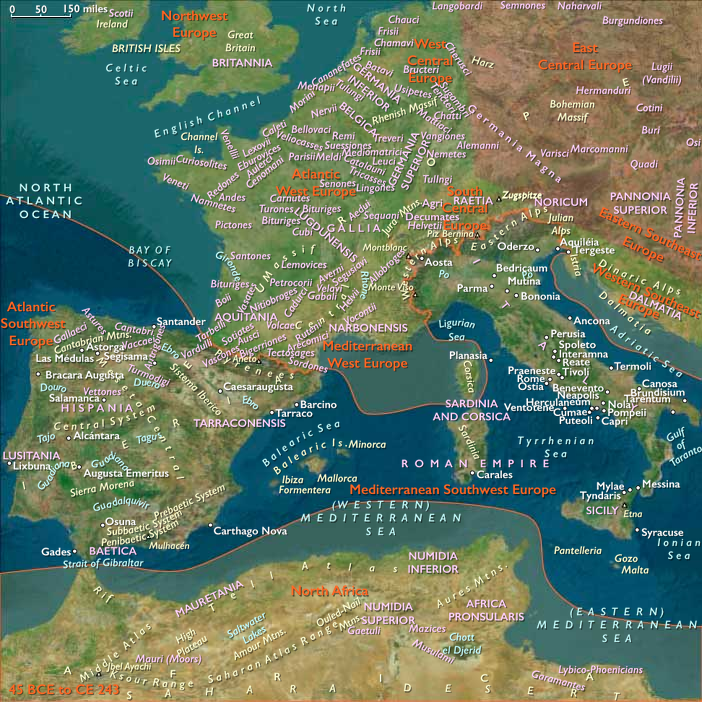
At the height of his success, the prolific 50-year-old poet has completed six of these by CE 9, when Augustus suddenly dispatches him into exile to Tomis, on the Black Sea, without any participation of the Senate or of any Roman judge.
The specific circumstances that have led to this event, which is to shape all of his following poetry, are unclear (remaining so even today); Ovid deliberately obscured them—as did Augustus.
Ovid's writing in the Ars Amatoria (Art of Love) concerns the serious crime of adultery: he may have been banished for these works, which appeared subversive to the emperor's moral legislation.
(The Julian Marriage Laws of 18 BCE promoted monogamous marriage to increase the Roman population's birth rate.)
However, because of the long distance of time between the publication of this work (1 BCE) and the exile (CE 8), some authors suggest that Augustus used the poem as a mere justification for something more personal.
Ovid wrote that the reason for his exile was carmen et error—"a poem and a mistake", claiming that his crime was worse than murder, more harmful than poetry.
The Emperor's grandchildren, Agrippa Postumus and Julia the Younger, are banished around the time of his banishment; Julia's husband, Lucius Aemilius Paullus, is put to death for conspiracy against Augustus, a conspiracy about which Ovid might have known.
Locations
People
Groups
Topics
Commodoties
Subjects
- Commerce
- Writing
- Environment
- Labor and Service
- Conflict
- Mayhem
- Faith
- Government
- Custom and Law
- Technology
- Mythology
Regions
Subregions
Related Events
Showing 9 events out of 9 total
Years: 8 - 8
Locations
People
Groups
Topics
Commodoties
Subjects
- Commerce
- Writing
- Environment
- Labor and Service
- Conflict
- Mayhem
- Faith
- Government
- Custom and Law
- Technology
- Mythology
Regions
Subregions