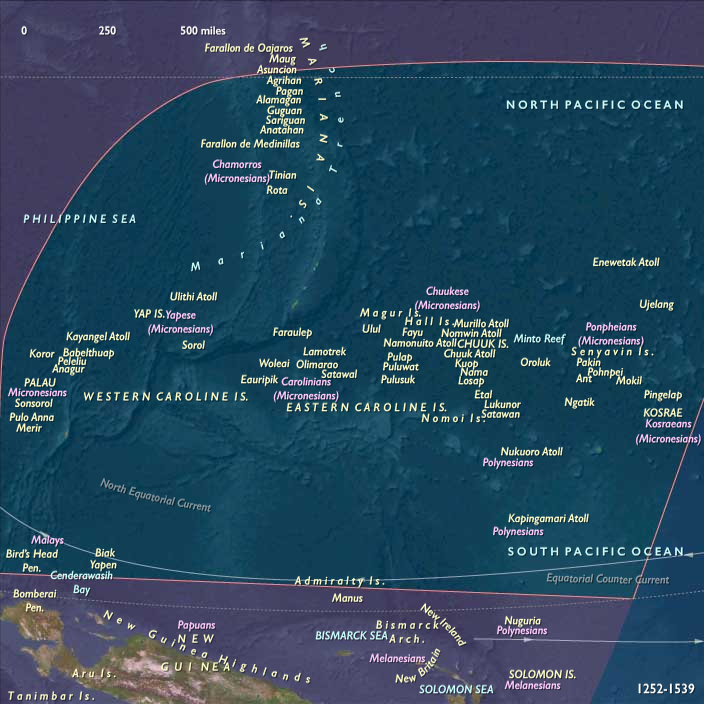
Alonso de Salazar, after just one month …
Years: 1526 - 1526
September
Alonso de Salazar, after just one month of holding the command of the Loaisa expedition, dies of scurvy shortly after having left Guam on September 5, 1526.
Locations
People
Groups
Topics
- Age of Discovery
- Colonization of the Americas, Spanish
- Colonization of Asia, Spanish
- Colonization of Oceania, European
- Loaísa expedition
Commodoties
Subjects
Regions
Subregions
Related Events
Filter results
Showing 10 events out of 38363 total
Three of the seven ships comprising Spain’s second spice-buying expedition to the East Indies had not make it through the Straits of Magellan, and a typhoon had scattered the four survivors upon their emergence into the Pacific.
One ship will eventually end up on the Pacific Coast of what will soon be organized as New Spain (Mexico); another has disappeared; The third ship, Santa María del Parral, has sailed the Pacific to Sangir off the northern coast of Sulawesi, where the ship is beached and its crew are variously killed or enslaved by the natives.
Four survivors will be rescued in 1528 by another Spanish expedition coming from Mexico.
The flagship of the decimated Loaísa expedition, the Santa Maria del Victoria, survives to complete its mission, reaching the islands of Visayas and Mindanao in the Philippines and the Moluccas, but its latest commander, one Yñigez, dies of food poisoning.
Only Andrés de Urdaneta and twenty other men survive to land in the Spice Island of Tidore, only to be taken prisoner by the Portuguese.
Yedisan, the western part of the Wild Fields that sprawl to the north of the Black Sea between the Dniester and Dnieper rivers, is east of Budjak and Bessarabia, south of Podolia and Zaporizhia, and west of Taurida.
The region is named for the Yedisan sept of the Nogai Horde As "Yedisan" is Turkic for "Seven Titles", doubtless the sept was made up of seven subgroups.
Yedisan is also sometimes referred to as Ochakov Tartary after Ochakov (Ochakiv), the main fortress of the region.
In the early medieval period, Yedisan was home to Ulichs, Pechenegs, and later Cumans (Polovtsians).
Following the Mongol invasions of the thirteenth century it was under control of the Khanate of the Golden Horde.
In the fifteenth century it had fallen to the Grand Duchy of Lithuania (when it was known as Dykra), and in 1526 falls to the Ottoman Empire’s vassal state, the Crimean Khanate.
Olaus Petri, born Olof Persson in Örebro in south-central Sweden to a local blacksmith, had learned to read and write at the local Carmelite monastery.
He then went to the capital and studied at the University of Uppsala, where he read theology and German.
Later, he attended the University of Leipzig until 1516, and finally finished his education and received a Master's degree at the University of Wittenberg in February 1518.
While in Wittenberg with his younger brother Lars, Olaus had met with and had been influenced by the main characters of the German reformation, Philipp Melanchthon and Martin Luther.
Both Petri brothers had returned to Sweden in 1519, nearly dying as their ship ran aground on Gotland island during a storm.
They had remained on Gotland for a while, with Olaus preaching and assisting the local priest, Soren Norby, and Lars teaching at the local school.
In 1520, Olaus had returned to Strängnäs on the mainland, accepting ordination as a deacon and serving bishop Mattias Gregersson Lilje as secretary, chancellor of the Diocese of Strängnäs, canon of the Strängnäs Cathedral and dean of the cathedral school.
Olaus had accompanied his mentor, Bishop Gregersson, to Stockholm and attended the tumultuous crowning of Danish King Christian II, who had captured Stockholm and held it for about a year until returning to Denmark, where he was soon deposed and replaced by his uncle, who became King Frederick I of Denmark.
Meanwhile, at the notorious Stockholm Bloodbath in early November, King Christian violated his promises of a general amnesty for the Sture party, and during the post-coronation festivities arrested and executed 80-90 churchmen and secular Swedish nobles, including Bishop Gregersson.
When Olaus expressed his outrage, he was nearly executed as well, but a German who had seen him in Wittenberg identified Olaus as a fellow German and thus saved his life.
King Christian tried to appoint his friend, Odense's bishop Jens Andersen Beldenak, to the now-vacant Strängnäs bishopric, but both Danes soon returned to Denmark, and the scholar-priest Laurentius Andreae, who had been named archdeacon in 1520, ran the diocese.
The massacre had provoked the Swedish War of Liberation, including the election and crowning of Gustav Vasa as King in Strängnäs in 1523.
Olaus (whose father died in 1521, after which he and his brother joined the insurgents under Vasa's leadership) had attended the coronation, sworn fealty to his monarch, and soon became the kingdom's chancellor.
A year later Olaus had been appointed Stockholm's town secretary and moved to the new capital, where he has also served as a judge (despite lack of specific legal training), and town councilor.
Olaus has become known for his advocacy of Lutheranism and criticism of prevailing Roman Catholicism.
In October 1524, the Uppsala Cathedral's chapter had excommunicated both brothers on grounds of heresy.
They remain, however, confident in the new Swedish king's strong support.
In 1525 Olaus had married, as Lutheran practice permitted, and also implemented another of Luther's ideas by having the mass sung in Swedish for the first time.
Throughout this period Olaus has als been involved in scholarly endeavors, including translating Lutheran works into Swedish.
In 1526, Olaus publishes the first Swedish translation of the New Testament, also publishing a catechism in Swedish.
His translation is of vital importance to the development of the Swedish language.

Lucas Cranach the Elder, whose earlier paintings—for example, the Torgau Altarpiece and Reclining Nymph—display influences of Quentin Massys and Jan Gossaert, as well as of Flemish and Italian Renaissance artists, in 1520 adopts a delicate, curvilinear style, derived form late Gothic Mannerism.
Cranach is the court painter to the electors of Saxony in Wittenberg, an area in the heart of the emerging Protestant faith.
His patrons are powerful supporters of Martin Luther, and Cranach uses his art as a symbol of the new faith.
Cranach makes numerous portraits of Luther, and provides woodcut illustrations for Luther's German translation of the Bible.
Somewhat later the duke confers on him the monopoly of the sale of medicines at Wittenberg, and a printer's patent with exclusive privileges as to copyright in Bibles.
Cranach's presses are used by Martin Luther.
His apothecary shop will be open for centuries, and will only be lost by fire in 1871.
Apparently a champion of the Reformation, Cranach creates woodcuts attacking the papacy, such as “The Pope in Hell,’ a caricature executed in 1521.
Like his patron, Cranach is friendly with the Protestant Reformers at a very early stage; yet it is difficult to fix the time of his first meeting with Martin Luther.
The oldest reference to Cranach in Luther's correspondence dates from 1520.
In a letter written from Worms in 1521, Luther calls him his "gossip", warmly alluding to his "Gevatterin", the artist's wife.
Cranach first made an engraving of Luther in 1520, when Luther was an Augustinian friar; five years later, Luther renounced his religious vows, and Cranach had been present as a witness at the betrothal festival of Luther and Katharina von Bora.
He is also godfather to their first child, Johannes "Hans" Luther, born 1526.
The League of Dessau is limited within Anhalt to the Principality of Anhalt-Dessau, because …
…the neighboring principalities of Anhalt-Köthen and …
…Anhalt-Bernburg had converted to Lutheranism in 1525 and 1526, as the second and third countries in the world to do so, after the Electorate of Saxony.
The League of Dessau does not have much effect: it is unable to motivate the Catholic princes in the south of the Holy Roman Empire to join.
During the First Diet of Speyer in 1526, followers of both faiths attempt to agree on a political compromise.
The Edict of Worms is repealed.
A decision is taken to tolerate the new faith until a Synod can resolve the religious differences.
Albrecht Altdorfer, returning from Innsbruck to Regensburg as a wealthy man, has become a member of the city's council.
Serving from 1526 as Regensburg’s town architect, he is also responsible for the fortifications of the city.
Best known as the developer of pure landscape painting, he is generally considered the greatest artist in the Danube School, which also includes Lucas Cranach the Elder, Wolfgang Huber, Jorg Breu, and Tyrolean master builder and court-painter Jörg Kölderer.
Albrecht Dürer presents to the city of Nuremberg in 1526 the “Adoration of the Trinity,” painted from 1508 to 1511.
On his return to Nuremberg, Dürer has worked on a number of grand projects with religious themes, including a crucifixion scene and a Sacra Conversazione, though neither is completed.
This may have been due in part to his declining health, but perhaps also because of the time he gave to the preparation of his theoretical works on geometry and perspective, the proportions of men and horses, and fortification.
However, one consequence of this shift in emphasis was that during the last years of his life, Dürer has produced comparatively little as an artist.
In painting, there is only a portrait of Hieronymus Holtzschuher, a Madonna and Child (1526), Salvator Mundi (1526), and two panels showing St. John with St. Peter in background and St. Paul with St. Mark in the background.
This last great work, the Four Apostles, a fusion of his personal vision with the monumental impact of Italian painting, is given by Dürer to the City of Nuremberg—although he is given one hundred guilders in return.
As for engravings, Dürer's work is restricted to portraits and illustrations for his treatise.
The portraits include Cardinal-Elector Albert of Mainz; Frederick the Wise, elector of Saxony; the humanist scholar Willibald Pirckheimer; Philipp Melanchthon, and Erasmus of Rotterdam.
For those of the Cardinal, Melanchthon, and Dürer's final major work, a drawn portrait of the Nuremberg patrician Ulrich Starck, Dürer depicts the sitters in profile, perhaps reflecting a more mathematical approach.
Despite complaining of his lack of a formal classical education, Dürer is greatly interested in intellectual matters and has learned much from his boyhood friend Willibald Pirckheimer, whom he no doubt consults on the content of many of his images.
He also derives great satisfaction from his friendships and correspondence with Erasmus and other scholars.
Dürer succees in producing two books during his lifetime.
"The Four Books on Measurement" are published at Nuremberg in 1525 and is the first book for adults on mathematics in German, as well as being cited later by Galileo and Kepler.
Years: 1526 - 1526
September
Locations
People
Groups
Topics
- Age of Discovery
- Colonization of the Americas, Spanish
- Colonization of Asia, Spanish
- Colonization of Oceania, European
- Loaísa expedition