
The British government, acting largely at the …
Years: 1828 - 1839
The British government, acting largely at the behest of the missionaries and their supporters in Britain in the 1820s, abolish the Hottentot Code.
Ordinance 50 of 1828 states that no Khoikhoi or free black has to carry a pass or can be forced to enter a labor contract.
Five years later, the British Parliament decrees that slavery will no longer be permitted in any part of the empire.
After a four-year period of "apprenticeship," all slaves will become free persons, able, because of Ordinance 50, to sell their labor for whatever the market would bear.
Moreover, slaveowners are to receive no more than one-third of the value of their slaves in official compensation for the loss of this property.
The Boers feel further threatened when, in 1834 and 1835, British forces, attempting to put a final stop to Boer-Xhosa frontier conflict, sweep across the Keiskama River into Xhosa territory and annex all the land up to the Keiskama River for white settlement.
In 1836, however, the British government, partly in response to missionary criticism of the invasion, returns the newly annexed lands to the Xhosa and seeks a peace treaty with their chiefs.
Groups
- Khoikhoi
- Zulu people
- Xhosa people
- Afrikaners
- Boers
- Britain (United Kingdom of Great Britain and Ireland)
- Cape Colony, British
- Zululand
- Zulu, Kingdom of the
- Natalia Republic
- Natalia (Natal), Boer Republic of
Topics
Commodoties
Subjects
Regions
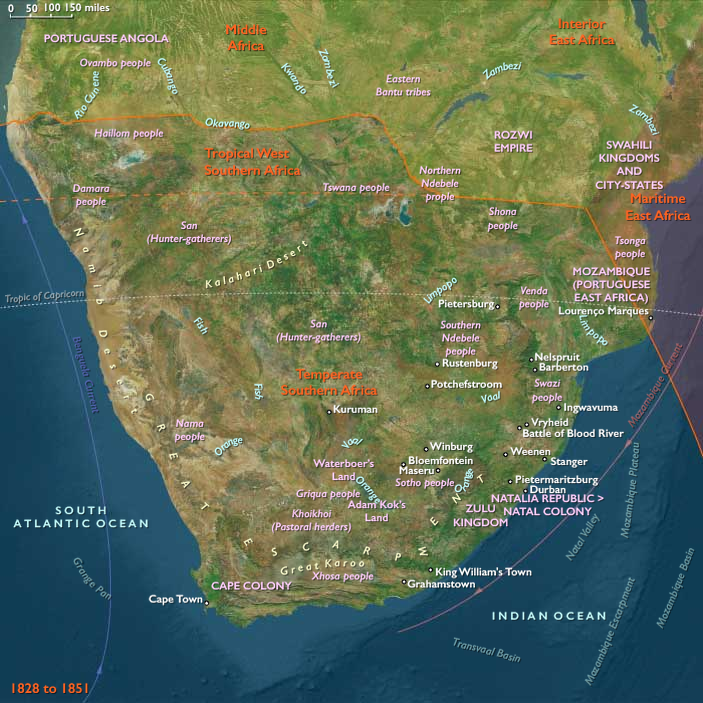
Subregions
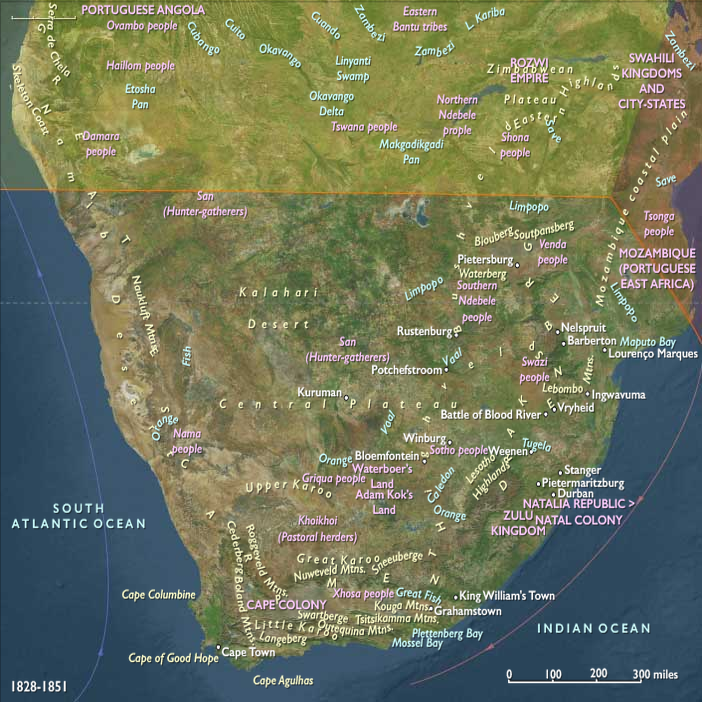
Related Events
Showing 8 events out of 8 total
Years: 1828 - 1839
Groups
- Khoikhoi
- Zulu people
- Xhosa people
- Afrikaners
- Boers
- Britain (United Kingdom of Great Britain and Ireland)
- Cape Colony, British
- Zululand
- Zulu, Kingdom of the
- Natalia Republic
- Natalia (Natal), Boer Republic of
Topics
Commodoties
Subjects
Regions
Subregions