
All public and private businesses close for …
Years: 14 - 14
All public and private businesses close for the day of Augustus’ burial.
Tiberius and his son Drusus deliver the eulogy while standing atop two rostra.
Coffin-bound, Augustus' body is cremated on a pyre close to his mausoleum.
It is proclaimed that Augustus joined the company of the gods as a member of the Roman pantheon.
Although no automatic system of succession exists under the principate, Livia, the late emperor’s wife and esteemed counselor, uses her influence to ensure the succession of Tiberius, already in possession of the chief military command, is now supreme.
The formalities involved in the succession prove embarrassing both to himself and to the Senate because the “principate” of Augustus had not, constitutionally speaking, been heritable or continuous.
He plays politics with the Senate and does not allow it to name him emperor for almost a month.
The Senate convenes on September 18 to validate Tiberius's position as Princeps and, as it had done with Augustus before, extend the powers of the position to him.
These proceedings are fully accounted by Tacitus.
Tiberius already has the administrative and political powers of the Princeps; all he lacks are the titles—Augustus, Pater Patriae, and the Civic Crown (a crown made from laurel and oak, in honor of Augustus having saved the lives of Roman citizens).
Tiberius, however, attempts to play the same role as Augustus: that of the reluctant public servant who wants nothing more than to serve the state.
This ends up throwing the entire affair into confusion, and rather than humble, he comes across as derisive; rather than seeming to want to serve the state, he seems obstructive.
He cites his age (56) as a reason why he cannot act as Princeps, states he does not wish the position, and then proceeds to ask for only a section of the state.
Tiberius finally relents and accepts the powers voted to him, though according to Tacitus and Suetonius he refuses to bear the titles Pater Patriae, Imperator, and Augustus, and declines the most solid emblem of the Princeps, the Civic Crown and laurels.
Problems arise quickly for the new Princeps.
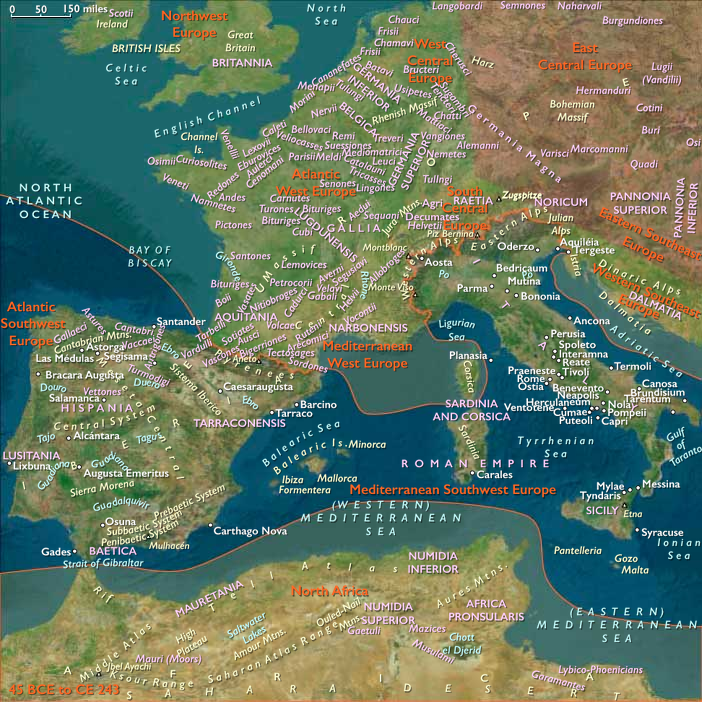
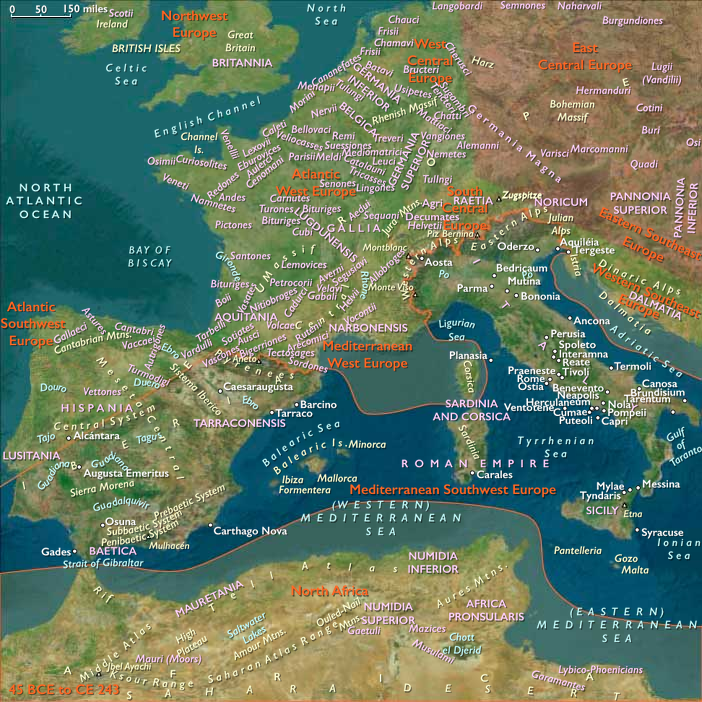
The legions posted in Pannonia and in Germania have not been paid the bonuses promised them by Augustus, and after a short period of time, when it is clear that a response from Tiberius is not forthcoming, mutiny.
Germanicus and Drusus are dispatched with a small force to quell the uprising and bring the legions back in line.
Locations
People
Groups
Topics
Commodoties
Subjects
Regions
Subregions
Years: 14 - 14
Locations
People
Groups
Topics
Commodoties
Subjects
Regions
Subregions