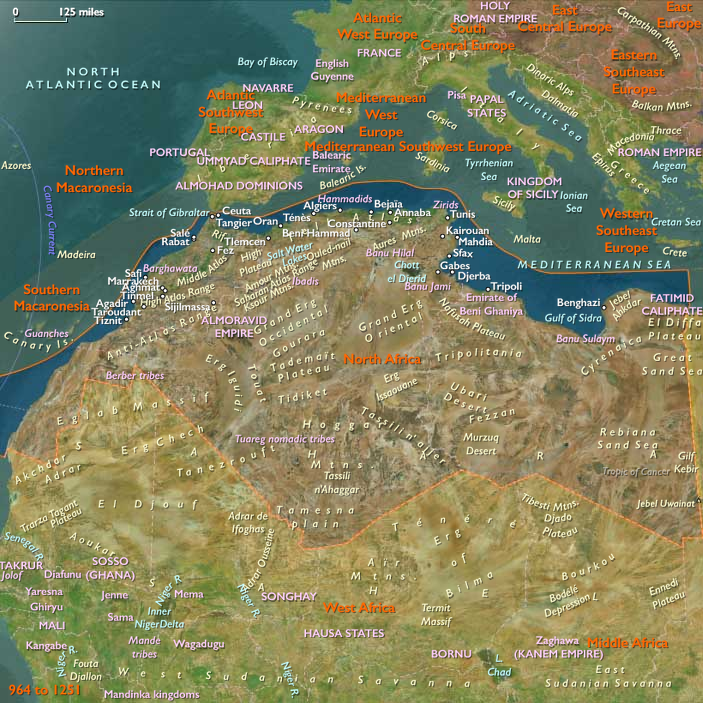
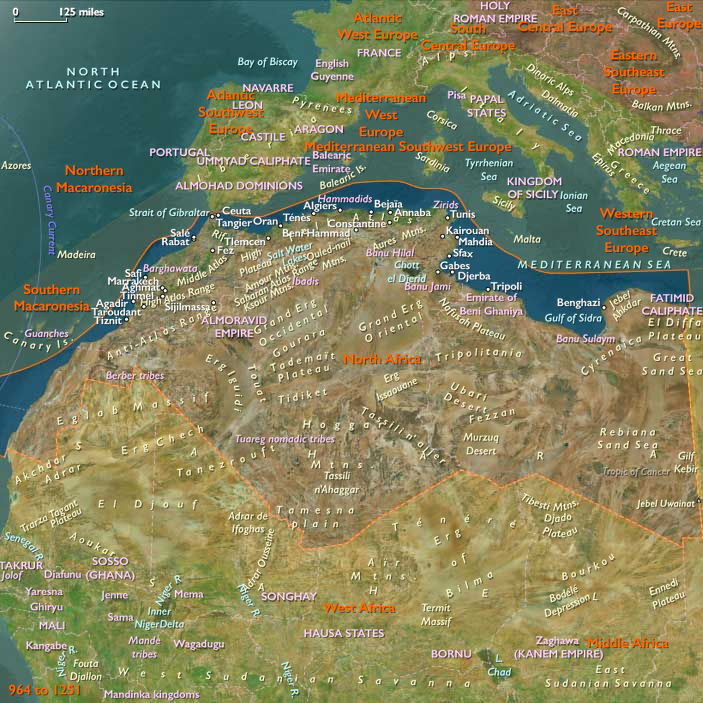
Ali ibn Hammud al-Nasir, named governor of …
Years: 1015 - 1015
Ali ibn Hammud al-Nasir, named governor of Ceuta after 1013 by his client caliph Sulayman ibn al-Hakam, has taken advantage of the anarchy existing in the reign to conquer Ceuta and …
Locations
People
Groups
- Arab people
- Berber people (also called Amazigh people or Imazighen, "free men", singular Amazigh)
- Córdoba, (Umayyad) Caliphate of
- Granada, (Zirid) Muslim statelet, or taifa, of
Topics
Commodoties
Subjects
Regions
Subregions
Related Events
Filter results
Showing 10 events out of 51769 total
Vladimir the Great, Grand Prince of Kiev, lives in a relative peace with his other neighbors Boleslaw I of Poland and Stephen I of Hungary.
After the death of his second wife Anna Porphyrogeneta, he had married again, likely to a granddaughter of Otto the Great.
His son Yaroslav had stopped paying tribute in 1014.
The early years of Yaroslav's life are shrouded in mystery.
He was one of the numerous sons of Vladimir, presumably his second by Rogneda of Polotsk, although his actual age (as stated in the Primary Chronicle and corroborated by the examination of his skeleton in the 1930s) would place him among the youngest of Vladimir’s children It has been suggested that he was a child begotten out of wedlock after Vladimir’s divorce from Rogneda and marriage to Anna Porphyrogeneta, or even that he was a child of Anna Porphyrogeneta herself.
Yaroslav figures prominently in the Norse Sagas under the name of Jarisleif the Lame; his legendary lameness (probably resulting from an arrow wound) was corroborated by the scientists who examined his remains.
In his youth, Yaroslav had been sent by his father to rule the northern lands around Rostov but was transferred to Novgorod, as befitted a senior heir to the throne, in 1010.
While living there, he had founded the town of Yaroslavl (literally, "Yaroslav's") on the Volga.
His relations with his father are apparently strained, and had grows only worse on the news that Vladimir has bequeathed the Kievan throne to his younger son, Boris.
Deciding to chastise the insolence of his son, Vladimir begins gathering troops against Yaroslav.
However, Vladimir falls ill, most likely of old age, and dies on July 15, 1015, at Berestovo, near Kiev, leaving his empire divided among several heirs.
His nephew Sviatopolk becomes grand duke in Kiev; his youngest son, Yaroslav, is vice-regent in Novgorod.
The Swedes of the ninth century had voyaged east while the Danes and Norwegians had gone south and west.
The large Russian mainland and its many navigable rivers had offered good prospects for merchandise and, at times, plundering.
These routes had brought them into contact with the Eastern Roman and Muslim empires.
Since the East was rich and well-defended, Viking activity there centered mainly around peaceful trade instead of pillage, as in Western Europe.
During the ninth century, extensive Scandinavian settlements had been made on the east side of the Baltic sea.
The Tale of Bygone Years (dated to 1113) relates how the Varangians arrived in Constantinople, and of piratical expeditions on the Black Sea and on the Caspian Sea.
The semi-legendary expeditions by Rurik (Rørik) and Askold (Haskuld) established settlements that resulted in the first Russian states; Novgorod and Kievan Rus', a predecessor state of Belarus, Russia and Ukraine.
The Slavic tribes in Russia were weak and submitted to the Vikings with little resistance, but had also rapidly assimilated their conquerors.
The Varangians had accumulated some wealth from its foreign trades.
A center of trade in northern Europe had developed on the island of Birka, not far from where Stockholm was later constructed, in mid Sweden.
Birka was probably demolished already during the eleventh century, but remains show its wealth in the ninth and tenth centuries.
Thousands of graves, coins, jewelry and other luxury items have been found here.
There are also other locations in Sweden where precious treasures have been found, revealing a widespread trade between Sweden and eastern countries down to Asia.
The Swedes have by 1015 abandoned their now-unprofitable trade routes to the east.
Leipzig, its name derived from the Slavic word Lipsk, which means "settlement where the linden trees (British English: lime trees; U. S. English: basswood trees) stand", is first documented in 1015 in the chronicles of Bishop Thietmar of Merseburg.
The Republic of Genoa, established in the early eleventh century, consists of the city of Genoa and the surrounding areas.
As the commerce of the city increases, so does the territory of the Republic.
The entirety of Liguria is part of the Republic of Genoa by 1015.
The city of Pisa, at this time a very important commercial center, controls a significant Mediterranean merchant fleet and navy, having expanded its powers by the sack of Reggio di Calabria in the south of Italy in 1005.
Pisa is in continuous conflict with the Saracens for control of the Mediterranean.
Mujāhid al-‘Āmirī, ruler of the Muslim taifa of Denia, is probably motivated to conquer Sardinia in order to legitimize his power in Denia and the Balearics.
A civil war (fitna) had broken out between various factions (taifas) after 1009 in the declining caliphate.
A freed slave, Mujāhid had found it necessary to legitimize his position by appointing a puppet caliph, ‘Abd Allāh ibn ‘Ubayd Allāh ibn Walīd al-Mu‘iṭī, in 1013.
He probably saw an opportunity to secure his authority by waging a holy war (jihād), a device which had been used effectively by the man who appointed Mujāhid to rule Denia, al-Manṣūr.
The conquest of Sardinia is thus undertaken in the name of al-Mu‘iṭī, and the Islamic historian Ibn al-Khatīb praises Mujāhid before God for his piety in the event.
One school of Islamic jurisprudence, represented in Mujāhid's day by al-Mawardī, recognizes "emirs by conquest", those like Mujāhid who have a right to rule lands they conquer for Islam.In 1015, Mujāhid comes to Sardinia with one hundred and twenty ships, a large number that confirms that the expedition was not designed for raiding.
The twelfth-century Pisan Liber maiolichinus, a history of the 1113–1115 Balearic Islands expedition, records that Mujāhid controlled all of the Sardinian coastal plain.
In the Pisan histories of the tim,e the expedition to Sardinia of 1015 is described tersely: "the Pisans and Genoese made war with Mujāhid in Sardinia, and defeated him by the grace of God" and "the Pisans and Genoese defended Sardinia."
The account of the Liber maiolichinus is more detailed, although it excludes the Genoese, and so is probably referring to the 1015 expedition.
It reports that even the Pisan nobles, in their eagerness, took turns rowing the galleys.
It also compares them to starving lions rushing their prey.
Mujāhid flees at the approach of the Italians, according to the Liber, which does not mention an actual engagement in 1015.

…Tangier.
The Battle of Florennes (1015): Godfrey II Secures Lower Lorraine
Following his appointment as Duke of Lower Lorraine in 1012 by Emperor Henry II, Godfrey II of Verdun faced several challengers to his rule, including Lambert I, Count of Leuven, and Reginar IV, Count of Mons. These rivals had strong claims and local support, threatening Godfrey’s authority. However, in 1015, Godfrey decisively defeated them at the Battle of Florennes, solidifying his control over the duchy.
Opposition to Godfrey’s Rule
- Lambert I of Leuven, brother-in-law of the late Duke Otto of Lower Lorraine, contested Godfrey’s appointment and sought to restore his family’s influence in the duchy.
- Reginar IV of Mons, a member of the powerful House of Reginar, had long sought to reclaim control over the region, particularly in Hainault.
The Battle of Florennes (September 12, 1015)
- The decisive confrontation occurred near Florennes, where Godfrey’s forces clashed with those of Lambert and Reginar.
- Lambert I was killed in battle, delivering a major blow to the opposition.
- Reginar IV, now without his strongest ally, was forced to make peace with Godfrey.
The Aftermath: Political Realignment
- With Lambert dead, Godfrey II’s rule over Lower Lorraine was secure.
- Reginar IV, now politically weakened, later married Godfrey’s niece, Matilda, daughter of Herman of Ename, count in the shire of Brabant.
- This marriage allowed Reginar IV to inherit the southern part of Brabant, which eventually became part of Hainault, demonstrating Godfrey’s ability to neutralize rivals through both force and diplomacy.
Legacy and Impact
- The victory at Florennes ensured that Lower Lorraine remained loyal to the Holy Roman Emperor, strengthening imperial influence in the Low Countries.
- Godfrey II secured his ducal authority and reinforced the position of the House of Ardennes-Verdun as dominant in the region.
- The conflict also demonstrated the fluidity of feudal allegiances, as former enemies, such as Reginar IV, were later integrated into the imperial system through marriage alliances.
Through his military success and political strategy, Godfrey II firmly established himself as the legitimate Duke of Lower Lorraine, bringing a measure of stability to the contested region.
Bishop Bernward of Hildesheim designs and in 1015 has cast the celebrated pair of monumental sculptured bronze doors for Hildesheim Cathedral.
The first large-scale castings in more than five hundred years, each door, ornamented with elaborately articulated biblical scenes, is cast in a single piece.
A vivid and stylized expressionism animates the high-relief figures of the panels, representing, along with the monolithic castings, a considerable technical achievement.
Thorfinn Karlsefni’s brothers Helgi and Finnbogi lead additional expeditions to Vinland around 1013, but the hostility of the native Skraelings apparently causes the Scandinavians to abandon all attempts at colonization around 1015.
(Vinland could refer to L’Anse aux Meadows, or to a mainland site perhaps as far south as the Virginia Capes; scholars debate its location, as they do the locations of earlier Viking settlements.)
The colonists return to Greenland; Thorfinn eventually settles in Iceland.
This three year excursion will be the longest-lasting European colony in the New World until Columbus' voyages four hundred years later initiate full-scale colonization.
Years: 1015 - 1015
Locations
People
Groups
- Arab people
- Berber people (also called Amazigh people or Imazighen, "free men", singular Amazigh)
- Córdoba, (Umayyad) Caliphate of
- Granada, (Zirid) Muslim statelet, or taifa, of