
'Ali ibn Abi Talib, the cousin and …
Years: 680 - 680
April
'Ali ibn Abi Talib, the cousin and one of the Ahl al-Bayt (people of the House) of the Islamic prophet Muhammad, had migrated to Medina shortly after Muhammad.
There Muhammad told Ali that he had been ordered by God to give his daughter, Fatimah, to Ali in marriage.
'Ali had been an active servant of Muhammad's service during his decade at the helm of the community in Medina, carrying messages and orders and leading war parties of warriors on battles, participating in all the battles fought for Islam during this time eith the exception of Tabuk.
After the assassination in 656 of the third Caliph, Uthman Ibn Affan, the Companions of Muhammad in Medina had chosen 'Ali to be the new Caliph.
Because Ali is unable to apprehend and punish Uthman's murderers due to the rebel infiltration of the Muslim ranks, Muawiyah ibn Abī Sufyān, who had been a companion of Muhammad and been Governor of Syria since 640, had refused to acknowledge his caliphate.
Muawiyah had met with considerable military success in the ensuing civil war, including the seizure of Egypt.
Whereas the Shiites believe, as they do today, that the imamate, or leadership, is the sole right of the house of 'Ali, the Kharijites insist that any pious and able Muslim can be a leader of the Muslim community.
And whereas the Sunnis believe that the imam's impiousness does not, by itself, justify sedition, the Kharijites insist on the right to revolt against any ruler who deviates from the example of the Islamic prophet Muhammad and the first two Caliphs.
A Kharajite had in 661 finally assassinated 'Ali at prayer in the mosque of Kufa with a strike of a poison-coated sword, and Muawiyah—holding both Syria and Egypt and, as commander of the largest force in the Muslim Empire, having strongest claim to leadership—had assumed the caliphate.
'Ali’s sons Hasan and Hussein had acquiesced to the rule of Mu'awiyah and received pensions from him.
Hasan, initially defying Muawiyah, had soon ceased hostilities and retired to a quiet private life in Medina, where he lived until his death in 670 under mysterious circumstances.
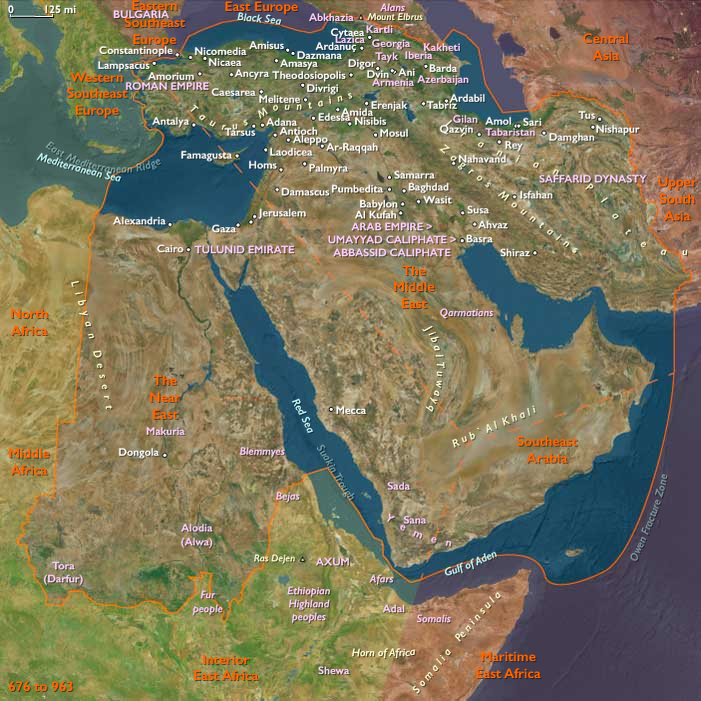
Hussein, however, refuses in April, 680 to recognize the legitimacy of Muawiyah's son and successor, Yazid.
The townsmen of Kufah, a city with a Shi'ite majority, now invite Hussein, reputedly the favorite grandson of Muhammad, to lead then in raising the standard of revolt against the Umayyads.
Locations
People
Groups
- Islam
- Egypt in the Middle Ages
- Muslims, Sunni
- Muslims, Kharijite
- Umayyad Caliphate (Damascus)
- Muslims, Shi'a
Topics
Commodoties
Subjects
Regions
Subregions

Related Events
Showing 2 events out of 2 total
Years: 680 - 680
April
Locations
People
Groups
- Islam
- Egypt in the Middle Ages
- Muslims, Sunni
- Muslims, Kharijite
- Umayyad Caliphate (Damascus)
- Muslims, Shi'a
Topics
Commodoties
Subjects
Regions
Subregions