
Sayyid Muhammad ibn Ali as-Senussi, preaching in …
Years: 1837 - 1837
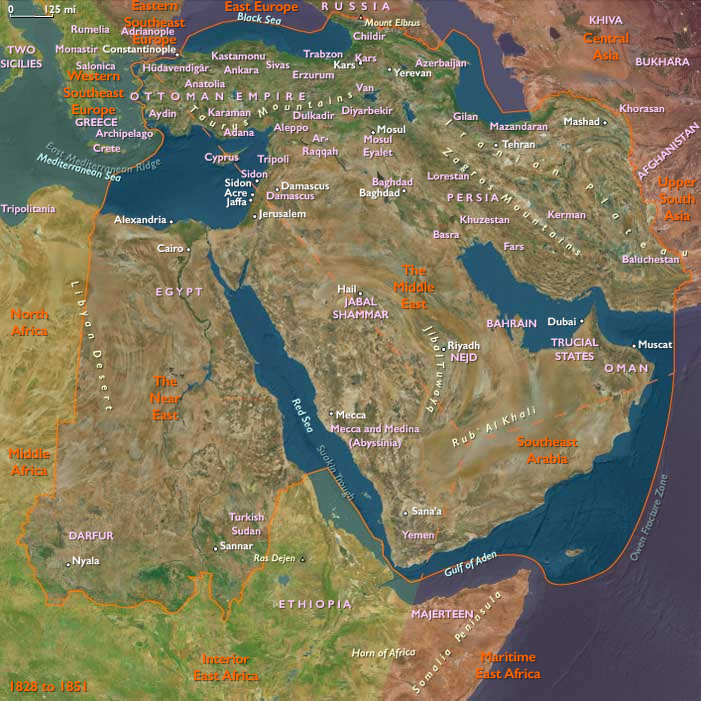
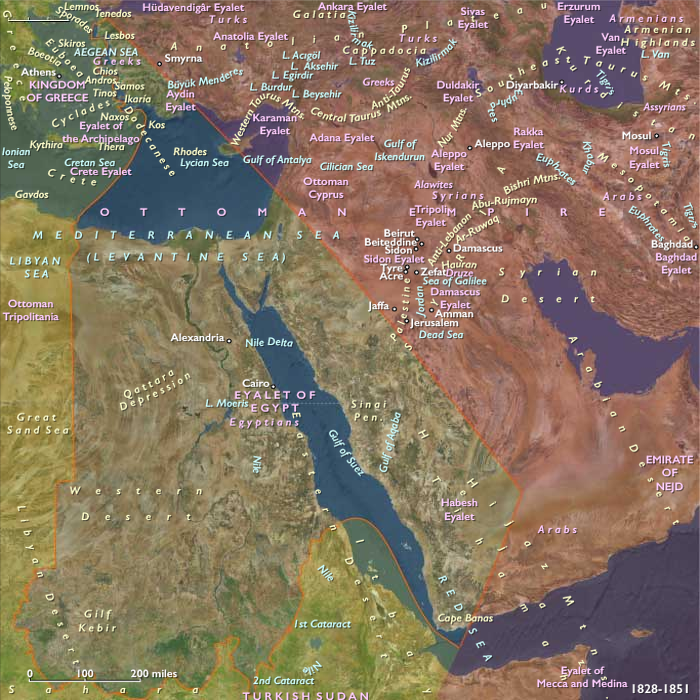
Sayyid Muhammad ibn Ali as-Senussi, preaching in western Arabia in 1837, forms the Senussi or Sanussi, a Sufi order dedicated to converting desert Bedouin to a life adhering to strict Koranic interpretation.
A member of the Walad Sidi Abdalla tribe, and a sharif tracing his descent from Fatima, the daughter of Mohammed, Senussi had studied at a madrassa in Fez.
He had then traveled in the Sahara preaching a purifying reform of the faith in Tunisia and Tripoli, gaining many adherents, and thence moved to Cairo to study at Al-Azhar University, where the pious scholar was forceful in his criticism of the Egyptian ulema for what he perceived as their timid compliance with the Ottoman authorities and their spiritual conservatism.
He also argued that learned Muslims should not blindly follow the four classical schools of Islamic law but instead engage in ijtihad themselves.
Not surprisingly, he was opposed by the ulema as unorthodox and they issued a fatwa against him.
Senussi had gone to Mecca, where he joined Ahmad Ibn Idris Al-Fasi, the head of the Khadirites, a religious fraternity of Moroccan origin.
On the death of Al-Fasi, Senussi had become head of one of the two branches into which the Khadirites had divided, and in 1835 he had founded his first monastery or zawia, at Abu Kobeis near Mecca.
Locations
People
Groups
Subjects
Regions
Subregions
Related Events
Showing 10 events out of 18351 total
Years: 1837 - 1837
Locations
People
Groups
Subjects
Regions
Subregions