
The economic and cultural development of the …
Years: 333BCE - 190BCE
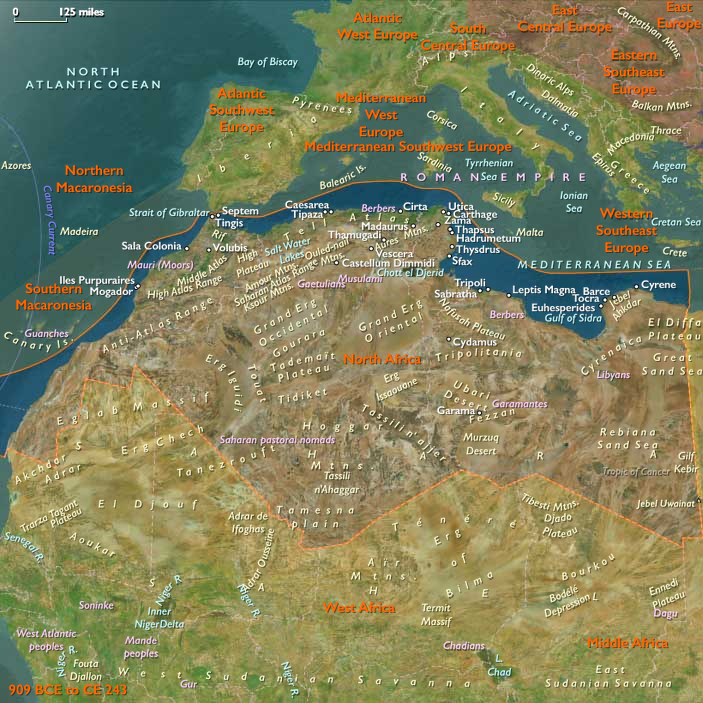
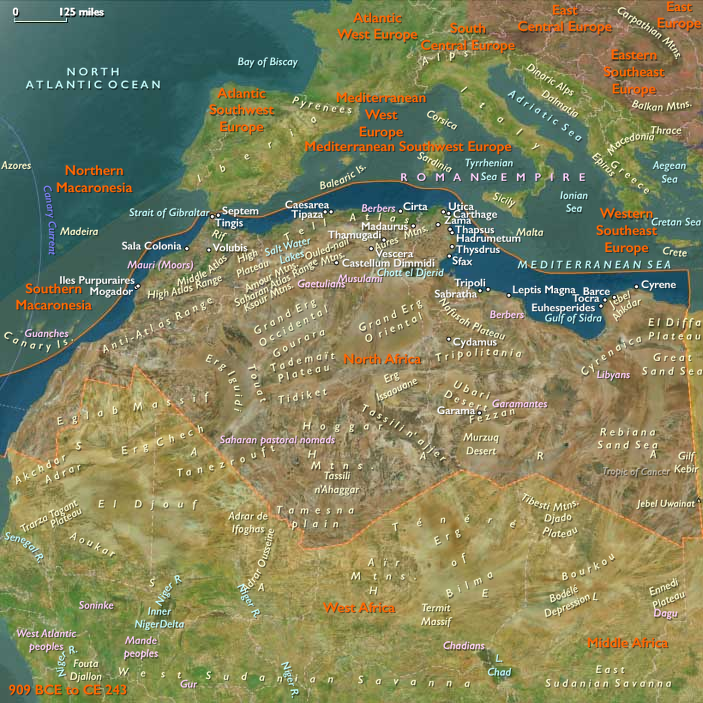
The economic and cultural development of the Pentapolis is unaffected by the turmoil its political life generates.
The region grows rich from grain, wine, wool, and stockbreeding and from silphium, an herb that grows only in Cyrenaica and is regarded as an aphrodisiac.
Cyrene becomes one of the greatest intellectual and artistic centers of the Greek world, famous for its medical school, learned academies, and architecture, which includes some of the finest examples of the Hellenistic style.
The Cyrenaics, a school of thinkers who expound a doctrine of moral cheerfulness that defines happiness as the sum of human pleasures, also make their home here and take inspiration from the city's pleasant climate.
Locations
Groups
- Berber people (also called Amazigh people or Imazighen, "free men", singular Amazigh)
- Greeks, Classical
- Cyrene
- Greece, Hellenistic
- Egypt, Ptolemaic Kingdom of
Commodoties
Subjects
Regions
Subregions
Related Events
Filter results
Showing 10 events out of 18 total
Philippa of Lancaster and the Anglo-Portuguese Alliance (1387–1430)
In 1387, Philippa of Lancaster, daughter of John of Gaunt, married King João I of Portugal, sealing the Anglo-Portuguese alliance, one of the longest-standing diplomatic alliances in history. Through this union, João and Philippa became the parents of a remarkable generation of princes, whom poet Luís de Camões would later call the "marvelous generation", responsible for leading Portugal into its golden age.
Philippa’s Influence: Education, Morality, and Commerce
Philippa brought to the Portuguese court the Anglo-Norman tradition of aristocratic education, ensuring her children received a rigorous intellectual and moral upbringing. She reformed the royal court, instilling strict standards of morality and discipline, shaping Portugal’s royal culture for generations.
Beyond courtly influence, Philippa also provided royal patronage for English commercial interests, fostering trade between Portugal and England. English merchants supplied cod and cloth, while Portuguese traders exported wine, cork, salt, and olive oil through English warehouses in Porto, strengthening economic ties between the two nations.
The "Marvelous Generation" and Their Achievements
Philippa’s sons were among the most accomplished figures in Portuguese history:
- Duarte (Edward I of Portugal) – A scholar-king, he authored moral treatises and ruled as King of Portugal from 1433 until his death in 1438.
- Pedro, Duke of Coimbra – A well-traveled intellectual, deeply interested in history and governance, who later served as regent of Portugal after Duarte’s death.
- Fernando, the Saint Prince – A crusader, he participated in the failed 1437 attack on Tangier, where he was captured and later died in captivity.
- Henrique (Prince Henry the Navigator) – Master of the Order of Avis, he became the driving force behind Portugal’s early voyages of discovery, laying the groundwork for the Age of Exploration.
Philippa’s Enduring Legacy
Philippa of Lancaster’s legacy extended beyond diplomacy; through her court reforms, patronage, and maternal influence, she shaped the cultural, political, and economic foundations of Portugal’s golden age. Her children’s military, intellectual, and exploratory achievements propelled Portugal to the forefront of European expansion and discovery in the 15th and 16th centuries.
The Regency Struggle and the Afonsine Ordinances (1433–1446)
Following the death of King João I of Portugal in 1433, the crown passed to his eldest son, Duarte I, whose brief five-year reign (1433–1438) was cut short by the plague. His death left the kingdom in political uncertainty, as his heir, Afonso V, was only six years old.
Duarte I’s Reforms and the Afonsine Ordinances
- Before his death, Duarte had convened a Cortes to begin the compilation of Portuguese royal law.
- This legal work would not be completed until the reign of Afonso V, when it was published as the Afonsine Ordinances (Ordenações Afonsinas).
- Duarte also declared that the land grants given by his father João I must be confirmed at the start of each reign, ensuring royal authority over noble holdings.
The Struggle for the Regency (1438–1446)
Upon Duarte’s death in 1438, his widow, Queen Eleanor of Aragon, assumed the regency, but she faced strong opposition from the nobility and the populace, who refused to accept a woman as sole ruler.
The Rival Factions
-
Infante Pedro, Duke of Coimbra (Duarte’s brother)
- Popular in Lisbon and supported by the merchants and middle class.
- A skilled administrator and advocate for strong royal authority over the nobility.
- Sought to strengthen his influence by marrying his daughter Isabel to the young King Afonso V.
-
Afonso, Duke of Bragança (João I’s eldest illegitimate son)
- Leader of the old nobility, including those who had gained extensive land grants under João I.
- Opposed Pedro’s regency, as he feared it would curb noble privileges.
- Attempted to secure power by marrying his own daughter to Afonso V.
Pedro’s Victory and Regency (1439–1448)
- The Lisbon populace strongly favored Infante Pedro, and he was officially recognized as regent after convening the Cortes of Évora in 1439.
- To secure his position, he arranged for his daughter, Isabel of Coimbra, to marry Afonso V once the young king reached his majority.
- When Afonso V turned 14 in 1446, he upheld the marriage agreement and requested Pedro to continue governing.
Aftermath and Future Conflicts
- Although Pedro remained in power, tensions with Afonso, Duke of Bragança, did not subside.
- When Afonso V fully assumed power in 1448, Bragança’s faction maneuvered to have Pedro removed.
- This power struggle would ultimately lead to the Battle of Alfarrobeira in 1449, where Pedro was killed, marking the triumph of the nobility over royal centralization.
The Afonsine Ordinances, the Lisbon merchants’ support for Pedro, and the ducal rivalry between Pedro and Bragança all shaped the political structure of Portugal for decades, reinforcing tensions between royal authority and aristocratic power.
The Battle of Alfarrobeira (1449): The Fall of Infante Pedro and the Rise of the House of Bragança
Following Afonso V’s assumption of full power in 1448, the Duke of Bragança successfully turned the young king against his uncle, Infante Pedro, Duke of Coimbra, claiming that Pedro was plotting to seize the throne. This manipulation led to Pedro’s dismissal from the regency and his exile to his estates.
Pedro’s Attempt to Regain Power
- As rumors of a plot against him spread, Pedro decided to resist rather than submit.
- He marched on Lisbon, where he enjoyed strong support from the merchants and populace.
- Afonso V, under the influence of the House of Bragança, declared Pedro a traitor and gathered an army to confront him.
The Battle of Alfarrobeira (May 24, 1449)
- Pedro’s army met the royalist forces, led by Afonso V and the Duke of Bragança, near Alfarrobeira, north of Lisbon.
- The battle was swift and decisive—Pedro was killed on the field, and his forces were crushed.
- The defeat eliminated the greatest advocate for strong royal authority, leaving Afonso V heavily influenced by the Bragança family.
Consequences of Pedro’s Defeat
-
The Rise of the House of Bragança
- The House of Bragança emerged as the dominant noble house in Portugal, vastly increasing its land, wealth, and political influence.
- The Braganças became "a state within a state", controlling vast territories and challenging the power of the monarchy.
-
Afonso V Becomes a Puppet of the Nobility
- Without Pedro’s guidance, the pliable Afonso V fell under the control of the nobility, particularly the Braganças.
- His reign was characterized by military adventures in Morocco and Castile, often influenced by aristocratic ambitions.
-
Weakening of Royal Centralization
- Pedro’s defeat marked a victory for the aristocracy over royal authority.
- The monarchy remained dependent on noble factions until later kings, such as John II (r. 1481–1495), took steps to curb noble power.
Legacy: The Path to Future Conflict
- The Battle of Alfarrobeira (1449) ensured the dominance of the House of Bragança, but it also set the stage for future confrontations between the Crown and the nobility.
- By the time John II ascended the throne in 1481, he saw the Braganças as a direct threat to the monarchy and took drastic measures to reduce their influence, culminating in the execution of the 3rd Duke of Bragança in 1483.
Thus, the Battle of Alfarrobeira was a turning point in Portuguese history, reinforcing aristocratic power at the expense of the Crown, but also laying the groundwork for future monarchical reforms and conflicts.
Atlantic Southwest Europe: Maritime Expansion and Internal Tensions (1432–1443)
Between 1432 and 1443, Atlantic Southwest Europe entered a transformative period, marked by intensified Portuguese maritime exploration, internal political struggles in Castile, and efforts by regional entities such as Navarre and the Basque territories to assert autonomy. Economic growth accelerated due to overseas discoveries, yet internal tensions and localized conflicts tested regional stability and influenced the cultural landscape.
Political and Military Developments
-
Portugal:
- Under King Duarte I (r. 1433–1438), Portugal continued maritime exploration initiated by João I and Prince Henry the Navigator, despite Duarte’s short reign and internal divisions following his death.
- Duarte’s premature death triggered a regency crisis, with his brother, Infante Pedro, Duke of Coimbra, serving as regent (1439–1448), reinforcing Portugal’s commitment to exploration and internal reform.
-
Northern Castile and León:
- King Juan II of Castile (r. 1406–1454) faced growing conflict between powerful nobles, notably between the factions led by Álvaro de Luna and the Infantes of Aragón, significantly impacting political stability in the northern provinces.
- The Basque territories and northern Rioja capitalized on Castilian internal strife to preserve local autonomy, solidifying their distinctive fueros and customs.
-
Navarre:
- Queen Blanche I of Navarre (r. 1425–1441) continued her father’s diplomatic neutrality but faced rising pressure from Castile and Aragón. Her death in 1441 led to a succession crisis, ultimately resolved by the ascension of her son, Charles, Prince of Viana, whose contested rule invited further regional instability.
Economic and Maritime Expansion
-
Portuguese Maritime Leadership:
- Continued expeditions along the African coast resulted in increased trade, particularly in gold and slaves, enriching coastal cities like Lisbon and Porto and fostering an emerging Atlantic economic system.
- Settlement and cultivation in Madeira expanded significantly, becoming a prosperous source of sugar and Madeira wine, thereby enhancing Portugal’s Atlantic trade dominance.
-
Trade and Urban Prosperity:
- Northern coastal cities, including Bilbao and Santander, maintained flourishing trade with England, France, and the Low Countries, ensuring regional economic prosperity despite Castilian internal tensions.
- The Basque fishing and shipbuilding industries expanded, driven by robust international demand and increased maritime activity.
Cultural and Social Developments
-
Humanism and Renaissance Influence:
- Portuguese scholars, sponsored by Infante Pedro and Prince Henry, continued developing maritime science, navigation techniques, and cartography, significantly contributing to Europe's growing intellectual and scientific heritage.
- Literary and humanistic influences from Italy and France permeated the courts of Portugal and Navarre, stimulating cultural refinement.
-
Local Autonomy and Identity:
- Northern Navarre, the Basque Country, and northern Rioja reinforced regional identities and fueros in response to broader political uncertainties, enhancing cultural resilience.
- Galicia and Asturias sustained vibrant pilgrimage traditions and cultural exchanges around Santiago de Compostela, preserving their importance as cultural hubs.
Significance and Legacy
The era of 1432–1443 proved critical in consolidating Portugal's maritime supremacy, significantly altering Europe's global position through its burgeoning Atlantic empire. Simultaneously, internal conflicts in Castile contrasted sharply with growing regional stability and cultural confidence in Basque, Navarrese, and Galician territories. These years set the foundation for further maritime expansion and shaped enduring patterns of autonomy, identity, and economic prosperity that would influence Atlantic Southwest Europe profoundly in subsequent decades.
The Introduction of the Ducal Title in Portugal by John I (1415–1432)
King John I of Portugal (r. 1385–1433) introduced the title of duke into Portugal as part of his reward system for his sons and key supporters, consolidating noble power while maintaining royal authority.
The First Portuguese Dukedoms (1415): Coimbra and Viseu
- After the successful conquest of Ceuta in 1415, John I created the first Portuguese duchies for his sons, establishing the title of "Duke" in Portugal for the first time.
- The newly created titles were:
- Duke of Coimbra – Granted to Infante Peter, John I’s second legitimate son.
- Duke of Viseu – Given to Infante Henry the Navigator, John I’s third legitimate son.
- These duchies strengthened the role of the royal family in governance, ensuring that John I’s sons remained powerful but loyal to the Crown.
The Creation of the Duchy of Bragança (1432): A New Noble Powerhouse
- In 1432, John I created the Duchy of Bragança for his illegitimate son, Afonso, marking the beginning of one of the most powerful noble houses in Portugal.
- Afonso, as the first Duke of Bragança, received vast landholdings, castles, and privileges, making his family a dominant force in Portuguese politics.
- Unlike the duchies given to his legitimate sons (Coimbra and Viseu), Bragança was created as a hereditary title, ensuring its long-term influence.
Impact on Portuguese Nobility and Politics
- Elevated the nobility – The creation of duchies formalized the power of the aristocracy, giving them greater autonomy and prestige.
- Secured loyalty – By granting ducal titles to family members, John I ensured that power remained within the royal circle.
- Strengthened Portugal’s feudal structure – These duchies played a key role in governance, military campaigns, and economic administration.
Legacy of the Ducal System in Portugal
- The House of Bragança would grow into the most powerful noble house in Portugal, eventually challenging the monarchy.
- In 1640, the 8th Duke of Bragança, João IV, led the Portuguese Restoration War against Spain and became King of Portugal, establishing the Bragança dynasty, which ruled until 1910.
Thus, John I’s introduction of the ducal title in Portugal was a pivotal moment in the kingdom’s noble and political structure, shaping the balance between royal power and aristocratic influence for centuries to come.
The 1437 Expedition Against Tangier: A Costly Disaster
By 1437, Portugal's occupation of Ceuta (since 1415) had failed to deliver the economic rewards expected. Instead of controlling lucrative West African trade routes, Ceuta became a costly military liability, constantly under siege by Muslim forces.
In response, Prince Henry the Navigator and his younger brother, Prince Fernando, proposed a military expedition against Tangier, hoping that:
- Capturing Tangier would secure Ceuta, preventing future attacks.
- The city could serve as a new commercial hub, providing economic returns to justify Portuguese presence in North Africa.
Despite King Edward’s reluctance, Henry and Fernando persuaded him to approve the campaign.
Opposition from Prince Peter
- Prince Peter, the second son of John I, strongly opposed the expedition.
- He believed Portugal’s true mission lay in maritime exploration, not in military campaigns in North Africa.
- Peter saw further discoveries along the African coast as the key to economic growth and Christian expansion, rather than continued warfare with the Moors.
- His warnings would prove correct, as the Tangier campaign turned into a disastrous failure.
The Siege of Tangier (1437) and Portuguese Defeat
- Henry led the Portuguese forces, consisting of around 6,000 men, in a poorly planned assault on Tangier.
- The Marinid defenders, reinforced by forces from Fez, outnumbered and overwhelmed the Portuguese army.
- Facing defeat and starvation, Henry negotiated a surrender:
- The Portuguese agreed to return Ceuta in exchange for safe passage.
- Prince Fernando was taken hostage by the Moroccans as a guarantee of Portuguese withdrawal.
The Aftermath: Fernando’s Tragic Fate and Political Fallout
- King Edward faced a dilemma: Should Portugal abandon Ceuta to free Prince Fernando, or hold on to the city and leave his brother in captivity?
- The nobility and clergy pressured Edward to keep Ceuta, fearing it would discredit Portugal if they surrendered it.
- As a result, Fernando remained a captive in Fez, where he died in 1443, earning him the title "the Holy Prince" (Infante Santo).
The Expedition’s Consequences
- Weakened the Portuguese Monarchy – The failure discredited King Edward, and his early death in 1438 led to a political crisis over the regency.
- Delayed Further African Exploration – The disastrous campaign diverted resources and focus from exploration, delaying Portuguese maritime expansion.
- Strengthened Prince Peter’s Influence – His anti-Tangier stance was vindicated, reinforcing the argument that Portugal’s future lay at sea, not in North African conquests.
Despite this failure, Portugal eventually resumed exploration, leading to the discovery of West African trade routes, which proved far more lucrative than North African military campaigns.
The Death of King Edward and the Regency Struggle (1438–1448)
King Edward of Portugal (Duarte I, r. 1433–1438), a scholarly and deeply moral ruler, earned the title "the philosopher-king" and authored O Leal Conselheiro ("The Loyal Counselor"), a reflection on ethics and governance. His reign, however, was overshadowed by the disastrous 1437 Tangier expedition, which led to the capture of his youngest brother, Prince Fernando ("the Holy Prince").
Grief-stricken and weakened by the plague, Edward died in Tomar on September 9, 1438, before his brother Henry the Navigator could return from North Africa. His six-year-old son, Afonso V, became king—the third consecutive ruler from the House of Avis, also known as the Joanina (Johannine) dynasty.
The Regency Crisis: Pedro vs. Leonor (1438–1439)
Since Afonso V was only six, a regent was needed, and two rival factions emerged:
-
Infante Pedro, Duke of Coimbra
- Second son of King John I, experienced in governance.
- Supported by the Portuguese nobility and urban elites.
- Advocated royal centralization and continued overseas expansion.
-
Queen Mother Leonor of Aragon
- Opposed Pedro’s regency, fearing he would sideline her influence.
- Sought to govern herself or install Henry the Navigator as regent.
- Deeply unpopular in Lisbon, where the people distrusted foreign influence.
Henry the Navigator’s Neutral Role
- Henry had no desire to rule and sought to avoid the family conflict.
- He attempted to mediate peace between Pedro and Leonor, but failed.
- Instead, he supported Pedro, recognizing his governing abilities.
Resolution of the Crisis (1439)
- The Lisbon populace opposed Leonor, favoring Pedro as regent.
- The Cortes of 1439 formally appointed Pedro as Regent of Portugal.
- Queen Leonor, facing overwhelming opposition, left the country, easing tensions.
Pedro’s Regency (1439–1448)
- As regent, Pedro focused on:
- Strengthening royal authority over the aristocracy.
- Protecting Portuguese maritime expansion.
- Educating young Afonso V, preparing him for kingship.
However, his regency would ultimately lead to conflict with the nobility, particularly with the House of Bragança, culminating in the Battle of Alfarrobeira (1449).
Thus, the death of Edward in 1438 led to a tense power struggle, but also allowed Prince Henry the Navigator to return to Sagres and focus on exploration, shaping Portugal’s future maritime dominance.
Afonso, Count of Barcelos and the First Duke of Bragança: Founder of a Dynasty
Afonso, Count of Barcelos (later 1st Duke of Bragança) was a key figure in 15th-century Portugal, playing a central role in aristocratic politics and establishing the House of Bragança, which would become Portugal’s most powerful noble family.
Birth and Early Life
- Born in Veiros, Estremoz, Alentejo, Afonso was a natural son of King John I of Portugal and Inês Pires Esteves.
- Despite his illegitimacy, Afonso was raised in the royal court and became an influential noble.
- He married Beatriz Pereira de Alvim, daughter of Nuno Álvares Pereira, Portugal’s greatest military leader and its wealthiest landowner, greatly increasing his wealth and status.
Military and Political Career
- Afonso was present at the 1415 conquest of Ceuta, a pivotal event in Portugal’s overseas expansion.
- As a cultivated and well-traveled noble, he gained considerable influence at court.
- When his half-brother, King Edward I (Duarte), died in 1438, a political struggle emerged over the regency of the young Afonso V:
- The Queen Mother, Eleonor of Aragon, was initially chosen as regent, but she was deeply unpopular due to her Aragonese origins.
- The Portuguese Cortes, convened by Afonso’s half-brother John, Lord of Reguengos de Monsaraz, selected Infante Peter, Duke of Coimbra, as regent, a choice favored by the burghers and lower nobility.
- However, Afonso and his aristocratic allies preferred Eleonor, fearing that Peter’s reformist policies would curtail noble privileges.
The Struggle for Power and the Creation of the Duchy of Bragança
- Afonso maneuvered to gain influence over Afonso V, competing with Peter of Coimbra for the young king’s favor.
- In 1443, in a gesture of reconciliation, Peter granted Afonso the title of Duke of Bragança, making him the first duke in Portugal.
- This new duchy, along with the Duchy of Coimbra (Peter’s) and the Duchy of Viseu (Henry’s), became one of Portugal’s first three noble duchies.
The Rise of the House of Bragança
- The House of Bragança quickly became the most powerful noble family in Portugal, accumulating immense landholdings and wealth.
- Over time, the Braganças became so powerful that they often rivaled the monarchy itself.
- In 1640, the 8th Duke of Bragança, João IV, led the Portuguese Restoration War against Spain and became King of Portugal, establishing the Bragança dynasty, which ruled Portugal until 1910.
Legacy
- Afonso’s strategic marriage and political maneuvering made the House of Bragança the most influential aristocratic family in Portugal.
- His descendants would challenge kings, amass vast fortunes, and eventually ascend to the throne.
- His creation as Duke of Bragança in 1443 shaped Portuguese politics for centuries, reinforcing the balance of power between monarchy and nobility.
Thus, Afonso’s legacy as the founder of the House of Bragança ensured that his lineage would play a dominant role in Portuguese history, ultimately ruling the nation for nearly three centuries.
Atlantic Southwest Europe: Maritime Dominance and Regional Struggles (1444–1455)
Between 1444 and 1455, Atlantic Southwest Europe underwent critical transformations marked by Portuguese maritime breakthroughs, persistent political strife in Castile, and contested successions in Navarre. This era saw heightened economic prosperity linked to overseas expansion, contrasted with enduring internal rivalries that reshaped political dynamics across the region.
Political and Military Developments
-
Portugal:
- Under regent Infante Pedro, Duke of Coimbra (1439–1448), maritime exploration expanded significantly, culminating in expeditions past Cape Verde (1444) and establishing Portugal’s claim over African coastal trade routes.
- After a brief civil conflict, King Afonso V (r. 1438–1481) ended Pedro’s regency violently in 1449, shifting Portugal’s internal politics toward increased royal centralization and expansionist ambitions.
-
Northern Castile and León:
- Ongoing instability under King Juan II of Castile (r. 1406–1454) intensified due to the influential minister Álvaro de Luna’s controversial control, leading to escalating feuds among noble factions and weakening royal authority in northern provinces.
- The execution of Álvaro de Luna (1453) brought temporary calm, yet political fragmentation persisted, allowing greater regional autonomy in territories such as Galicia, Asturias, and the Basque Country.
-
Navarre:
- Succession crises intensified under Charles, Prince of Viana, whose disputed inheritance after Queen Blanche’s death (1441) drew Navarre into deeper conflict, particularly with the ambitions of John II of Aragon, destabilizing governance and increasing external interference in Navarrese politics.
Economic and Maritime Expansion
-
Portuguese Trade Networks:
- Portuguese expeditions along West Africa’s coast led to significant economic gains from gold, ivory, and slave trade, consolidating Lisbon as a thriving Atlantic port and financial hub.
- Madeira’s sugar plantations, established in prior decades, matured into prosperous enterprises, significantly influencing future patterns of plantation agriculture and Atlantic commerce.
-
Urban and Commercial Vitality:
- Atlantic ports in northern Iberia, notably Bilbao and Santander, benefited from trade stability, especially with northern Europe, strengthening their economic standing despite Castilian political fragmentation.
- Basque maritime traditions flourished through shipbuilding and fisheries, reinforcing the region’s economic independence and international trade connections.
Cultural and Social Developments
-
Intellectual Growth and Humanism:
- Portuguese courts embraced Renaissance humanism and maritime innovation, sponsoring mapmakers, astronomers, and navigators such as Diogo Gomes and Alvise Cadamosto, whose work refined Europe’s geographic knowledge.
- Cultural exchanges through pilgrimage routes to Santiago de Compostela continued to foster literary and scholarly interactions across the Pyrenean territories.
-
Regional Identity and Autonomy:
- Basque territories and northern Navarre reinforced traditional legal privileges (fueros), promoting distinctive regional identities and autonomy amid Castile’s internal struggles.
- Galicia and Asturias preserved vibrant local cultures, resisting centralized pressures through the strength of traditional communal institutions and networks centered around religious and cultural hubs.
Significance and Legacy
The years 1444–1455 marked a significant juncture in Atlantic Southwest Europe's trajectory, consolidating Portugal’s ascendancy as a maritime power while deepening internal divisions within Castile. The period shaped critical economic patterns through expanded Atlantic commerce and set the stage for further Portuguese global exploration. Simultaneously, the struggle for regional autonomy in northern Spain—particularly in Navarre and the Basque territories—established enduring political and cultural frameworks that would continue influencing the region’s historical evolution.
The regent prince Peter of Coimbra had in 1443 granted his brother Henry the Navigator an exclusive monopoly on all trade south of Cape Bojador.
A consortium of merchants of Lagos, sometimes referred to as the Companhia de Lagos ('Lagos Company', although it was probably little more than a temporary association of merchants, rather than an incorporated company in the proper sense), have applied to Henry for a license.
Sometime in the 1430s or early 1440s, Henry had appointed one Lançarote de Freitas (better known simply as Lançarote de Lagos), trained as a squire and chamberlain in his household, as almoxarife (customs-collector) of Lagos.
Possibly on account of his intimate relationship with Henry, the Lagos merchants elect Lançarote as their head.
Having acquired their license, the Lagos company have equipped a fleet of six ships and about thirty men that had set out for the Arguin banks in the Spring of 1444.
Lançarote's fleet heads straight to the southern end of the Arguin Bay, where they had been told by Nuno Tristão's captives that populous fishing settlements could be found.
A pre-dawn raid on Nar (Nair island) yields the first set of captives.
This is followed up by raids on the larger neighboring island of Tider (Tidra island) and Cerina (Serenni peninsula).
In just a few days, the Lagos fleet takes captive some two hundred and thirty-five hapless Berber natives.
The remaining population having fled the coastal settlements and hidden in the hinterlands, there is little point remaining in the area.
By August, the fleet has arrived back in Lagos with their human cargo.
The spectacle of the disembarkation, partition and sale of the Arguin slaves in Lagos, in the presence of Prince Henry, mounted on his horse, is described in heartbreaking detail in Zurara's Crónica.
For this lucrative enterprise, Lançarote is knighted by Henry on the spot (even though, according to Zurara, Henry gave away his own allotment —some forty-six slaves, to which he was entitled as licenser of the expedition—among his captains and household servants).
Years: 333BCE - 190BCE
Locations
Groups
- Berber people (also called Amazigh people or Imazighen, "free men", singular Amazigh)
- Greeks, Classical
- Cyrene
- Greece, Hellenistic
- Egypt, Ptolemaic Kingdom of
Commodoties
Subjects
Regions
Subregions