Alexander receives the surrender of the famous …
Years: 330BCE - 330BCE
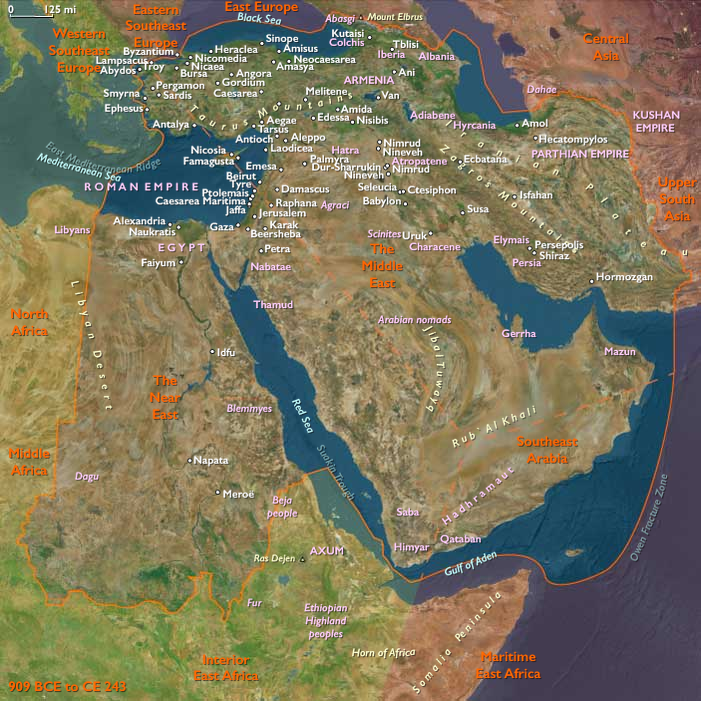
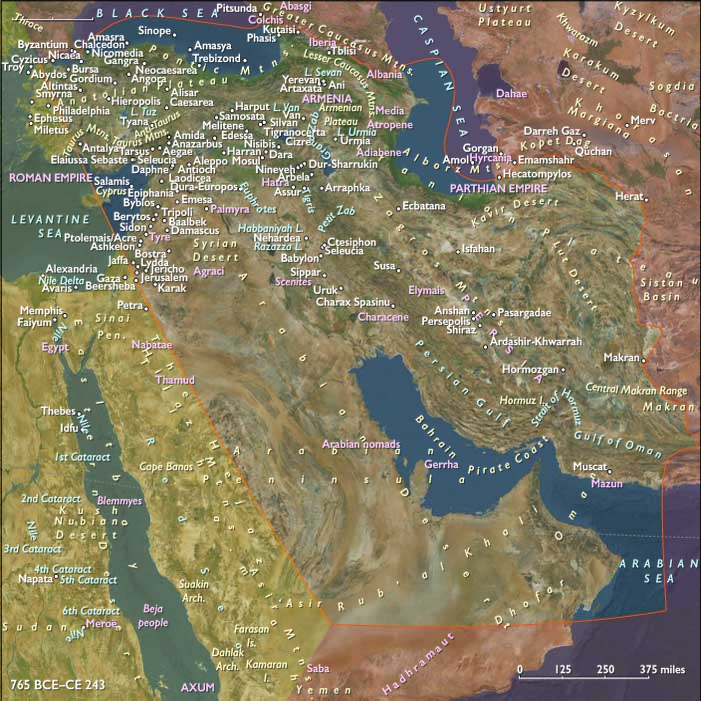
Alexander receives the surrender of the famous Persian treasury at nearby Pasargadae, the burial place of Cyrus the Great.
Locations
People
Groups
- Persian people
- Macedon, Argead Kingdom of
- Achaemenid, or First Persian, Empire
- Alexander, Empire of
- Greece, Hellenistic
Topics
Commodoties
Subjects
Regions
Subregions
Related Events
Filter results
Showing 10 events out of 64364 total
Alexander crushes the mountain tribe of the Ouxians, then presses on over the Zagros range into Persis proper.
Successfully turning the strong defensive position known as the “Persian Gates”, held by the satrap Ariobarzanes, only after an unsuccessful and costly initial assault, he enters Persepolis, the official Achaemenian capital.
Plundering the city, he ceremonially burns down the palace of Xerxes, as a signal to dissident Greeks at home that the Panhellenic war of revenge is at an end (for such seems the probable significance of an act that tradition later explains as a drunken frolic inspired by Thaïs, an Athenian courtesan. The authenticity of this anecdote, which forms the subject of John Dryden's Alexander's Feast (1697), is doubtful, since it is based upon the authority of Cleitarchus, one of the least trustworthy of the historians of Alexander.).
Alexander marches north into Media in spring 330 BCE and occupies its capital Ecbatana, the summer residence of the Achaemenian kings.
He sends home the Thessalians and Greek allies; henceforward he will wage a purely personal war.
His views on the empire are changing, as the appointment of Mazaeus indicates: he has come to envisage a joint ruling people consisting of Macedonians and Persians, and this serves to augment the misunderstanding that now arises between him and his people.
Before continuing his pursuit of Darius, who has retreated into Bactria, he assembles all the Persian treasure and entrusts it to Harpalus, who is to hold it at Ecbatana as chief treasurer.
Parmenio, an older man whose presence has perhaps become irksome, is also left behind in Media to control communications.
Darius had retired toward Bactria on the approach of Alexander, but his cousin Bessus, the satrap of Bactria, distrusts Darius' will to keep fighting.
After a skirmish near modern Shahrud, Bessus deposes Darius, has him stabbed, and leaves him to die.
Alexander sets out at a high speed in midsummer 330 BCE for the eastern Persian provinces via Rhagae (modern Rayy, near Tehran) and the Caspian Gates, where he learns that Bessus has deposed Darius.
The death of Darius, whose body Alexander covers with his own robe and sends his for burial with due honors in the royal tombs at Persepolis, leaves no obstacle to Alexander's claim to be Great King; a Rhodian inscription of this year calls him “lord of Asia” i.e., of the Persian Empire.
Soon afterward, his Asian coins will carry the title of king.
Crossing the Elburz Mountains to the Caspian, Alexander seizes Zadracarta (Astrabad, modern Gorgan) in Hyrcania (“Wolf's Land) and receives the submission of a group of satraps and Persian notables, some of whom he confirms in their offices; in a diversion westward, …
…perhaps to modern Amol, Alexander reduces the Mardi, a mountain people who inhabit the Elburz Mountains.
He also accepts the surrender of Darius' Greek mercenaries.
Alexander III of Macedon, following the unification of the multiple city-states of ancient Greece under the rule of his father, Philip II (a labor Alexander had had to repeat because the southern Greeks had rebelled after Philip's death), has set out to conquer the Achaemenid Persian Empire.
His conquests will usher in centuries of Greek settlement and cultural influence over distant areas, a period known as the Hellenistic Age, a combination of Greek and Middle Eastern culture.
Alexander’s advance eastward in 330 BCE increases in speed.
Marching through the borders of Aria, a region in the eastern part of the Persian empire, on his way from Hyrcania against the Parthians, Alexander had been met at a city named Susia by Satibarzanes, who had made submission to him, and had been rewarded for it by the restoration of his satrapy.
In order to prevent the commission of any hostilities against the Arians by the Macedonian troops which were following from the west, Alexander had left behind with Satibarzanes forty horse-dartmen, under the command of Anaxippus.
These, however, together with their commander, had soon after been murdered by the satrap, who then excited the Arians to rebellion, gathering his forces together at the city of Artacoana.
On the approach of Alexander, Satibarzanes flees to join the traitor Bessus; and the city, after a short siege, is captured by the Macedonians.
Alezander founds Alexandria of the Arians (modern Herat).
Although Alexander fails to take the satrap himself, he maintains direction southward, toward Arachosia and Drangiana, home satrapies of Barsaentes, another of Darius' murderers.
Barsaentes, however, flees to India.
Towards the end of this same year (330 BCE), Alexander hears that Satibarzanes has again entered Aria with two thousand horses, supplied by Bessus, and has excited the Arians to another revolt.
According to Arrian, upon this, he sends a force against him, led by Artabazus, Erigyius, and Caranus.
In a battle that ensues, and of which the issue is yet doubtful, Satibarzanes comes forward and defies any one of the enemy's generals to single combat.
The challenge is accepted by Erigyius, and Satibarzanes is slain.

Alexander at last takes steps to destroy Parmenio and his family at Phrada, the capital of Drangiana (either near modern Nad-e 'Ali in Seistan or farther north at Farah).
Philotas, the son of Parmenio and commander of the elite Companion cavalry, is implicated in an alleged plot against Alexander's life, condemned by the army, and executed; and, as a matter of practical politics, a secret message is sent to Cleander, Parmenio's second in command, who obediently assassinates him.
This ruthless action excites widespread horror but strengthens Alexander's position relative to his critics and those whom he regards as his father's men.
Ptolemy, having taken part in Alexander's European campaigns of 336-335, in the fall of 330, is appointed personal bodyguard (somatophylax) to Alexander.
All Parmenio's adherents are now eliminated and men close to Alexander promoted.
The Companion cavalry is reorganized in two sections, each containing four squadrons (now known as hipparchies); one group is commanded by Alexander's oldest friend, Hephaestion, the other by Cleitus, an older man.
Bessus, now in Bactria and ruling as Artaxerxes V with the usurped title of Great King, attempts to continue guerilla resistance against Alexander by raising a national revolt in the eastern satrapies.
An Athenian court finally hears the case of Aeschines versus Ctesiphon in 330, nearly six years after the original charges were filed.
Demosthenes is of course the real target, for Aeschines had accused Ctesiphon of making a false statement when he praised the orator's patriotism and public service.
In Demosthenes’ brilliant speech (On the Crown), he speaks so eloquently in Ctesiphon's defense that his lifelong rival loses the suit and is required to pay damages.
The discredited Aeschines leaves Athens for Rhodes, where he is said to have taught rhetoric.
Aristotle around 330 writes the Rhetoric, in which he treats the subject in a more systematic and theoretical fashion while employing traditional rhetorical methods.
He assigns priority to the orator's ability to invent arguments, to determine what is plausible in a given case; only then does he examine the strategy and verbal form of the plea.
Aristotle identifies three types of persuasive oratory: the oratory of the courtroom, of the public forum, and of the ceremony.
He then defines three means of persuasion: the appeal to reason (logos), the appeal to emotion (pathos), and the appeal of the speaker’s character (ethos).
The animal fables of Aesop begin to be collected in Greece.
Aristotle describes Aesop’s use of the tale of the fox and the hedgehog to defend a corrupt politician: a hedgehog asked a fox, ridden with fleas, if he could remove them.
“No,” replied the fox, “these fleas are full and will not suck much blood.
Remove them, and new, hungry fleas will replace them.”
Aesop supposedly appended the tale with an appeal to the jury: “So, gentlemen, should you put my wealthy client to death, others not rich will come along and rob you completely.”
Years: 330BCE - 330BCE
Locations
People
Groups
- Persian people
- Macedon, Argead Kingdom of
- Achaemenid, or First Persian, Empire
- Alexander, Empire of
- Greece, Hellenistic