
Alexander II of Macedon has intervened in …
Years: 369BCE - 369BCE
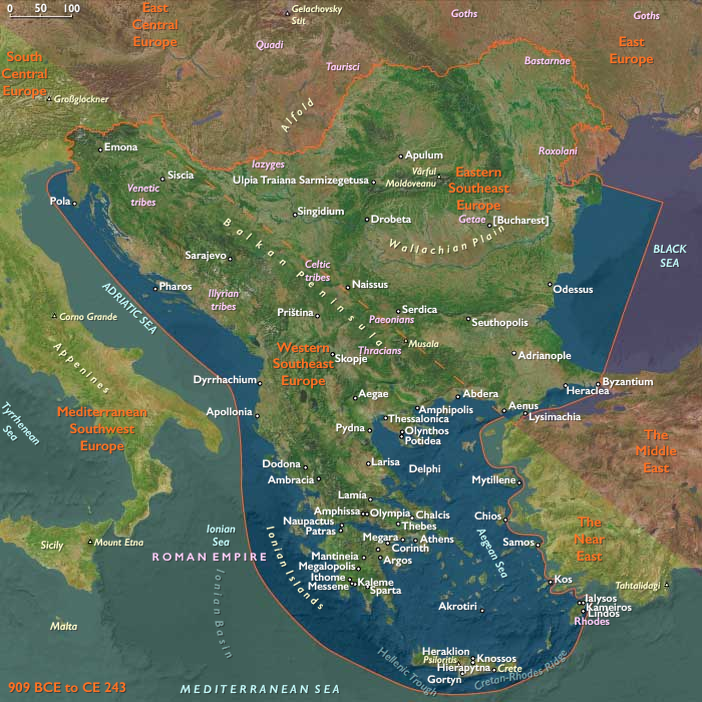
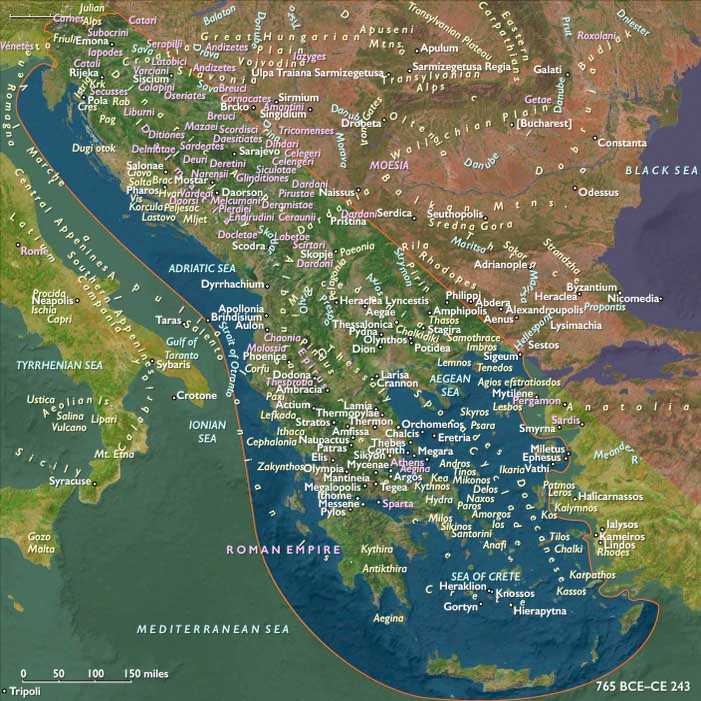
Alexander II of Macedon has intervened in the civil war at the request of the Thessalian Aleuadae.
Alexander of Pherae, prepares to meet his enemy in Macedonia but the king anticipates him, and, reaching Larissa, is admitted into the city.
Alexander withdraws to Pherae while the Macedonian king places a garrison in Larissa, as well as in Crannon, which has also come over to him.
Once the bulk of the Macedonian army retires, however, the states of Thessaly, fearing the return and vengeance of Alexander, send for aid to Thebes, whose policy it is to put a check on any neighbor who might otherwise become too formidable.
Thebes accordingly dispatches Pelopidas to the aid of Thessaly.
Pelopidas checks the ambitions of Alexander of Pherae, and drives the forces of the king of Macedon out of Thessaly.
During the successful campaign, …
Locations
People
Groups
Topics
Commodoties
Subjects
Regions
Subregions
Related Events
Filter results
Showing 10 events out of 64790 total
Cotys, king of Thrace, opposes Ariobarzanes of Phrygia, and his ally, the Athenians, on their revolt from Persian rule.
He goes to war with the Athenians soon after for the possession of the Thracian Chersonese.
Athens, now that she cannot trust Iphicrates to protect her interests, organizes a rebellion against Cotys, led by his treasurer Miltokythes.
Iphicrates, having retired to Thrace, fights also for the Thracian king against Athens: with the help of Charidemus, a Greek mercenary leader from Euboea who had served under Iphicrates at Amphipolis, he bribes the Athenian military and naval commanders to suppress the rebellion.
Charidemus, captured by the Athenians, is taken into their service and receives their citizenship, but in 362, he is discharged.
After participating in the revolt of satraps in Persia, he again joins Cotys, and returns to Athens in 361 with a treaty from Cotys, proclaiming him an ally.
Cotys has successfully retained his kingdom.
By 359 BCE, Cotys controls the whole Chersonese peninsula.
During the same year he makes an alliance with the new Macedonian king, Philip II.
In 358 BCE, he is murdered by two of Plato’s students from Aenus, Python and Heraclides.
Thought previously as advisers to the King, they murdered him during a feast in his palace, under the pretext that he had wronged their father.
Upon their return to Athens, they are proclaimed honorary citizens and rewarded with gold wreaths.
On Cotys' murder, Charidemus becomes guardian to the dead king's young son, Cersobleptes, in conjunction with Berisades and Amadocus II, who are probably his brothers.
He is very young at this time, and the whole management of his affairs is assumed by Charidemus, who is connected by marriage with the royal family.
The area controlled by Cersobleptes is east of the river Hebrus.
The Odrysian empire splits itself in three smaller kingdoms, of which this one, with the capital at Seuthopolis, is to survive the longest.
The Middle East: 369–358 BCE
Revolts and Realignments within the Persian Empire
This era in the Persian Empire under Artaxerxes II is marked by continued political turbulence, with satraps frequently challenging central authority. Following the resolution of Evagoras' rebellion in Cyprus, unrest flares again in the empire’s western provinces, notably in Anatolia, Phoenicia, and Egypt. These regions are consistently restive, driven by local ambitions, dissatisfaction with Persian rule, and encouragement from external powers, particularly Greek city-states.
In Egypt, Pharaoh Nectanebo I (reigned 380–362 BCE) strengthens defenses against Persian reconquest attempts and sponsors revolts in Syria and Palestine to divert Persian resources. This results in prolonged but indecisive warfare that weakens Persian control in the Levant.
Meanwhile, in Anatolia, Persian satraps continue to assert semi-autonomous authority, often forming informal alliances with influential Greek states. The Persian Empire, though still powerful, increasingly appears strained by internal dissent and external pressures, foreshadowing greater difficulties in maintaining cohesion over its extensive territories.
Despite these tensions, Artaxerxes II successfully manages the immediate crises through strategic use of diplomacy and selective military interventions. The empire remains intact, though clearly demonstrating vulnerabilities that future opponents, such as the rising kingdom of Macedon, will later exploit.
Near East (369–358 BCE): Revolt of the Satraps and Persian Restoration
Between 369 and 358 BCE, the Near East is significantly shaped by internal turmoil within the Persian Empire, prominently featuring the Revolt of the Satraps. This widespread insurrection represents the greatest challenge to Persian authority since the earlier revolt led by Cyrus the Younger.
Key figures in this revolt include Orontes, traditionally identified as the satrap of Mysia but possibly of Armenia, indicating an even broader geographical scope of rebellion. Joining Orontes are notable regional rulers such as Mausolus of Caria (briefly), Autophradates of Lydia, and the distinguished military commander Datames, satrap of Cappadocia. Datames, respected for his skill, had inherited his position around 384 BCE but rebelled in 372 BCE due to deteriorating relations with the Persian court. Despite efforts by neighboring satraps Autophradates and Artumpara of Lycia to suppress his rebellion, Datames successfully withstands their attacks.
Further complicating matters, Ariobarzanes, satrap of Phrygia and initially a temporary appointee in Hellespontine Phrygia, refuses to yield his authority to the legitimate heir, Artabazos, and joins the revolt around 366 BCE. He receives crucial support from King Agesilaus II of Sparta, enabling him temporarily to withstand a siege by Persian-aligned satraps, including Mausolus and Autophradates. Nevertheless, Ariobarzanes is ultimately betrayed and killed in 363 BCE by his son Mithradates.
Orontes emerges as the leader of the insurgent satraps due to his noble status, but internal distrust among the rebels undermines the revolt. Seeking compromise, Orontes eventually betrays his fellow satraps, leading to the swift collapse of the rebellion. Datames, betrayed by his son-in-law Mitrobarzanes, is assassinated, and Persian authority is systematically restored through a series of treacheries.
By the time of King Artaxerxes II's death in 359 BCE, the revolt is effectively quelled, less by decisive Persian military action than by internal rivalries among the insurgents themselves. This era underscores the persistent challenges to Persian dominance and highlights the complex interplay of local ambition and imperial control shaping the Near Eastern geopolitical landscape.
Orontes, described by the sources as satrap of Mysia, leads the last and greatest phase of the Revolt of the Satraps (362-359). (“Mysia”, possibly an enclave in the Troad region of Anatolia, could, however, also be an error for “Armenia.” If so, the geographic spread of the insurrectionist satraps is still greater.)
The other rebelling satraps are Mausolus of Caria (briefly) and …
…Autophradates of Lydia.
Some participation by local Greek cities in Anatolia is possible, though perhaps they merely follow the lead of their satrapal overlords; Athens and Sparta seem surreptitiously to have helped.
The aims of the revolt are a matter for speculation, but it looks serious: a second and successful Cunaxa is a possibility.
The satraps, however, are divided by mutual distrust.
Datames, the satrap of Cappadocia and a talented military commander, had after 384 BCE inherited his satrapy from his father Camissares.
He is a respected military commander but later problems with the court led him to revolt in 372 BCE.
The Persian court commanded the neighboring satraps, Autophradates of Lydia and Artumpara of Lycia, to crush the rebellion but Datames successfully resists their attacks.
Ariobarzanes, satrap of Phrygia and son of the ruler of Pontus, had been made acting satrap of Hellespontine Phrygia until Artabazos, the legitimate heir of the satrapy, could take office, but when Artabazos is ready to take the satrapy, Ariobarzanes refuses to surrender it and in 366 BCE joins Datames' revolt.
Ariobarzanes seeks foreign aid and receives it from King Agesilaus II of Sparta.
Ariobarzanes withstands a siege from Mausolus of Caria and Autophradates of Lydia until Agesilaus negotiates the besiegers’ retreat.
Ariobarzanes is killed in 363, betrayed by his son Mithradates.
Orontes, satrap of Armenia, revolts in 362 after he is ordered by the King to move to Mysia.
His noble birth leads the other satraps to recognize him as leader of the revolt but Orontes later seeks a compromise with the King and betrays the other satraps, after which the rebellion soon collapses.
Orontes receives much of the Aegean coast while Datames is killed after his son-in-law Mitrobarzanes betrays him.
Ariobarzanes is also killed but the other satraps are pardoned, thus ending the rebellion.
The rebellion is finally put down by Persia through a series of treacheries.
The revolt is over at the date of Artaxerxes' death in 359, Achaemenid authority having been restored over most of the empire—more from internal rivalries and discord than from Artaxerxes' efforts.
Olynthus reestablishes the Chalcidian League following the defeat of Sparta by Thebes in 371 BCE, and is able to attain even greater wealth and power than before.
Xenophon, banished from Athens because of his pro-Spartan sympathies, serves in the Spartan army.
The Spartans eventually reward him with a property near Olympia, where he devotes himself to hunting and literature.
Picking up where Thucidydes left off, Xenophon writes the Hellenica, a history of Greece from 411 to 362.
He also authors a romantic biography of Cyrus the Great, Cyropaedia, and numerous lesser essays.
Mediterranean Southwest Europe (369–358 BCE): Syracuse’s Stalemate, Roman Political Reforms, and Renewed Etruscan Conflict
The era 369–358 BCE witnesses a critical transition in Mediterranean Southwest Europe, marked by the waning efforts of Dionysius I of Syracuse against Carthage, transformative political reforms within the Roman Republic, and renewed conflict involving Rome and the Etruscan city of Tarquinia.
Dionysius I and Carthage: A Stalemate in Sicily
Throughout his lengthy reign, Dionysius I of Syracuse has conducted persistent but inconclusive military campaigns against Carthage, aiming to fully expel Carthaginian power from Sicily. Despite intermittent successes, Dionysius' strategic goal ultimately remains unattained. At the time of his death in 367 BCE, Carthaginian dominance persists robustly over approximately one-third of the island, underscoring a stalemate that confirms Carthage as an enduring power in the region.
Dionysius' failure to decisively remove Carthaginian presence from Sicily leaves Syracuse powerful yet restrained, reflecting the entrenched geopolitical balance in the Western Mediterranean.
Roman Republic: The Plebeians Gain Political Influence
In central Italy, significant political reforms dramatically alter Rome’s internal structure. By 367 BCE, Rome’s plebeian class achieves a major milestone: after years of agitation, plebeians secure the right to hold the highest political office, the consulship. The landmark change requires that one of the two annually elected consuls now be chosen from among the plebeians, significantly reducing the political exclusivity historically held by Rome’s patrician elite.
This pivotal reform enables plebeians to enter the previously patrician-dominated Senate, profoundly altering the composition of Roman political institutions. This newfound representation gradually transforms Rome into a more inclusive republic, setting crucial precedents for future political developments.
Renewed Conflict: Tarquinia and Rome
Amidst internal political adjustments, Rome confronts external conflict. The prominent Etruscan city-state of Tarquinia, perceiving Roman expansion as a direct threat, initiates a defensive war against Rome in 358 BCE. This conflict underscores the fragility of regional alliances and highlights the broader tensions among Etruscans, Romans, and other Italian peoples. Tarquinia’s decision to wage defensive warfare symbolizes a broader resistance to Rome’s expansionist ambitions and sets the stage for subsequent hostilities between the two states.
Legacy of the Era
The era 369–358 BCE critically reshapes Mediterranean Southwest Europe through Syracuse’s stalemated rivalry with Carthage, Rome’s internal transformation driven by plebeian political empowerment, and the resurgence of Etruscan resistance symbolized by Tarquinia. These intertwined developments significantly influence the region’s subsequent history, establishing the foundation for future political and military shifts in Italy and Sicily.
Dionysius I of Syracuse has warred against Carthage with mixed success; his attempts to drive the Carthaginians entirely out of Sicily fail, and they are masters of at least a third of the island at his death in 367 BCE.
Rome’s plebeians have gradually gained admission to virtually all state offices; after 367, only one consul is chosen from among Rome’s patricians, the other is elected from the plebeians.
Now that the consulship is opened to them, plebeians begin to enter the Senate.
