Alexander II marries Joan Plantagenet, the sister …
Years: 1221 - 1221
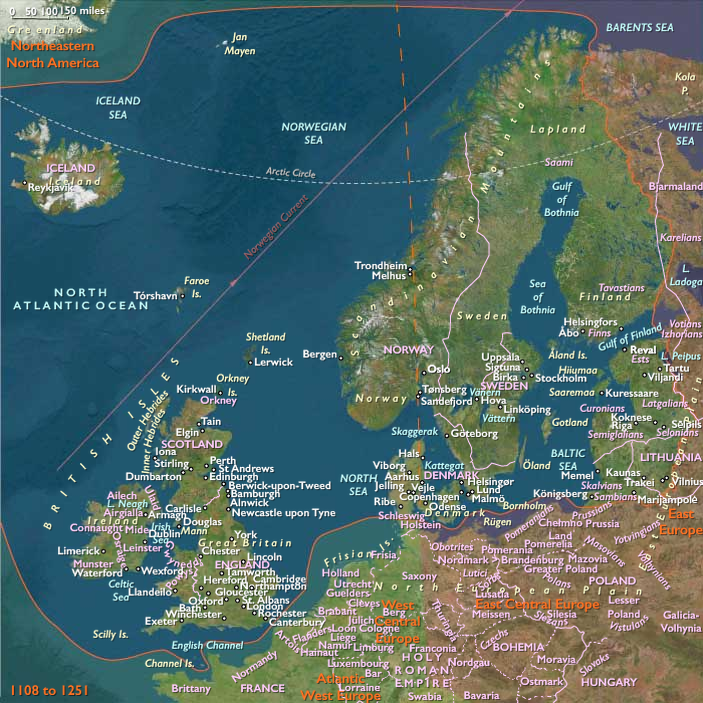
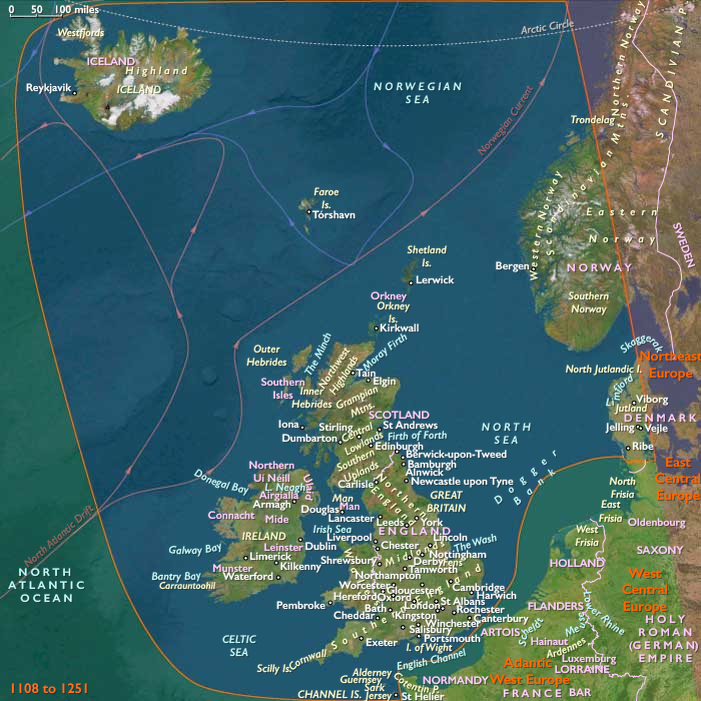
Alexander II marries Joan Plantagenet, the sister of English king Henry III, in 1221.
Locations
People
Groups
Subjects
Regions
Subregions
Related Events
Filter results
Showing 10 events out of 47182 total
The hereditary shogun has become a puppet ruler much like the emperor, as real power in Japan has passed into the hands of the Hojo family, whose leaders take the title of shikken (regent) and direct the Emperor in his appointments of puppet shoguns.
The imperial court and the Bakufu, the military government at Kamakura, now function virtually independently of each other.
Japan’s house of Genji perishes with the third shogun Ninamoto-no-Sanetomo, assassinated in 1219.
Emperor Go-toba (Toba II), realizing that his influence is severely limited, abdicates in hope of gaining more by manipulating, from off his throne, important officials.
Having gained the backing of large, militarily strong monasteries, he attempts in 1221 to raise an imperial army to break the power of the Bakufu in Kamakura.
Samurai forces loyal to Hojo Masako, Yoritomo’s widow and Sanetomo’s mother, quickly counter an uprising in Kyoto.
The samurai army marches to Heian and crushes the rebellion in 1221.
The emperor is banished, and the Hojos install two of their own as military governors in Kyoto, assume command of the court and the imperial succession, and confiscate the estates of the emperor’s adherents and distribute them among their own loyalists.
The result of this so-called Jokyu War is the entrenchment of the feudal system and the strengthening of control by the Japanese military establishment.
The twelfth and early thirteenth centuries had been the golden age of Urgench, which had become the capital of the Khwarezm Empire, surpassing in population and fame all other Central Asian cities barring Bukhara.
In 1221, Genghis Khan razes it to the ground in one of the bloodiest massacres in human history.
Large areas of Islamic Central Asia and northeastern Iran are seriously depopulated, as every city or town that resists the Mongols is subject to destruction.
In Termez, on the Oxus: "all the people, both men and women, were driven out onto the plain, and divided in accordance with their usual custom, then they were all slain".
Each soldier is required to execute a certain number of persons, with the number varying according to circumstances.
For example, after the conquest of Urgench, each Mongol warrior—in an army group that might have consisted of two tumens (units of ten thousand)—is required to execute twenty-four people.

A hillfort named Obran Osh (Ashli) at the site of future stone Kremlin, a small Russian wooden hillfort is founded by Grand Prince Yury II in 1221 after the destruction of the Mordvin Inäzor Obram in 1220.
Located at the confluence of two most important rivers of his principality, the Volga (Mordvin "Rav" or "Rava") and the Oka, Obran Osh is renamed.
Its name literally means Lower Newtown to distinguish it from the older Veliky Novgorod. (With a current population of 1,250,615, it is today the fifth largest city in Russia and the administrative center of Nizhny Novgorod Oblast.)
Robert of Courtenay, an irresponsible youth, had set out to take possession of his distracted inheritance, currently ruled by Conon of Béthune as regent.
Arriving in Constantinople in early 1221, he is crowned emperor on March 25.
Alexander of Hales and the Introduction of Peter Lombard’s Sentences as the Standard Theological Text (c. 1220 CE)
Around 1220, Alexander of Hales, an English theologian teaching at the University of Paris, became the first master to lecture on Peter Lombard’s Sentences as a formal part of theological education. His decision to adopt the Sentences as the foundational theological textbook set a precedent that would shape scholastic theology for centuries.
Alexander of Hales: A Pioneer of Scholastic Theology
- Born in Hales, England, Alexander began his formal education at the University of Paris in 1201, at the age of 15, studying arts, philosophy, and theology.
- By 1220, he had achieved the rank of master, allowing him to lecture on theology.
- It was during this period that he introduced Peter Lombard’s Sentences as the standard text for theological studies, transforming scholastic education.
Peter Lombard’s Sentences: The New Theological Textbook
- Written in the 12th century, Peter Lombard’s Four Books of Sentences was a systematic compilation of Christian doctrine, structured around:
- The Trinity
- Creation and sin
- The Incarnation and virtues
- The sacraments and the Last Things (eschatology)
- Before Alexander’s time, theology was studied primarily through commentaries on Scripture.
- By establishing the Sentences as the standard theological textbook, Alexander shifted theological study toward a structured, question-and-answer format, laying the foundation for scholastic disputation.
Impact and Legacy
-
Standardization of Theological Education
- The Sentences became the core text for theological study at Paris, Oxford, and other medieval universities.
- Every major scholastic theologian from Thomas Aquinas to John Duns Scotus and William of Ockham would later be required to write a commentary on the Sentences.
-
Scholastic Methodology
- Alexander’s use of the Sentences encouraged rigorous logical analysis of theological issues, influencing the development of systematic theology.
-
Establishing the Scholastic Tradition
- His work helped define the intellectual framework of medieval theology, bridging Augustinian thought with Aristotelian logic.
Alexander of Hales’ decision to lecture on Peter Lombard’s Sentences around 1220 revolutionized the study of theology, cementing the scholastic tradition that would dominate medieval Christian thought for the next three centuries.
The Mongols’ battle with the Georgians at Bardav (Pardav; modern-day Barda, Azerbaijan) is indecisive and the invaders withdraw to the Caspian Sea.
The Georgians have suffered heavy losses and the King himself has been severely wounded.
The Mongols under Subutai and Jebe march to the north, plundering northeastern Armenia and Shirvan en route.
Jalal ad-Din Mengübirti had come to power in 1220 following the defeat of his father, the Khwarezm Shah Ala ad-Din Muhammad II, by Genghis Khan, but rejects the title shah that his father had assumed, calling himself simply sultan.
Jalal ad-Din has retreated with the remaining Khwarazmian forces, while pursued by a Mongol army, and at the battle of Parwan, near Ghazni, he defeats the Mongols.
The minor rout at Parwan inspires the cities of Herat and Merv to rebel, resulting in their destruction on the orders of Genghis Khan.
Due to the Mongol invasion, the sacking of the capital city of Samarkand, and the desertion of his Afghan allies, Jalal ad-Din is forced to flee to India.
Jalal ad-Din’s Muslim forces block their Mongol pursuers near the Afghan city of Bamian in a pass between the Koh-i-Baba mountains and the Hindu Kush.
Genghis Khan lays siege to the city.
Angered at the death of a grandson at the hands of the defenders, he captures Bamian after incurring heavy losses, razes it, and slaughters all the inhabitants.
(Afterward, even the Mongols refer to Bamian as “the city of sorrow.”) Jalal’s forces continue their flight into India, the Mongols at their heels, adhering to Genghis Khan’s dictum that he leave no potential attacker alive.
It is commonly believed after the local Afghan population was wiped out, Genghis repopulated the area with some of his Mongol troops and their enslaved women, in order to guard the region while he continued his campaign.
These settlers would become the ancestors of the Hazara people—with the word “Hazara” most likely derived from the Persian word “yek hezar” (“one thousand”), for the Mongol military unit of one thousand soldiers.