
Alexander confronts his first Persian army at …
Years: 334BCE - 334BCE
May
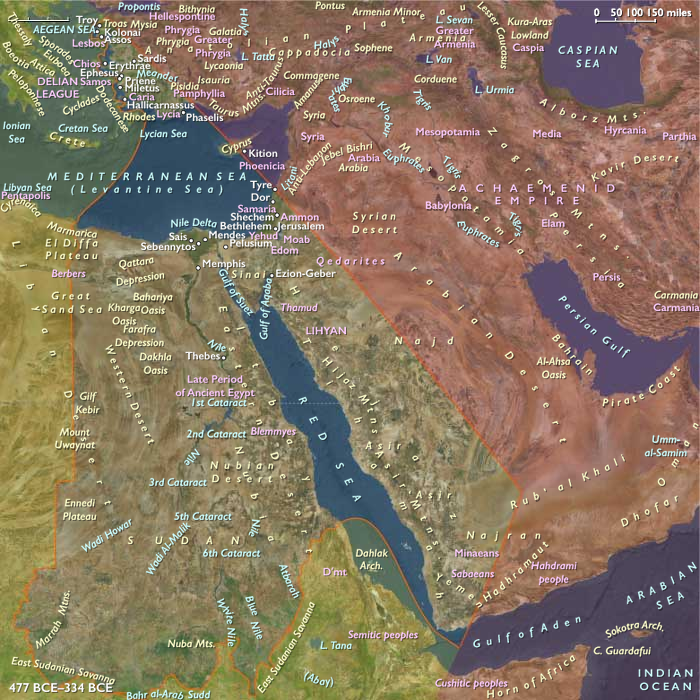
Alexander confronts his first Persian army at the Granicus River (modern Kocabas, flowing into the Sea of Marmara) in May/June 334.
This is not the central army of the Persian king but a very sizable force levied by the satraps from Anatolia itself, numbering perhaps forty thousand and led by three satraps.
Darius has made no serious preparations to resist the Macedonian invasion.
Alexander's shock troops ford the stream and clamber up the bank under a shower of javelins.
Alexander follows and charges the generals, who are concentrated in the left center of the Persian line, leading the right wing with a battle cry to the god of battle.
He kills two relatives of the Persian king, Darius, and is himself saved from death by his cavalry commander, Cleitus the Black.
The Persian plan to tempt Alexander across the river and kill him in the melee almost succeeds; but the Persian line breaks, and Alexander's victory is complete.
Darius' Greek mercenaries are largely massacred, but two thousand survivors are sent back to Macedonia in chains.
According to Alexander's biographer, Arrian (second century CE), the struggle has cost the Macedonians only one hundred and fifteen men.
This victory exposes western Asia Minor to the Macedonians, and most cities hasten to open their gates.
The tyrants are expelled and (in contrast to Macedonian policy in Greece) democracies are installed.
Alexander thus underlines his Panhellenic policy, already symbolized in the sending of three hundred panoplies (sets of armor) taken at the Granicus as an offering dedicated to Athena at Athens by “Alexander son of Philip and the Greeks (except the Spartans) from the barbarians who inhabit Asia.” (This formula, cited by the Greek historian Arrian in his history of Alexander's campaigns, is noteworthy for its omission of any reference to Macedonia.)
However, the cities remain de facto under Alexander, and his appointment of Calas as satrap of Hellespontine Phrygia reflects his claim to succeed the Great King of Persia.
Locations
People
Groups
- Ionians
- Greece, classical
- Persian people
- Greeks, Classical
- Macedon, Argead Kingdom of
- Achaemenid, or First Persian, Empire
- Athens, City-State of
- Corinth, League of
Topics
Commodoties
Subjects
Regions
Subregions
Years: 334BCE - 334BCE
May
Locations
People
Groups
- Ionians
- Greece, classical
- Persian people
- Greeks, Classical
- Macedon, Argead Kingdom of
- Achaemenid, or First Persian, Empire
- Athens, City-State of
- Corinth, League of
Topics
Commodoties
Subjects
Regions
Subregions