
Alesso Baldovinetti is appointed curator and restorer …
Years: 1483 - 1483
Alesso Baldovinetti is appointed curator and restorer of the Florence Baptistery mosaics at fifty-eight in 1483.
Verrocchio in this year completes eighteen years of work on his major public sculpture in Florence, the “Doubting of Thomas,” a life-size group cast in bronze.
Placed in a niche at Or San Michele, the work displays the mastery and sensitivity of Desiderio at his best.
Luigi Pulci polishes and exploits the Carolingian epic of “Roland” in his Italian romantic epic Morgante, sometimes also called Morgante Maggiore (i.e., the "Greater Morgante", the name given to the complete twenty-eight canto edition published in 1483; a now lost twenty-three canto version had likely appeared in late 1478; two other twenty-three canto versions had been published in 1481 and 1482.)
Based on popular Matter of France material, the poem tells the story of Orlando and Renaud de Montauban (in Italian, Renaldo or Rinaldo), the most famous of Charlemagne's paladins, in a frequently burlesque fashion.
The title character is a giant who becomes Orlando's loyal follower after the knight stops him from attacking the monastery of Chiaromonte and converts him to Christianity.
After many strange adventures, Morgante is killed by a bite from a crab.
Other characters include Morgante's friend, the gluttonous Margutte who dies in a fit of laughter, and the philosophically inclined demon Astarotte.
The poem ends with an account of Orlando's defeat and death at the Battle of Roncesvalles.
The last five cantos of Pulci's work are based on La Spagna, a fourteenth-century Italian epic attributed to the Florentine Sostegno di Zanobi.
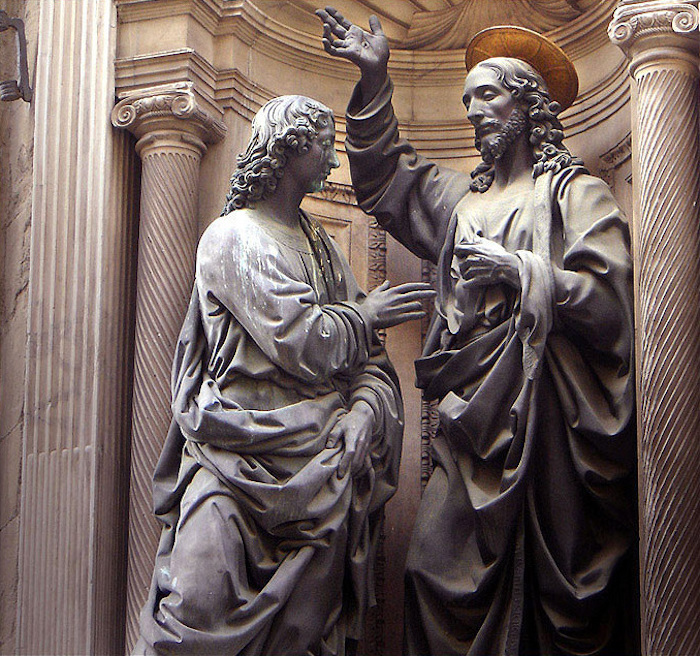
Andre del Verrocchio: Doubting of Thomas (1483) Orsanmichele, Florence, Italy. Photo taken 2007 taken by Ricardo André Frantz
Locations
People
Groups
Topics
Subjects
Regions
Subregions
Related Events
Showing 10 events out of 40535 total
Years: 1483 - 1483
Andre del Verrocchio: Doubting of Thomas (1483) Orsanmichele, Florence, Italy. Photo taken 2007 taken by Ricardo André Frantz
Locations
People
Groups
Topics
Subjects
Regions
Subregions