
Albrecht Dürer presents to the city of …
Years: 1526 - 1526
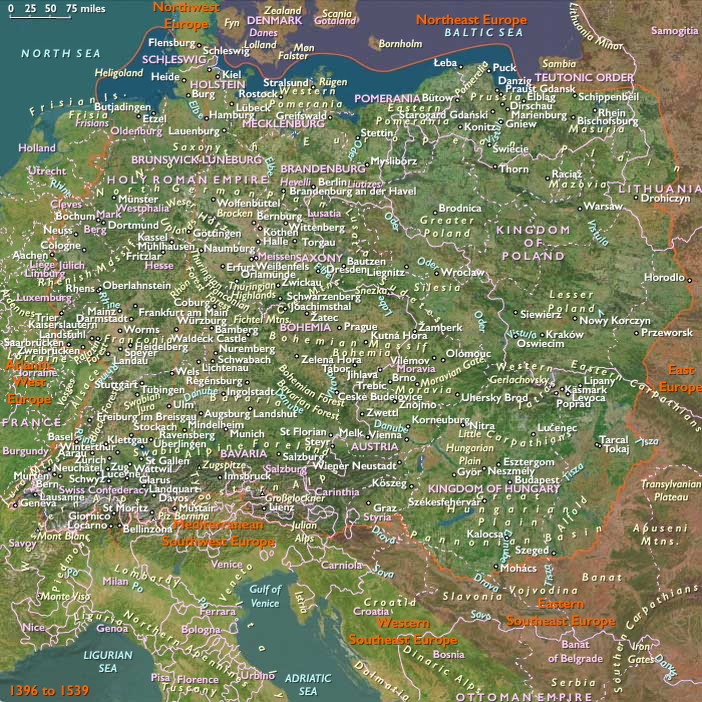
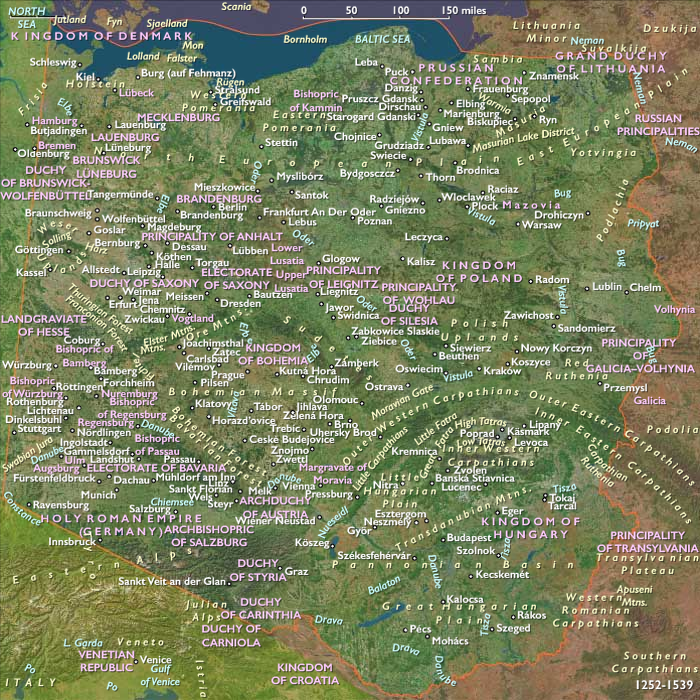
Albrecht Dürer presents to the city of Nuremberg in 1526 the “Adoration of the Trinity,” painted from 1508 to 1511.
On his return to Nuremberg, Dürer has worked on a number of grand projects with religious themes, including a crucifixion scene and a Sacra Conversazione, though neither is completed.
This may have been due in part to his declining health, but perhaps also because of the time he gave to the preparation of his theoretical works on geometry and perspective, the proportions of men and horses, and fortification.
However, one consequence of this shift in emphasis was that during the last years of his life, Dürer has produced comparatively little as an artist.
In painting, there is only a portrait of Hieronymus Holtzschuher, a Madonna and Child (1526), Salvator Mundi (1526), and two panels showing St. John with St. Peter in background and St. Paul with St. Mark in the background.
This last great work, the Four Apostles, a fusion of his personal vision with the monumental impact of Italian painting, is given by Dürer to the City of Nuremberg—although he is given one hundred guilders in return.
As for engravings, Dürer's work is restricted to portraits and illustrations for his treatise.
The portraits include Cardinal-Elector Albert of Mainz; Frederick the Wise, elector of Saxony; the humanist scholar Willibald Pirckheimer; Philipp Melanchthon, and Erasmus of Rotterdam.
For those of the Cardinal, Melanchthon, and Dürer's final major work, a drawn portrait of the Nuremberg patrician Ulrich Starck, Dürer depicts the sitters in profile, perhaps reflecting a more mathematical approach.
Despite complaining of his lack of a formal classical education, Dürer is greatly interested in intellectual matters and has learned much from his boyhood friend Willibald Pirckheimer, whom he no doubt consults on the content of many of his images.
He also derives great satisfaction from his friendships and correspondence with Erasmus and other scholars.
Dürer succees in producing two books during his lifetime.
"The Four Books on Measurement" are published at Nuremberg in 1525 and is the first book for adults on mathematics in German, as well as being cited later by Galileo and Kepler.
Locations
People
Groups
Topics
Commodoties
Subjects
Regions
Subregions
Related Events
Showing 10 events out of 38363 total
Years: 1526 - 1526
Locations
People
Groups
Topics
Commodoties
Subjects
Regions
Subregions