
Albert, called Albert the Bear, the only …
Years: 1157 - 1157
Albert, called Albert the Bear, the only son of Otto, Count of Ballenstedt, and Eilika, daughter of Magnus Billung, Duke of Saxony, had inherited the valuable estates in northern Saxony of his father in 1123, and on his mother's death, in 1142, had succeeded to one-half of the lands of the house of Billung.
Albert was a loyal vassal of his relation, Lothar I, Duke of Saxony, from whom, about 1123, he had received the Margraviate of Lusatia, to the east; after Lothar became King of the Germans, Albert had accompanied him on a disastrous expedition to Bohemia in 1126, when he suffered a short imprisonment.
Albert's entanglements in Saxony stemmed from his desire to expand his inherited estates there.
After the death of his brother-in-law, Henry II, margrave of a small area on the Elbe called the Saxon Northern March, in 1128, Albert, disappointed at not receiving this fief himself, had attacked Udo, the heir, and was consequently deprived of Lusatia by Lothar.
In spite of this, he had gone to Italy in 1132 in the train of the king, and his services there were rewarded in 1134 by the investiture of the Northern March, which was again without a ruler.
Once he was firmly established in the Northern March, Albert's covetous eye lay also on the thinly populated lands to the north and east.
For three years, he had campaigned against the Slavic Wends, who as pagans are considered fair game, and whose subjugation to Christianity had been the aim of the Wendish Crusade of 1147 in which Albert took part; diplomatic measures were more successful, and by an arrangement made with the last of the Wendish princes of Brandenburg, Pribislav of the Hevelli, Albert had secured this district when the prince died in 1150.
Taking the title "Margrave of Brandenburg", he has pressed the "crusade" against the Wends, extended the area of his mark, encouraged German migration, established bishoprics under his protection, and so becomes the founder of the Margraviate of Brandenburg in 1157, which his heirs — the House of Ascania — will hold until the line dies out in 1320.
Locations
People
Groups
- Polytheism (“paganism”)
- Saxons
- Germans
- Rani (Slavic tribe)
- Wends, or Sorbs (West Slavs)
- Polabian Slavs (West Slavs)
- Obotrites (Slavic tribal confederation)
- Saxony, Duchy of
- Holy Roman Empire
- Christians, Roman Catholic
- Brandenburg (Ascanian) Margravate of
Topics
Subjects
Regions
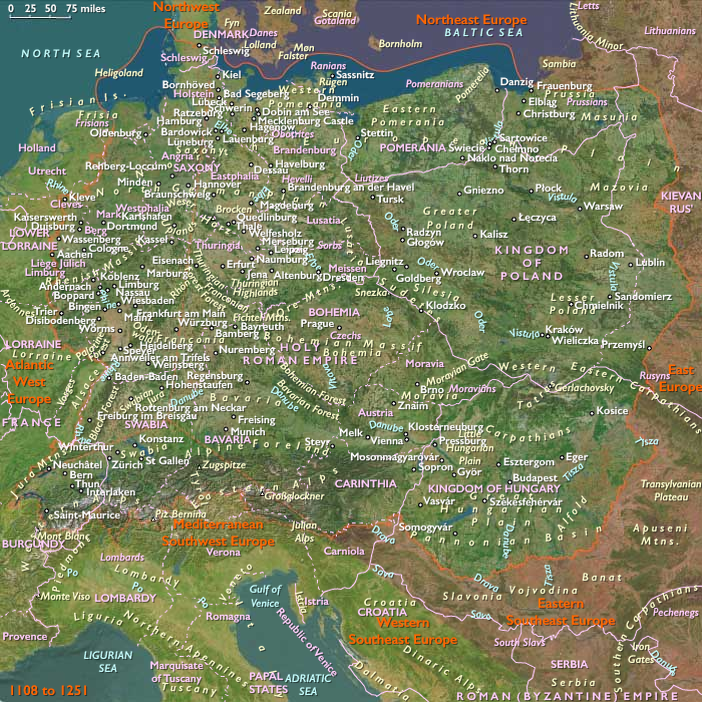
Subregions
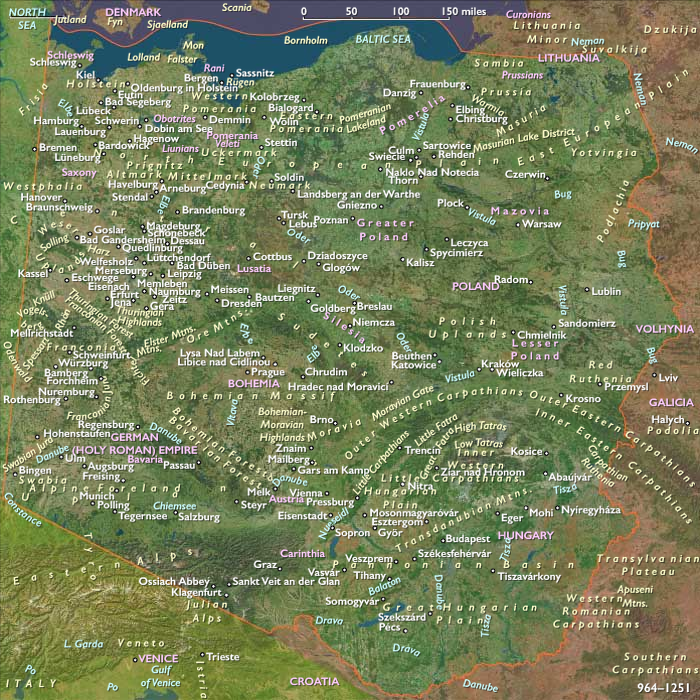
Years: 1157 - 1157
Locations
People
Groups
- Polytheism (“paganism”)
- Saxons
- Germans
- Rani (Slavic tribe)
- Wends, or Sorbs (West Slavs)
- Polabian Slavs (West Slavs)
- Obotrites (Slavic tribal confederation)
- Saxony, Duchy of
- Holy Roman Empire
- Christians, Roman Catholic
- Brandenburg (Ascanian) Margravate of
Topics
Subjects
Regions
Subregions