
Alauddin Khilji has by 1311 made tributaries …
Years: 1311 - 1311
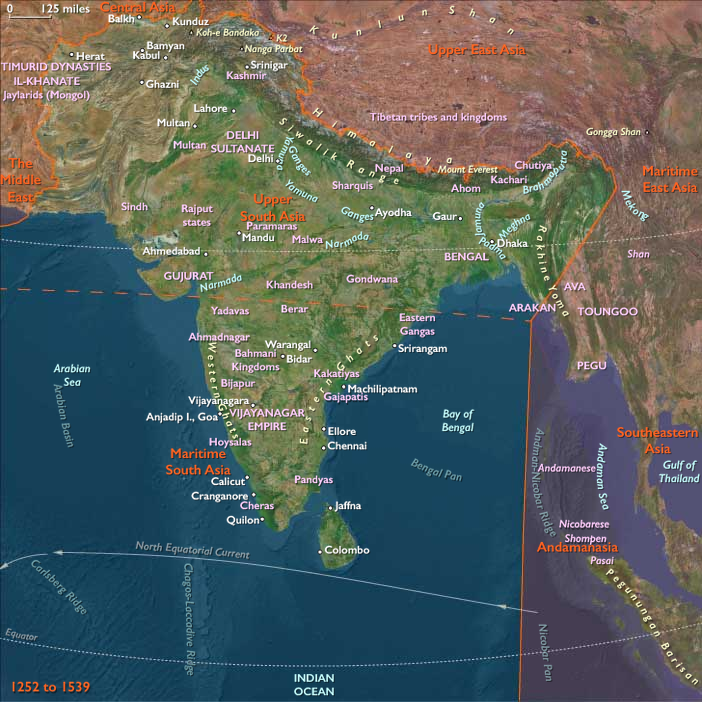
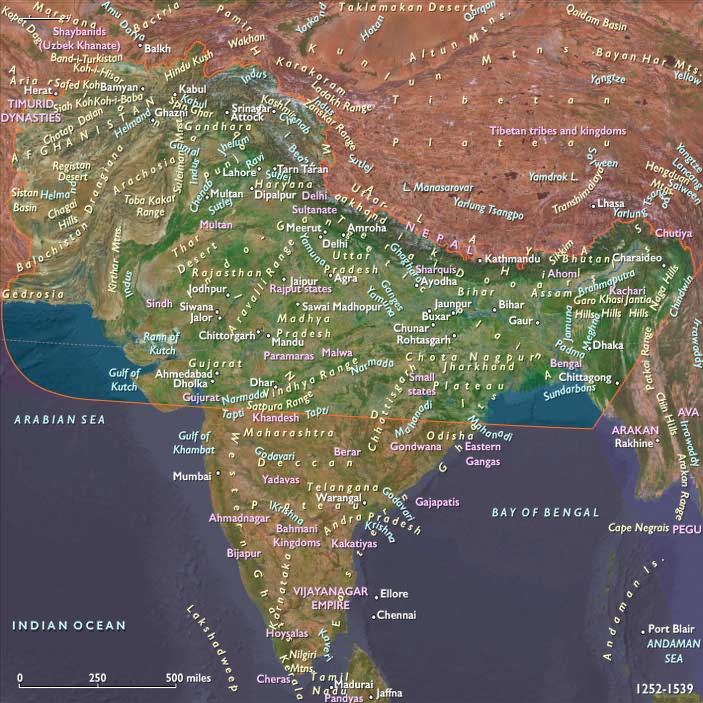
Alauddin Khilji has by 1311 made tributaries of the kingdoms of Rajasthan.
Locations
People
Groups
Topics
Commodoties
Subjects
Regions
Subregions
Related Events
Filter results
Showing 10 events out of 10 total
New Spain in the years following the conquest of Central Mexico by Hernán Cortés had been governed by a military government, generally with the objectives of maximizing personal economic gains by the Spanish conquistadors.
The metropolitan government of Charles V in Burgos, hoping to establish a more orderly government, to reduce the authority of Cortés, and to secure the authority of the Spanish crown in the New World, had on December 13, 1527 named the Real Audiencia de México to take over the government of the colony.
This Audiencia consists of a president and four oidores (judges).
Nuño Beltrán de Guzmán had been named president.
His oidores were Juan Ortiz de Matienzo, Diego Delgadillo, Diego Maldonado and Alonso de Parada; these two last had fallen sick during the voyage to New Spain and died shortly after arrival.
At the time Guzmán was serving as governor of Pánuco, so Charles had ordered the judges to assemble in Veracruz and from there make a joint entrance into the capital.
The four from Spain, however, had not waited for the arrival of Guzmán, and proceeded directly to the capital.
They arrived on December 8, 1528, taking over the government on the following day.
They had been given a splendid reception by the city government.
Guzmán had arrived a few days after the others; the Franciscan cleric Juan de Zumárraga had arrived in the capital only a few days before the oidores, with the title of bishop-elect and protector and defender of the Indians.
The instructions given to the Audiencia included a recommendation for good treatment of the indigenous people and a directive that the investigation into the conduct of Cortés and his associates Pedro de Alvarado, Alonso de Estrada, Rodrigo de Albornoz, Gonzalo de Salazar and Pedro Almíndez Chirino be concluded within ninety days.
Most of these associates had participated in the government in the preceding few years while Cortés was in Honduras, with a lot of infighting among themselves and injustices to the population, both Spanish and indigenous.
Cortés himself is currently in Spain, where he is defending his conduct and appealing his loss of authority to Charles.
Cortés has had some success with his appeal, being named Marqués del Valle de Oaxaca and receiving some other honors.
Nevertheless, Guzmán is now in charge in New Spain.
Among his official acts is the placement of plaques bearing the royal coat of arms on the principal buildings of the capital, to stress that sovereignty resides in the king, not in Cortés.
He has Pedro de Alvarado arrested for questioning the loyalty of Gonzalo de Salazar.
There is already some animosity between Cortés and Guzmán, because the former had been reluctant to recognize the latter as governor of Pánuco.
Subsequent events make the two enemies.
The Audiencia has also banned direct communication with the court in Spain.
This is so effective that Bishop Zumárraga feels the necessity of hiding a letter sealed in wax in a cask, to be smuggled to the Spanish authorities by a confederate sailor.
Juan de Zumárraga, born in 1468 of a noble family, in Durango in the Biscay province in Spain, had entered the Franciscan Order, and in 1527 was custodian of the convent of Abrojo.
Shortly afterwards he was appointed one of the judges of the court for the examination of witches in the Basque province.
From his writings it would appear that he looked upon witches merely as women possessed of hallucinations.
By this time more detailed accounts of the importance of the conquest of Hernán Cortés had begun to be received, and on December 20, 1527, Zumárraga was recommended by Charles V for the post of first bishop of Mexico.
Without having been consecrated and with only the title of bishop-elect and Protector of the Indians, he, accompanied by Andrés de Olmos, had left Spain with the first civil officials, auditors (oidores), towards the end of August 1528, and reached Mexico on December 6.
Thirteen days after, two auditors, Alonso de Parada and Diego Maldonado, persons of years and experience, died.
Their companions, Juan Ortiz de Matienzo and Diego Delgadillo, have assumed their authority, which is also shared by Nuño de Guzmán, who had come from his territories in the Pánuco Valley.
Their administration is one of the most disastrous epochs in New Spain and one of great difficulty for Zumárraga.
During the court case against Cortés in 1529, Guzmán accuses Cortés himself of being a traitor and a rebel.
Zumárraga, who had traveled with Guzmán to Hispaniola, in turn accuses Guzmán of having been a sworn enemy of Cortés even before setting foot in New Spain.
Meanwhile, news reaches Mexico that Cortés has been well received at the Spanish court and is about to return to New Spain.
Fearful of the consequences, Guzmán puts Ortiz de Matienzo in charge of the Audiencia.
Then, gathering a military force of three hundred to four hundred discontented conquistadors and between five thousand and eight thousand indigenous Nahua allies, Guzmán sets out on December 21, 1529, to the west of Mexico City to conquer lands and peoples who have so far resisted the conquest.
Among the officers on this expedition is Pedro Almíndez Chirino.
Zumárraga publishes a treaty in 1531 decrying Guzmán's 1529 campaign as unjust.
Guzmán, who has by now made many enemies, falls out of favor with the authorities and the Second Audiencia.
The calumnies spread by the enemies of Zumárraga and the partisans of the first auditor have meanwhile shaken the confidence of the Spanish Court, and he sets sail in May 1532 under orders to return to Spain.
Juan de Zumárraga’s Struggle for Recognition as Bishop of Mexico (1530–1533)
Juan de Zumárraga (1468–1548), a Franciscan friar and missionary, was appointed the first bishop of Mexico, but his consecration was delayed due to political and legal disputes. His rivalry with Diego Delgadillo, a corrupt Spanish official, temporarily blocked his official recognition by Emperor Charles V, despite papal approval.
Delays in Zumárraga’s Episcopal Appointment
- Pope Clement VII issued a papal bull on September 2, 1530, naming Juan de Zumárraga as Bishop of Mexico.
- However, Diego Delgadillo, a powerful and implacable enemy, accused Zumárraga of mismanagement and overreach in New Spain, leading Charles V to withhold the papal bull.
- Delgadillo, despite facing his own legal charges, continued to spread calumnies against Zumárraga, delaying his consecration.
Zumárraga’s Vindication and Consecration as Bishop (1533)
- Zumárraga successfully defended himself, clearing his name in Spain.
- On April 27, 1533, he was finally consecrated bishop in Valladolid by:
- Diego Ribera de Toledo, Bishop of Segovia (Principal Consecrator).
- Francisco Zamora (de Orello), Titular Bishop of Brefny (Co-Consecrator).
- Francisco Solís, Bishop of Drivasto (Co-Consecrator).
Significance of His Appointment
- Zumárraga’s official consecration cemented his authority as the first bishop of Mexico, strengthening the role of the Catholic Church in New Spain.
- He would later establish schools, promote printing, and advocate for the rights of Indigenous peoples, making him a key figure in the religious and cultural history of Mexico.
Conclusion: Overcoming Opposition to Lead the Church in New Spain
Despite political intrigue and delays, Juan de Zumárraga secured his position as Mexico’s first bishop in 1533, laying the foundation for the institutional Church in Spanish America. His struggles reflected the broader power dynamics between religious and secular authorities in Spain’s expanding empire.
The Spanish crown awards the followers of Hernán Cortés “encomiendas,” grants of native villages from which they can collect tribute.
These grants give the colonists control over native labor and produce.
Many of the clergy object to the “encomiendas.”
Bartolomé de Las Casas, former encomendero turned missionary, argues vociferously for their suppression.
Bishop Zumárraga, after another year in Spain working for favorable concessions for the Indians, had returned to Mexico in October 1534, accompanied by a number of mechanics and six female teachers for the native girls.
Although finally consecrated, he no longer holds the title of Protector of the Indians, as it is thought that the new auditors will refrain from the abuses of prior regimes.
Pope Adrian VI had on May 9, 1522, issued the bull Exponi nobis fecisti to Charles V, in which he had transferred his own Apostolic authority in all matters to the Franciscans and other mendicant orders when they judged it necessary for the conversion of the natives, except for acts as requiring episcopal consecration.
This provision affected regions where there was no bishop, or where it required two or more days of travel to reach one.
Pope Paul III had confirmed the bull on January 15, 1535.
The bishops had found their authority much limited, and a series of assemblies followed in which Zumárraga with his customary prudence tried to arrive at an understanding with the regulars without openly clashing with them.
Various modifications had been adopted with the consent of the regulars on condition that these "should not impair the privileges of the regulars".
The question therefore remained open.
In 1535, Bishop Zumárraga receives the title and powers of Apostolic Inquisitor of the diocese of Mexico from the Inquisitor General, Álvaro Manrique, Archbishop of Seville, including that of delivering criminals to the secular courts.
He never avails himself of the title and does not establish the tribunal, although he does indict and deliver to the secular courts a lord of Texcoco, known as Don Carlos Ometochtzin Chichimecatecuhtli, accused of having "reverted to idolatry" and of offering human sacrifices.
He also encourages the destruction of native manuscripts and artifacts.
On November 14, 1535, with the arrival of the first viceroy, Antonio de Mendoza, the rule of the new auditors ends.
Mendoza wields authority over every corner of Spain’s American empire, which now includes five provinces: The Islands, New Spain (central Mexico), the just-conquered New Galicia, the partially conquered Guatemala, and the not-even-nominally-pacified Yucatan.
Mendoza forbids future expeditions by the still-ambitious Cortés.
Ramírez de Fuenleal, while Bishop of Santo Domingo, had encouraged the Franciscans to teach the sons of Indians grammar in their native language of Nahuatl.
Franciscan Arnaldo de Basccio had begun the task with considerable success, which gave support to the project of establishing an institute of higher learning.
Ramírez de Fuenleal had urged the crown to provide funds to establish and support such an institution.
The Franciscans had already established primary schools, one at Texcoco, established by Fray Pedro de Gante in 1523 and the other by the leader of the First Twelve Franciscans, Martín de Valencia in Mexico-Tenochtitlan in 1525.
Still others had been founded by Franciscans in this early period.
These schools for Indian and mestizo boys taught basic literacy, but also singing, instruction in how to help with the mass, and sometimes manual labor.
The primary education of Indian girls was also a concern and schools were established in Mexico City, Texcoco and six other locations lasting only for a decade.
However, not until the establishment of the Colegio de Santa Cruz de Santiago Tlatelolco, the first seminary in the New World, are sons of Indian men given higher education.
Bishop Zumárraga is a supporter of the establishment of the colegio, but credits Fuenleal and the crown for the accomplishment.
The colegio is inaugurated on January 6, 1536, the feast of the Epiphany, deliberately chosen for its symbolism of calling the gentiles to the true faith.
The establishment of such a school to train young men for the priesthood is highly controversial, with opposition especially coming from Dominican friars and articulated by the head of that order, Fray Domingo Betanzos.
Franciscan Bernardino de Sahagún writes a strong defense of the capacity of the Indians, countering the opinions of those who doubted the Indians' ability not only to learn Latin grammar, but to speak, and compose in it.
He goes on to refute concerns about the possibility of the Indians spreading heresy.
Betanzos in his opposition to the colegio says that Indians who know Latin could expose the ignorance of (European) priests, an argument that perhaps unwittingly exposes the flaws of the existing clergy.
The original purpose of the colegio is to educate a male indigenous priesthood, so pupils are selected from the most prestigious families of the Aztec ruling class.
These young men are taught to be literate in Nahuatl, Spanish and Latin, and receive instruction in Latin in music, rhetoric, logic, and philosophy, and indigenous medicine.
One student educated at the colegio is Nahua botanist Martín de la Cruz, who in 1552 will write the Libellus de Medicinalibus Indorum Herbis, an illustrated herbal.
Actual instruction at the colegio is by two Franciscans at a time, aided by Indian assistants.
Nuño de Guzmán has by 1536 completed the bloody six-year conquest of the region of modern-day Jalisco and other Pacific coastal regions, but has found little silver and no trace of the fabled “Seven Cities.” Reports of Guzmán's treatment of indigenous peoples had reached Mexico City and Spain, and, at Bishop Zumárraga's request, the Crown had sent Diego Pérez de la Torre to investigate.
Guzmán was arrested in 1536, held prisoner for more than a year, then sent to Spain in fetters.
He will be released from the Castle of Torrejón prison in 1538, and in 1539 will return to his position as royal contino bodyguard—court records show him on the payroll every year from 1539 to 1561 (in 1561 as "deceased").
In 1552 he will write up a memorial containing his own version of the events leading to his fall, justifying his execution of the Purépecha Cazonci as being necessary in order to bring a Christian rule of law to the area, and assuring that: "in truth no execution more just has been carried out in all of New Spain, and if I were deserving of any punishment it would be for having doubted some days about whether to carry it out."
In 1558 he will write his last will.
Uncovered in 1973, it shows him as a poverty stricken noble struggling to save his heirs from his debts, having had even to pawn his heirlooms to pay for medicine.
In it, he requests some of the property that was confiscated from him to be returned to his heirs, and wages still due to him for his years as Governor and President be paid and turned over to his heirs.
With affection he bequeaths most of his belongings to a woman Sabina de Guzmán, who had taken care of him in his illness.
He also bequeaths belongings to the Franciscan Order, in spite of the conflicts he had had with its members in New Spain.
He probably died in Valladolid in 1558 on October 16 or shortly thereafter.
The number of baptized Indians in Mexico in 1536 was five million according to Fray Toribio de Benavente Motolinia.
The multitude of Indians who have asked for baptism, said to have greatly increased after the apparition of Our Lady of Guadalupe in 1531, had forced the missionaries to adopt a special form for administering this sacrament.
The catechumens are arranged in order, with children in front.
Prayers are recited in common over all, salt, saliva, etc., applied to a few, and then water is poured on the head of each without using the customary holy oils or chrism.
The practice faced no opposition while the Franciscans were in charge of the missions, but as soon as members of other religious orders and some secular ecclesiastics arrived, doubt began to be cast upon the validity of these baptisms.
To put an end to the dispute Bishop Zumárraga has submitted the case to Rome, and on June 1, 1537, Pope Paul III issues the bull Altitudo divini consilii, which declares that the friars had not sinned in administering baptism in this form, but decrees that in the future it should not be thus administered except in cases of urgent need.
Another difficulty had arisen regarding marriage.
The pre-Columbian religions had permitted polygamy and the taking of concubines, and when Natives were converted the question arose as to which were legitimate wives and which were concubines, and whether any of the marriages had been valid at all.
The Franciscans know that certain rites are observed for certain unions, and that in some cases where separation or divorce is desired, it is necessary to obtain the consent of the authorities, while in other cases the consent of the interested parties suffices.
These customs, they argue, mean that there are valid marriages among the Indians.
Others deny that this was the case.
Bishop Zumárraga had taken part in all these discussions until the case was submitted to the Holy See.
Pope Paul III decrees in the Altitudo that the converted Indians should keep the first woman wed as their wife.
Bishop Zumárraga, after receiving permission from Spanish king Carlos V and the archbishop of Mexico City, has a printing press brought to Mexico City from Europe in October 1539.
The press is set up in a house called the “Casa de las Campanas” (House of the Bells) by the Seville-based publisher Juan Cromberger with Italian printer Juan Pablos, who works for living expenses for ten years.
Pablos, born Giovani Paolo born in the region of Brescia around 1500, may have been trained in the same school as Aldus Manutius, but apart from that nothing is known about his early years.
They begin printing viceregal- and Church-related documents.
One of these documents is a catechism entitled “The Brief and Most Concise Christian Doctrine in the Mexican Language” written by the archbishop himself.
Years: 1311 - 1311
Locations
People
Groups
Topics
Commodoties
Subjects
Regions
Subregions