
Al-Qa'im enters Alexandria on November 6 with …
Years: 914 - 914
Al-Qa'im enters Alexandria on November 6 with the rest of his army.
The Fatimid army leaves Alexandria in December under Husaba, followed at a distance by Al-Qa'im.
Locations
People
Groups
- Berber people (also called Amazigh people or Imazighen, "free men", singular Amazigh)
- Islam
- Egypt in the Middle Ages
- Ismailism
- Abbasid Caliphate (Baghdad)
- Ifriqiya, Fatimid Caliphate of
Commodoties
Subjects
Regions
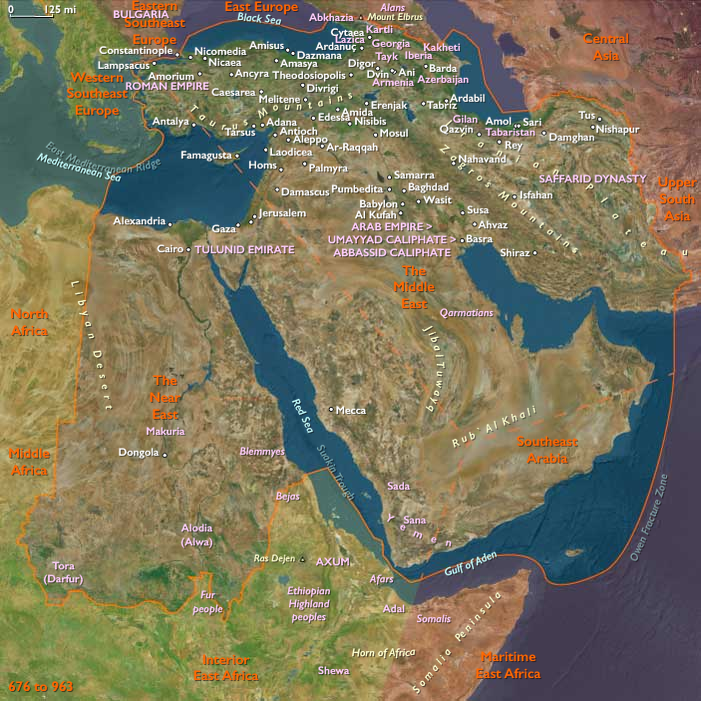
Subregions
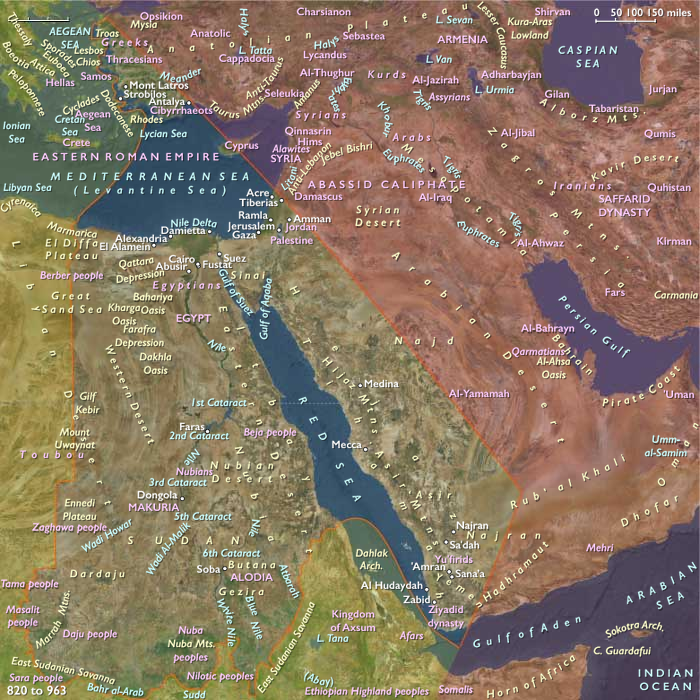
Related Events
Filter results
Showing 10 events out of 53386 total
Four Japanese court poets had been selected to compile the Kokin Wakashū, an anthology of poetry in the classical thirty-one- syllable “waka” form.
The Kokin Wakashū ("Collection of Japanese Poems of Ancient and Modern Times"), commonly abbreviated as Kokinshū, is an Imperial anthology, conceived of by Emperor Uda, who reigned from 887 to 897, and published by order of his son Emperor Daigo, who will reign from 897 to 930, in approximately 905.
Its finished form dates to around 920, though according to several historical accounts the last poem was added to the collection in 914.
The compilers of the anthology are led by Ki no Tsurayuki and also including Ki no Tomonori (who died before its completion), Ōshikōchi Mitsune, and Mibu no Tadamine.
A protracted struggle with the supporters of Euthymios had followed the restoration of Nicholas to the patriarchate about the time of the accession of Leo VI's brother Alexander to the throne in May 912; the struggle will not end until the new Emperor Romanos I Lekapenos promulgates the Tomos of Union in 920.
In the meantime Alexander had died in 913 after provoking a war with Bulgaria, and the underage Constantine VII had succeeded to the throne.
Simeon I of Bulgaria, intending to reduce the Empire by force—his goal, as always, the throne—seizes Albania, Macedonia, and the imperial stronghold of Adrianople in 914, then proceeds to take most of the Balkan peninsula.
Nicholas Mystikos has become the leading member of the regency for the young emperor, and as such has to face the advance of Simeon on Constantinople, who, coveting the imperial crown, has severely defeated the imperial armies.
Nicholas negotiates a peaceful settlement, crowns Simeon emperor of the Bulgarians in a makeshift ceremony outside Constantinople, and arranges for the marriage of Simeon's daughter to Constantine VII.
This unpopular concession, which looks like a betrayal of the empire to the Bulgarians, undermines his position, and by March 914, Zoe Karbonopsina has overthrown Nicholas and replaces him as foremost regent.
She revokes the agreement with Simeon, prompting the renewal of hostilities with Bulgaria.
Yusuf, during the siege of Erenjak, has Smbat tortured and executed before the fortress' walls in an effort to persuade the defenders to surrender.
The king’s body is then sent to Dvin and hung there.
Smbat's son Ashot succeeds him as Ashot II.
Yusuf initially tries to defeat him as well; Gagik refuses to cooperate so he sets up the Sparapet Ashot as rival king in Dvin.
Ashot II is able to gain the loyalty of the Armenians, however, and can also count on the support of the Empire.
Since Yusuf is having his own problems with the caliphate again, he will in 917 make peace with Ashot, giving him a crown.
Yusuf—known to the Georgians as Abu l'Kasim—also campaigns in the Georgian territories in 914.
This campaign in one of the last major attempts on the part of the Abbasid Caliphate to retain its crumbling hold of the Georgian lands, which, at this time, are a patchwork of rival, native states and Muslim holdings.
Yusuf makes Tiflis the base for his operations.
He first invades Kakheti and took hold of the fortresses of Ujarma and Bochorma, but the former is then given back to the Kakhetian ruler Kvirike following his plea for peace.
Yusuf then proceeds to Kartli, only to see the fortifications of Uplistsikhe demolished by their defenders.
From there, the amir surges into Samtskhe and Javakheti.
Unable to seize control of the stronghold of Tmogvi, he captures the fortress of Q'ueli and puts its defender, Gobron, to death.
The Muslim sources are silent about these events.
Ahmed bin Ismail bin Ahmed had become amir of the Samanids upon his father's death in late 907.
Some time afterwards, he had been granted the rights to Sistan, the heart of the Saffarid realm, by Caliph al-Muqtadir.
The Saffarids' infighting made the job much easier.
Ahmad's army had traveled from Farah to Bust, where they meet little resistance.
At the same time, Simjur al-Dawati is now installed as the Samanid governor of Sistan, Tabaristan and Gurgan; however, he soon revolts against Samanid authority as well, and before Ahmad can deal with the rebellion, he is decapitated while sleeping in his tent near Bukhara by some of his slaves on January 12, 914.
After his death, he is brought to Bukhara and buried in Naukanda.
Some of the slaves who had killed the Amir are caught and executed, while others flees to Turkestan.
He is designated as the "Martyred Amir".
Ahmad may have become unpopular among his subjects for his order to change the language of the court from Persian to Arabic; this order was soon rescinded.
He is succeeded by his young son Nasr II.
Due to his youth, his prime minister Abu ’Abd-Allah al-Jaihani undertakes the regency.
Almost immediately, a series of revolts breaks out within the state, the most serious being the one led by his great-uncle Ishaq ibn Ahmad.Ishaq’s sons take part in the rebellion; one son, Mansur, takes control of Nishapur and several other cities in Khurasan.
Eventually, Ishaq is captured, while Mansur dies in Nishapur.
The Abbassids try to benefit from the turmoil of the interregnum to reconquer Sistan, in vain.
Hasan, taking advantage of the murder of Ahmad ibn Ismai'il in January 914 and the preoccupation of his successor Nasr II with cementing his own authority, is soon able to extend his control over all the old Zaydid domains, including both Tabaristan and Gurgan.
A Samanid counterattack temporarily forces him to abandon Amol and withdraw to Chalus, but after forty days, he beats back the invasion and reestablishes his position.
Even old opponents of the first Zaydid emirs, like the Bavandid Sharvin ibn Rustam, make peace with him and accept his authority.
His achievement is undermined, however, by tensions among his supporters over the issue of his succession, given his advanced age.
Hasan's own sons are regarded as dissolute and incapable for leadership, while Hasan falls out with his son-in-law and chief general, Abu Muhammad al-Hasan ibn al-Qasim.
On one occasion, the latter even takes the elderly imam captive, but this produces such an outcry that he is forced to flee to Daylam.
In the end, the notables of Tabaristan prevail upon both to mend their differences, and his son-in-law Abu Muhammad is named as successor over Hasan's own sons.
Indra III, immediately after coming to power as Rashtrakuta Emperor, has to fight a Paramara ruler, a feudatory of Gurjara Prathihara, and rout him from Govardhana near Nasik.
Hereafter, the Paramaras become feudatories of the Rashtrakutas.
The Fatimid general Husaba of the Kutama Berber tribe had on February 6 taken Barqah (Benghazi).
Al-Qa'im Bi-Amrillah, son of the Fatimid caliph Abdullah al-Mahdi Billah, had on July 11, 914, left Raqqada in an attempt to conquer Egypt.
Hubasa takes Alexandria after his victory over Egyptian troops near al-Hanniyya; Tekin, the Abbassid governor, refuses to surrender and asks for reinforcements, which reach him in September.
Years: 914 - 914
Locations
People
Groups
- Berber people (also called Amazigh people or Imazighen, "free men", singular Amazigh)
- Islam
- Egypt in the Middle Ages
- Ismailism
- Abbasid Caliphate (Baghdad)
- Ifriqiya, Fatimid Caliphate of
