
Al-Hirah begins to decline early in the …
Years: 602 - 602
Al-Hirah begins to decline early in the sixth century, the Persians having brought about the collapse of the Lakhmid dynasty.
Al-Nu'man III ibn al-Mundhir, the son of Al-Mundhir IV ibn al-Mundhir and the enslaved Salma or Sulma, had succeeded his father in 580.
In later histories, he is celebrated for his patronage of numerous poets.
He is also the only Lakhmid ruler to convert to Nestorian Christianity.
According to Arab accounts, he assisted Khosrau II during his flight from the usurper Bahram Chobin in 581.
Nevertheless, according to creditable historical accounts, when Khosrau II demanded Nu'man's Christian daughter as part of his extensive harem, he refused the Shah's demand.
In response, Khosrau II had him crushed by elephants; however, according to a Syriac chronicle, Khosrau invited Nu'man to a feast where he was dishonored and trapped; another Syriac chronicle states that Khosrow captured Nu'man along with his sons, who then were poisoned.
This is the spark that will lead to the Battle of Dhi Qar in 609.
His destiny after his arrival at Ctesiphon is largely disputed, even in near-contemporary sources; he was either immediately executed or imprisoned for a period of time and then executed, but in 609 he was certainly dead and Iyas his ex-friend was installed, marking the end of the dynasty, although Nu'man's son al-Mundhir will attempt to revive the kingdom during the Ridda wars and will rule the Bahrain region for a short period of eight months until he is captured.
Locations
People
Groups
- Arab people
- Persian people
- Persian Empire, Sassanid, or Sasanid
- Lakhmid kingdom of al-Hira
- Christians, Eastern (Diophysite, or “Nestorian”) (Church of the East)
- Roman Empire, Eastern: Justinian dynasty
- Roman Empire, Eastern: Non-dynastic
Topics
Commodoties
Subjects
Regions
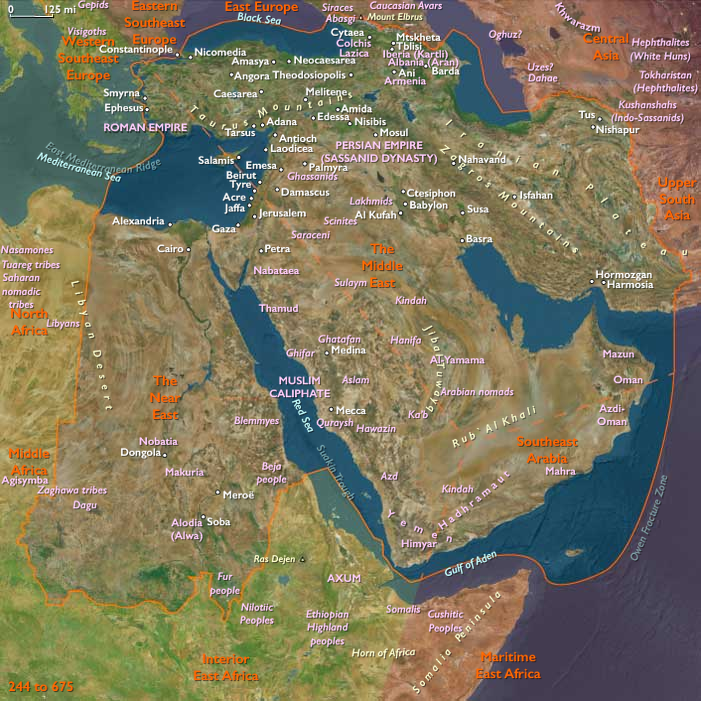
Subregions
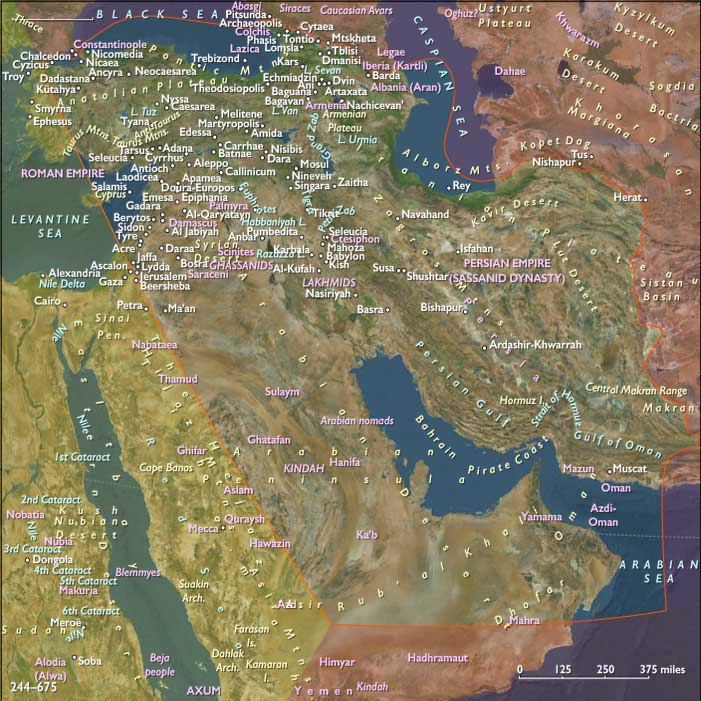
Related Events
Showing 10 events out of 57105 total
Years: 602 - 602
Locations
People
Groups
- Arab people
- Persian people
- Persian Empire, Sassanid, or Sasanid
- Lakhmid kingdom of al-Hira
- Christians, Eastern (Diophysite, or “Nestorian”) (Church of the East)
- Roman Empire, Eastern: Justinian dynasty
- Roman Empire, Eastern: Non-dynastic
Topics
Commodoties
Subjects
Regions
Subregions