Constantinople’s hold on the southern Balkans disintegrates …
Years: 808 - 819
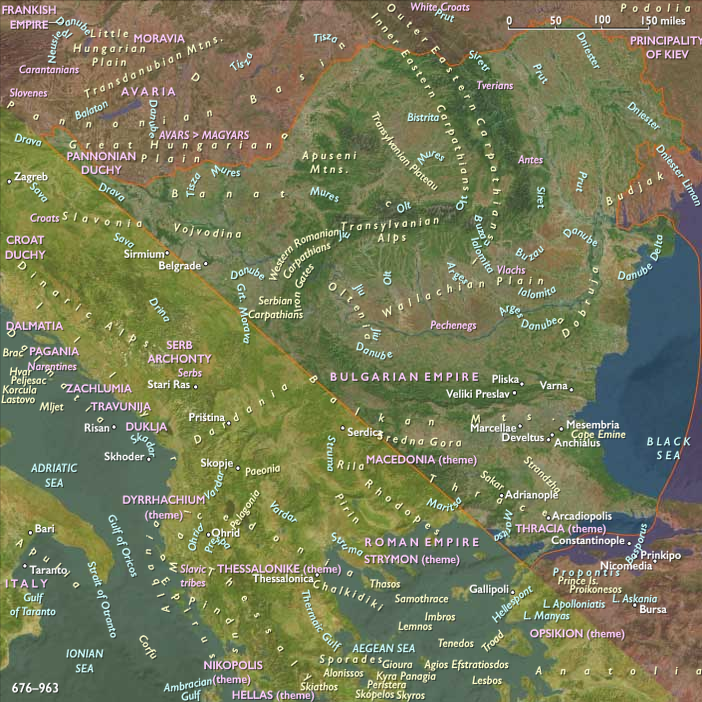
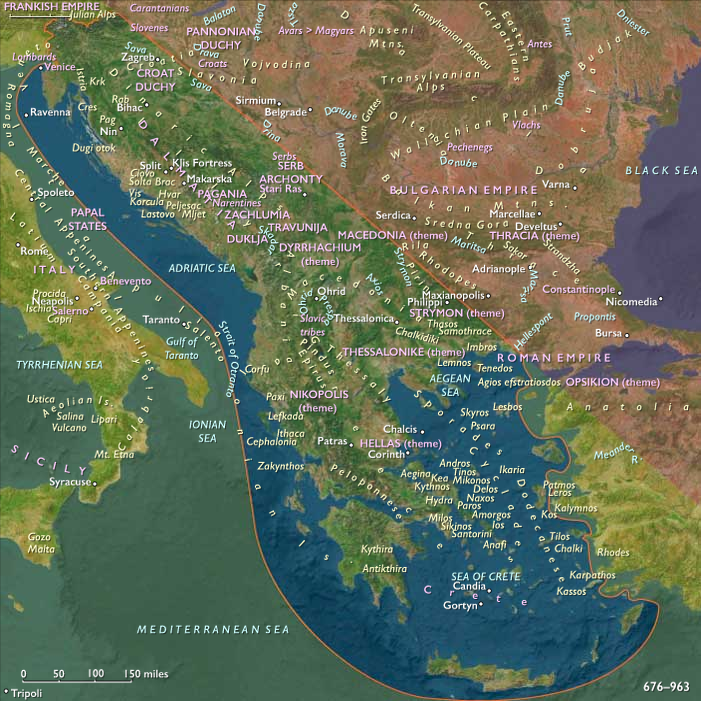
Constantinople’s hold on the southern Balkans disintegrates as the Bulgarian Empire expands its territory eastward to the Black Sea, south to include Macedonia, and northwest to present-day Belgrade.
Related Events
Filter results
Showing 10 events out of 54778 total
The Japanese, having in the seventh century finally acquired the art of making paper (kept secret by the Chinese for five hundred years) in the seventh century, produce the first mass publication, a block-printed Buddhist prayer paper, of which one million are printed in the early ninth century.
East Central Europe (808–819 CE): Consolidation of Carolingian Authority, Emergence of Great Moravia, and Slavic–Frankish Diplomacy
Between 808 and 819 CE, East Central Europe—encompassing Poland, Czechia, Slovakia, Hungary, and those portions of Germany and Austria lying east of 10°E and north of a line stretching from roughly 48.2°N at 10°E southeastward to the Austro-Slovenian border near 46.7°N, 15.4°E—experienced a period of relative stability and political consolidation under strengthened Carolingian influence. The foundation for Great Moravia emerged, significantly reshaping the political landscape of Slavic territories. Meanwhile, Carolingian governance became firmly established throughout former Avar domains, Bavaria, and Thuringia, cementing their integration into Frankish political and economic structures.
Political and Military Developments
Foundation of Great Moravia
-
Around 810–820 CE, the foundations were laid for the emergence of Great Moravia, a powerful Slavic state centered in Moravia and western Slovakia.
-
Leaders such as Mojmir I began uniting regional Slavic tribes, establishing coherent governance structures, and significantly enhancing regional political cohesion.
Carolingian Political Consolidation
-
Carolingian authority stabilized in former Avar territories and became deeply integrated into eastern Austria and western Hungary. Frankish administrative structures and governance models reshaped regional political organization and identity.
Strengthening of Carolingian Control in Bavaria and Thuringia
-
The autonomy of Bavaria and Thuringia was further reduced, with these territories increasingly managed under direct Frankish administrative frameworks, reflecting their deeper integration into Carolingian governance.
Economic and Technological Developments
Integration of Regional Trade
-
Economic ties strengthened significantly under Carolingian governance, facilitating increased trade activity in agricultural goods, textiles, precious metals, and crafts across Bavaria, Thuringia, former Avar territories, and the emerging Slavic principalities.
Fortified Infrastructure and Administrative Centers
-
Continued Carolingian investment in regional infrastructure and fortifications enhanced administrative control, facilitated trade, and improved military logistics in strategic locations across East Central Europe.
Cultural and Artistic Developments
Expansion of Carolingian Cultural and Religious Influence
-
The Carolingian presence further reinforced Christianization and Frankish cultural norms across former Avar domains and Bavarian and Thuringian territories, significantly reshaping artistic, religious, and social practices.
Emergence of Moravian Cultural Identity
-
The developing state of Great Moravia fostered distinctive Slavic cultural traditions visible in settlement patterns, pottery, jewelry, and other artifacts, indicating a clearly articulated Moravian identity distinct from neighboring regions.
Settlement and Urban Development
Growth of Carolingian Administrative Centers
-
Urban and administrative centers expanded significantly under Carolingian control, establishing strategic towns and fortifications particularly in eastern Austria, western Hungary, Bavaria, and Thuringia.
Development of Moravian Urban and Political Centers
-
Great Moravia witnessed the growth of prominent urban and political hubs, serving as focal points for Slavic governance, trade, and cultural identity.
Stabilization of Bavarian and Thuringian Settlements
-
Settlements across Bavaria and Thuringia became more prosperous and firmly integrated into Carolingian administrative and economic systems, reflecting increased stability and prosperity.
Social and Religious Developments
Intensified Christianization
-
The period saw heightened missionary activity and religious organization under Carolingian influence, particularly in former Avar territories and among Slavic populations, fostering widespread adoption of Christianity and the establishment of early church infrastructure.
Centralization of Slavic Leadership in Moravia
-
Slavic communities within Great Moravia significantly centralized governance structures, improving internal administration, military organization, and diplomatic relations with Carolingian neighbors.
Societal Integration under Carolingian Rule
-
Societies across Bavaria, Thuringia, and former Avar domains experienced increased integration into Frankish social hierarchies, governance models, and administrative frameworks.
Long-Term Consequences and Historical Significance
The era 808–819 CE marked significant political consolidation in East Central Europe, defined by the establishment of Great Moravia and strengthened Carolingian governance. These developments set enduring foundations for the medieval political, cultural, and economic landscapes of the region, significantly influencing subsequent historical trajectories and interactions between Frankish and Slavic powers.
Eastern Southeast Europe (808–819 CE): Bulgarian Expansion and Byzantine Decline
Settlement and Migration Patterns
Bulgarian Territorial Expansion
From 808 to 819 CE, Eastern Southeast Europe underwent significant demographic and geopolitical shifts driven by the aggressive territorial expansion of the Bulgarian Empire. This expansion eastward to the Black Sea, southward to encompass Macedonia, and northwestward reaching present-day Belgrade, markedly altered regional dynamics and settlement patterns.
Political and Military Developments
Decline of Byzantine Influence
The Bulgarian Empire’s expansion severely undermined Constantinople’s control over the southern Balkans. This period marked a noticeable disintegration of Byzantine authority, leading to the establishment of a stronger Bulgarian presence in territories once firmly under imperial influence.
Bulgarian Dominance
Under strong leadership, Bulgaria significantly extended its influence, solidifying its position as a formidable regional power. This territorial growth diminished Byzantine strategic capabilities and shifted the geopolitical balance in the region.
Economic and Technological Developments
Economic Reorientation
The expansion of the Bulgarian state reshaped regional economic networks, redirecting trade and commerce routes. The diminished Byzantine presence necessitated economic adjustments as communities adapted to new political realities.
Fortifications and Defense
Both the Bulgarian and Byzantine states continued investing in military fortifications to secure newly acquired territories and defend remaining imperial areas. These efforts reflected heightened regional competition and strategic tensions.
Cultural and Artistic Developments
Cultural Adaptation
The shifting political landscape led to significant cultural exchanges between Byzantine and Bulgarian traditions. Artistic and cultural expressions adapted to reflect the changing influences and power structures within the region.
Scholarly and Intellectual Continuity
Despite geopolitical upheavals, scholarly and educational institutions persevered in preserving classical and theological traditions. The intellectual resilience displayed during this period helped maintain cultural continuity.
Social and Religious Developments
Shifts in Religious Influence
The Bulgarian expansion introduced new social dynamics, influencing religious practices and organizational structures. Eastern Orthodoxy continued its influential role but adapted to the changing political realities and Bulgarian influence.
Community Cohesion and Identity
Communities navigated complex identities shaped by both Byzantine heritage and Bulgarian expansion. These evolving identities highlighted the adaptive social dynamics and resilience of the local populations.
Long-Term Consequences and Historical Significance
The period from 808 to 819 CE was defined by Bulgaria’s expansive territorial growth and the corresponding decline of Byzantine power in the southern Balkans. These developments significantly reshaped Eastern Southeast Europe's geopolitical landscape, setting the stage for enduring regional power dynamics and cultural exchanges.
The Middle East: 808–819 CE
Abbasid Stability and Cultural Flourishing
Prosperity and Intellectual Activity in Baghdad
Under the rule of Caliph Harun al-Rashid (786–809) and his son Al-Ma'mun (813–833), the Abbasid Empire continues to thrive culturally, intellectually, and economically. Following Harun's death in 809, the empire briefly faces internal struggles over succession but quickly stabilizes under Al-Ma'mun's leadership. Baghdad, the Abbasid capital, remains the cultural heart of the Islamic Golden Age, drawing scholars, philosophers, and scientists from across the known world.
The Translation Movement and Cultural Synthesis
During this era, Al-Ma'mun energetically supports the expansion of the Bayt al-Hikma ("House of Wisdom"), established in Baghdad, significantly advancing the translation of Greek, Persian, and Indian scientific, medical, and philosophical texts into Arabic. This great intellectual enterprise lays the foundations for major developments in science, mathematics, medicine, astronomy, and philosophy throughout the Islamic world and eventually influences medieval Europe.
Regional Stability and Urban Development
This period sees the continued growth of cities across the Abbasid territories, with urban infrastructure improving significantly due to the Caliphate's wealth. Enhanced trade networks, bolstered by stable governance, facilitate cultural exchanges and economic prosperity, ensuring that the Middle East remains central to global commerce and cultural dialogue.
Thus, the years from 808 to 819 underscore a significant chapter of intellectual growth, cultural openness, and regional stability within the Abbasid Empire.
The Fourth Fitna or Great Abbasid Civil War is a conflict between the brothers al-Amin and al-Ma'mun over the succession to the Abbasid Caliphate's throne.
Their father, Harun al-Rashid, had named al-Amin as the first successor, but had also named al-Ma'mun as the second, with Khorasan granted to him as an appanage, while a third son, al-Qasim, had been designated as third successor.
After Harun dies in 809, al-Amin succeeds in Baghdad.
Encouraged by the Baghdad court, al-Amin begins trying to subvert the autonomous status of Khorasan; Qasim is quickly sidelined.
In response, al-Ma’mun seeks the support of the provincial elites of Khorasan, and makes moves to assert his own autonomy.
As the rift between the two brothers and their respective camps widens, al-Amin declares his own son Musa to be his heir, and assembles a large army.
Al-Amin's troops march towards Khorasan, but al-Ma'mun's general Tahir ibn Husayn defeats them in the Battle of Rayy, then invades Iraq and besieges Baghdad itself.
The city falls after a year, al-Amin is executed, and al-Ma'mun becomes Caliph, but he remains in Khorasan and does not come to Baghdad.
This allows the power vacuum, which the civil war had created in the Caliphate's provinces, to grow, and several local rulers spring up in Jazira, Syria and Egypt.
In addition, the pro-Khorasani policies followed by al-Ma'mun's powerful chief minister, al-Fadl ibn Sahl, and al-Ma'mun's espousal of an Alid succession, alienates the traditional Baghdad elites, who see themselves increasingly marginalized.
As a consequence, al-Ma'mun's uncle Ibrahim is proclaimed rival Caliph at Baghdad in 817, forcing al-Ma'mun to intervene personally.
Fadl ibn Sahl is assassinated and al-Ma'mun leaves Khorasan for Baghdad, which he enters in 819.
The next years will be taken up with consolidating al-Ma'mun's authority and reincorporating the western provinces, a process that will not be completed until 827.
Some local rebellions, however, notably that of the Khurramites, will drag on for far longer.
The Gurjar Pratihars rule Malwa, which is bounded to the South by the Rashtrakuta Empire, and the Pala dynasty to the East.
Pratihara king Nagabhata II has extended his Gurjara kingdom northward to the southern edge of Kashmir and eastward to the frontier of Bengal.
Al-Hakam I, Umayyad Emir of Cordoba, crushes a rebellion led by clerics in a suburb called al-Ribad on the south bank of the Guadalquivir River.
He punishes the inhabitants by exiling them by ship.
They eventually reach Alexandria and will dominate the city until 827, after which they are expelled.
They will sail on to Crete, where they will establish an independent emirate that is to survive until the reconquest by the East Romans in 961.
Jewish Life Under Muslim Rule in Spain and North Africa
Unlike the Christian East Roman (Byzantine) Empire, where Jews often faced persecution and restrictions, Muslim rule in Spain and North Africa ushers in a period of relative peace and prosperity for Jewish communities.
Under Islamic governance, Jews are recognized as dhimmis—a protected but subordinate group—allowing them to practice their religion, engage in commerce, and contribute to intellectual and cultural life. This era lays the groundwork for the Jewish Golden Age in Al-Andalus, where Jewish scholars, poets, and philosophers thrive under Muslim patronage.
Mediterranean Southwest Europe (808–819 CE): Carolingian Stability, Moorish Iberian Prosperity, and Cultural Interactions
The era 808–819 CE in Mediterranean Southwest Europe is marked by continued Carolingian political stability in Italy, economic and cultural prosperity in Moorish Iberia, and ongoing ecclesiastical influence throughout the region.
Carolingian Consolidation and Italian Stability
Under the leadership of Charlemagne (until his death in 814 CE) and subsequently his son, Louis the Pious, the Carolingian Empire maintains firm political and administrative control in Italy. Charlemagne’s systematic governance reforms and effective integration of former Lombard territories sustain political cohesion and stability, reinforcing northern and central Italy's role within the broader Carolingian framework.
Flourishing Moorish Iberia under the Umayyads
In Iberia, the Umayyad Emirate, especially under Emir al-Hakam I (r. 796–822 CE), continues to experience significant economic and cultural prosperity. Córdoba solidifies its position as a leading center of Islamic culture, scholarship, and architecture, with the continued enhancement of the Great Mosque of Córdoba symbolizing the region’s vibrant cultural landscape.
Mozarab Communities and Cross-Cultural Exchange
Mozarab communities continue to play a pivotal role, enriching Iberian culture through ongoing interactions between Latin-Christian and Islamic traditions. Their contributions remain influential in urban centers such as Toledo, Córdoba, and Seville, reflecting the complex cultural exchanges shaping Iberia during this period.
Ecclesiastical Leadership and Cultural Continuity
The papacy retains its central role as a stabilizing force and mediator among competing political powers. Ecclesiastical leaders uphold doctrinal authority, foster regional stability, and support intellectual and cultural continuity, reinforcing the integral role of the Church in shaping regional identity and governance.
Economic and Technological Advancements
Economic vitality persists, driven by sustained improvements in agriculture, craftsmanship, and technology, notably through advanced ironworking techniques such as those provided by the Catalan forge. These developments underpin broader economic growth, supporting urban prosperity and enhancing regional trade networks.
Legacy of the Era
The era 808–819 CE reflects enduring Carolingian stability, continued Moorish cultural flourishing, and vibrant cross-cultural interactions facilitated by Mozarab communities. These factors significantly influence the trajectory of Mediterranean Southwest Europe, laying essential foundations for subsequent medieval developments.
North Africa (808–819 CE)
Aghlabid Prosperity, Idrisid Consolidation, and Vibrant Berber Autonomy
Between 808 and 819 CE, North Africa experiences sustained political stability and economic prosperity under the rule of influential local dynasties, particularly the Arab-led Aghlabids in Ifriqiya and the Idrisids in Morocco, while Berber states maintain vibrant autonomy in the central Maghreb.
In Ifriqiya, the Aghlabid Dynasty, founded by Ibrahim ibn al-Aghlab in 800 CE, reaches significant prosperity and political stability. Kairouan (Al Qayrawan), the capital, thrives as an urban center of commerce, learning, and cultural exchange, rivaling major cities throughout the broader Islamic world. The Aghlabid rulers, notably Abdallah ibn Ibrahim (812–817 CE) and Ziyadat Allah I (817–838 CE), oversee extensive public works projects, dramatically expanding agricultural production through restored Roman-era irrigation systems. This fosters considerable regional wealth, making Ifriqiya a prosperous, semi-autonomous polity nominally loyal to the Abbasid Caliph in Baghdad.
To the west, the Idrisid Dynasty in Morocco further consolidates its political authority under Idris II, who continues his reign until 828 CE. After establishing the city of Fez (Fès) as his capital, Idris II significantly expands urban infrastructure, attracting scholars, merchants, and artisans. Under his governance, Fez becomes a leading intellectual and commercial hub, firmly embedding the Idrisid state as the dominant political force in western North Africa.
The central Maghreb remains firmly under the influence of the Rustamid Dynasty, based in Tahert (modern Tiaret). Governed by elective Ibadi Kharijite principles emphasizing justice, scholarship, and religious tolerance, the Rustamids continue to attract scholars, traders, and diverse religious groups from across North Africa and the Islamic world. The Rustamid imamate remains a pivotal node in regional commerce and intellectual exchange, a counterpoint to centralized Abbasid authority, highlighting indigenous Berber independence and regional cultural distinctiveness.
The coastal Barghawata confederation retains its distinctive identity, blending indigenous Berber traditions with Islamic practices along the Moroccan Atlantic coastline. Additionally, the oasis city of Sijilmasa, situated along vital trans-Saharan trade routes managed by influential Tuareg tribes, continues as a robust and prosperous economic center. Its wealth and influence underscore the importance of Saharan commerce, maintaining essential economic connections between sub-Saharan Africa and the Mediterranean world.
By the conclusion of 819 CE, North Africa stands as a region defined by substantial political autonomy, economic prosperity, and cultural diversity. The era concludes with the Aghlabid, Idrisid, and Rustamid states solidly established as influential regional powers. Together, they form a dynamic political mosaic characterized by decentralized governance, vibrant economic interconnectivity, and enduring cultural distinctiveness, setting the stage for continued historical evolution throughout subsequent centuries.
Years: 808 - 819
Groups
- Bulgarian Empire (First)
- Roman Empire, Eastern: Nikephorian dynasty
- Roman Empire, Eastern: Non-dynastic
Topics
Subjects
Regions
Subregions