
Al-Hajjaj, leading his Syrian troops, defeats the …
Years: 697 - 697
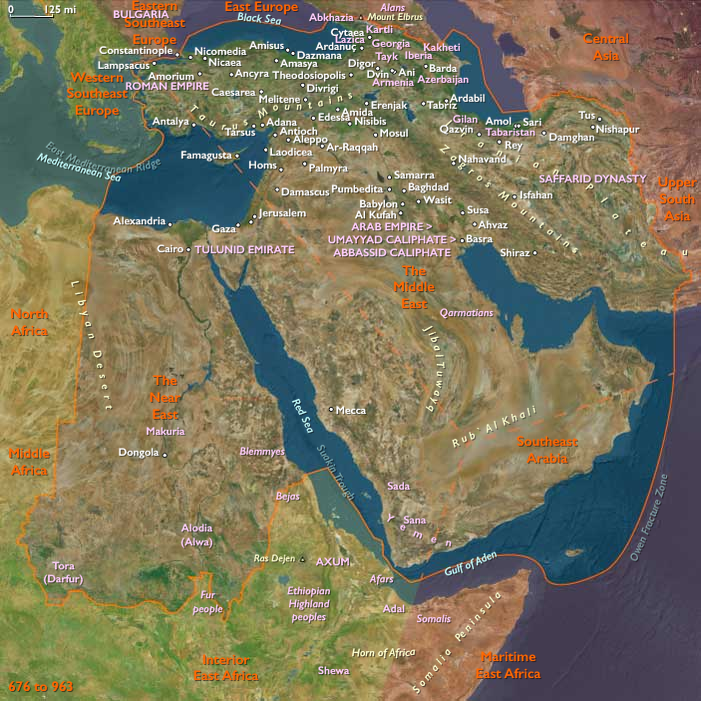
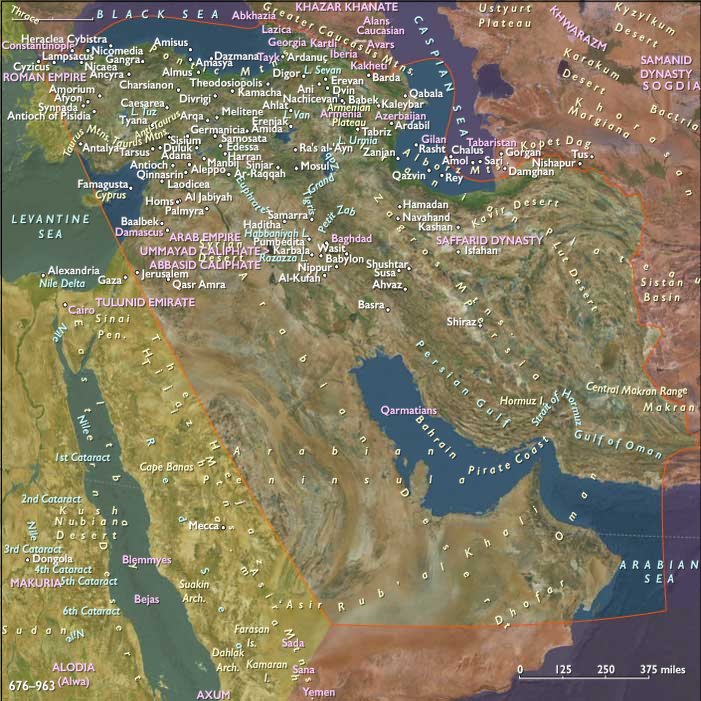
Al-Hajjaj, leading his Syrian troops, defeats the Kharajites also in 697.
The movement, however, remains strong, especially among the Bakr tribes between Mosul and Kufah.
Locations
People
Groups
- Arab people
- Banū Bakr (Arabic tribe)
- Muslims, Sunni
- Muslims, Kharijite
- Umayyad Caliphate (Damascus)
- Muslims, Shi'a
Topics
Commodoties
Subjects
Regions
Subregions
Related Events
Filter results
Showing 10 events out of 55907 total
Sun, after taking over as khan and reorganizing Khitan forces, again attacks Zhou territory and has many victories over Zhou forces, including a battle during which Wang Shijie is killed.
Wu Zetian tries to allay the situation by making peace with Ashina Mochuo at fairly costly terms—the return of Tujue people who had previously submitted to Zhou and the provision of Ashina Mochuo with seeds, silk, tools, and iron.
In summer 697, Ashina Mochuo launches another attack on Khitan's base of operations, and this time, after his attack, Khitan forces collapse, and Sun is killed in flight, ending the Khitan threat.
Meanwhile, also in 697, Lai Junchen, who had at one point lost power but had then returned to power, falsely accuses Li Zhaode (who has been pardoned) of crimes, and then plans to falsely accuse Li Dan, Li Zhe, the Wu clan princes, and Princess Taiping, of treason.
The Wu clan princes and Princess Taiping act first against him, accusing him of crimes, and he and Li Zhaode are executed together.
After Lai's death, the reign of the secret police largely ends, and many of the victims of Lai and the other secret police officials are gradually exonerated posthumously.
Meanwhile, around this time, Wu Zetian begins to engage herself with two new lovers—the brothers Zhang Yizhi and Zhang Changzong, who become honored within the palace and are eventually created dukes.
Wu Chengsi and another nephew of Wu Zetian's, Wu Sansi the Prince of Liang, are making repeated attempts to have officials persuade Wu Zetian to create one of them crown prince—again citing the reason that an emperor should pass the throne to someone of the same clan.
However, Di Renjie, who by now has become a trusted chancellor, is firmly against the idea and instead proposes that Li Zhe be recalled.
He is supported in this by fellow chancellors Wang Fangqing and Wang Jishan, as well as Wu Zetian's close advisor Ji Xu, who further persuades the Zhang brothers to support the idea as well.
In spring 698, Wu Zetian agrees and recalls Li Zhe from exile.
Soon, Li Dan offers to yield the crown prince position to Li Zhe, and Wu Zetian creates Li Zhe crown prince, soon changing his name back to Li Xiǎn and then Wu Xian.
Later, Ashina Mochuo demands a Tang dynasty prince for marriage to his daughter, part of a plot to join his family with the Tang, displace the Zhou, and restore Tang rule over China (under his influence).
When Wu Zetian sends a member of her own family, grandnephew Wu Yanxiu, to marry Mochuo's daughter instead, he rejects him.
Ashina Mochuo has no actual intention to cement the peace treaty with a marriage; instead, when Wu Yanxiu arrives, he detains Wu Yanxiu and then launches a major attack on Zhou, advancing as far south as Zhao Prefecture (in modern Shijiazhuang, Hebei) before withdrawing.
Now governor of all the eastern province, Al-Hajjaj is a ruthless and efficient administrator, intent upon pacifying all the provinces entrusted to him by 'Abd al-Malik.
A great Muslim army, led by an Arab aristocrat, Ibn al-Ash'ath, and operating in the Afghanistan region, mutinies, swears allegiance to its commander, and turns back to Iraq.
With the aid of Syrian reinforcements, al-Hajjaj is able to defeat the rebels; their leader will be murdered in 704 in Afghanistan.
The formation of the theme of Hellas in 697 is evidence that that Roman authority is beginning to prevail along the peninsular coastline and in certain parts of Greece where Slavs have penetrated.
The Frankish Conquest of Utrecht and the Rhine Delta
Between 690 and 692, Pepin of Heristal seizes Utrecht, a crucial Frisian stronghold, bringing the Rhine trade routes under Frankish control and solidifying his dominance over commerce between the Middle Rhineland and the North Sea. This victory significantly weakens Radbod, the Frisian ruler, forcing him to retreat.
Sources diverge on Radbod’s exact movements after his defeat. Some accounts suggest that by 697, he withdrew to the island of Heligoland, while others place his retreat within the lands still known as Friesland. Regardless of his exact refuge, his power is significantly diminished, and the Rhine delta—a vital commercial and strategic region—falls firmly into Frankish hands.
The capture of Utrecht and control of the Rhine delta mark a major milestone in the expansion of Austrasian influence, strengthening Frankish hegemony over the Low Countries and paving the way for the Christianization of the region under Frankish rule.
The earliest extant recorded mention of Balhae comes from the Old Book of Tang, which was compiled between 941 to 945.
Southern Manchuria and northern Korea were previously the territory of Goguryeo, one of the Three Kingdoms of Korea.
Goguryeo had fallen to the allied forces of Silla and the Tang Dynasty in 668.
The Tang had annexed much of western Manchuria, while Silla has unified the Korean peninsula south of the Taedong River and become Unified Silla.
In the confusion of uprising by the Khitan against the Tang, Dae Jung-sang, a former Goguryeo official, who is a leader of remnants people of Goguryeo, allies with Geolsa Biu, a leader of Mohe, and rises against the Tang in 698.
After Dae Jung-sang’s death, his son Dae Jo-yeong, a former Goguryeo general, succeeded his father.
Geolsa Biu dies in battle against the Tang army led by the general Li Kaigu.
Dae Jo-yeong manages to escape outside of the Tang controlled territory with the remaining Goguryeo and Mohe soldiers.
He defeats the pursuing army sent by Wu Zetian at the Battle of Tianmenling, which enables him to establish the state of Balhae in the former region of Yilou.
The Cibyrrhaeots ("men of Cibyrrha") derive their name from the city of Cibyrrha (it is unclear whether this is Cibyrrha the Great in Caria or Cibyrrha the Lesser in Pamphylia).
At this time, the Cibyrrhaeots are subordinate to the great naval corps of the Karabisianoi.
The command first appears in the expedition against Carthage in 698, when a Germanic naval officer from the region of Pamphylia, originally named Apsimaros, has risen to the position of droungarios of the Cibyrrhaeots.
He is attested as commanding the men from Korykos and has participated in the failed campaign of 698 to regain Carthage.
As admiral John the Patrician retreats from Carthage to Crete, the fleet rebels, deposes and murders their commander, and chooses Apsimaros as his replacement.
Changing his name to Tiberios, Apsimaros sails on Constantinople, which is suffering from a plague, and proceeds to besiege it.
His revolution attracts the support of the Green faction, as well as detachments from the field army and the imperial guard, and officers loyal to him open the gates of the city and proclaim him emperor, after which his troops proceed to pillage the city.
When he is firmly established on the throne, he commands that the nose of deposed Emperor Leontius be cut off, and orders him to enter the monastery of Psamathion.
The Arabs have by 698 taken most of North Africa from the Empire.
The area is divided into three provinces: Egypt with its governor at al-Fustat, Ifriqiya with its governor at Kairouan, and the Maghreb (modern Morocco) with its governor at Tangiers.
The constant minor warfare between Damascus and the Constatinople, endemic since the peace of 679, breaks out into full scale war in spring 698, when the Muslim commander Hasan ibn al-Nu'man and a force of forty thousand men crushes Roman Carthage.
Many of its defenders are Visigoths sent to defend the Exarchate by their king, who also fears Muslim expansion.
Many Visigoths fight to the death; in the ensuing battle Roman Carthage is again reduced to rubble, as it had been centuries earlier by the Romans.
The loss of the mainland African Exarchate is an enormous blow to the Empire in the Western Mediterranean because both Carthage and Egypt have been Constantinople's main sources of manpower and grain.
It is also an enormous blow because it permanently ends the Roman presence in Africa.
The Tufan threat ceases in 699.
The Tufan king Tridu Songtsen, unhappy that Lun Qinling is monopolizing power, takes an opportunity when Lun Qinling is away from the capital Lhasa to slaughter Lun Qinling's associates.
He then defeats Lun Qinling in battle, and Lun Qinling commits suicide.
Lun Zanpo and Lun Qinling's son Lun Gongren surrender to Zhou.
After this, Tufan will experience internal turmoil for several years, and there will be peace for Zhou on the Tufan border.
Also in 699, Wu Zetian, realizing that she is growing old, fears that after her death, Li Xian and the Wu clan princes will not be able to have peace with each other, and she compels him, Li Dan, Princess Taiping, Princess Taiping's second husband Wu Youji (a nephew of hers) the Prince of Ding, and other Wu clan princes to swear an oath to each other.
Construction on the site of Fujiwara-kyo had begun as early as 682, near the end of the reign of Emperor Temmu, as revealed by ongoing excavations from 2006.
With a brief halt upon Emperor Temmu's death, construction had resumed under Empress Jitō, who officially moved Japan's capital from Asuka to Fujiwara-kyo in 694.
Fujiwara is Japan's first capital built in a grid pattern on the Chinese model; recent investigation has revealed that the city covered an area of roughly five kilometers, much larger than previously thought.
The palace occupies a plot measuring about one square kilometer, and is surrounded by walls roughly five meters high.
Each of the four walls has three gates; Suzakumon, the main gate, stands at the center of the south wall.
The Daigokuden and other palace buildings are the first palace structures in Japan to have a tile roof in the Chinese style.
The area had previously been the domain of the Nakatomi clan, who oversee the observation of Shintō rituals and ceremonies on behalf of the Imperial court.
Years: 697 - 697
Locations
People
Groups
- Arab people
- Banū Bakr (Arabic tribe)
- Muslims, Sunni
- Muslims, Kharijite
- Umayyad Caliphate (Damascus)
- Muslims, Shi'a
