
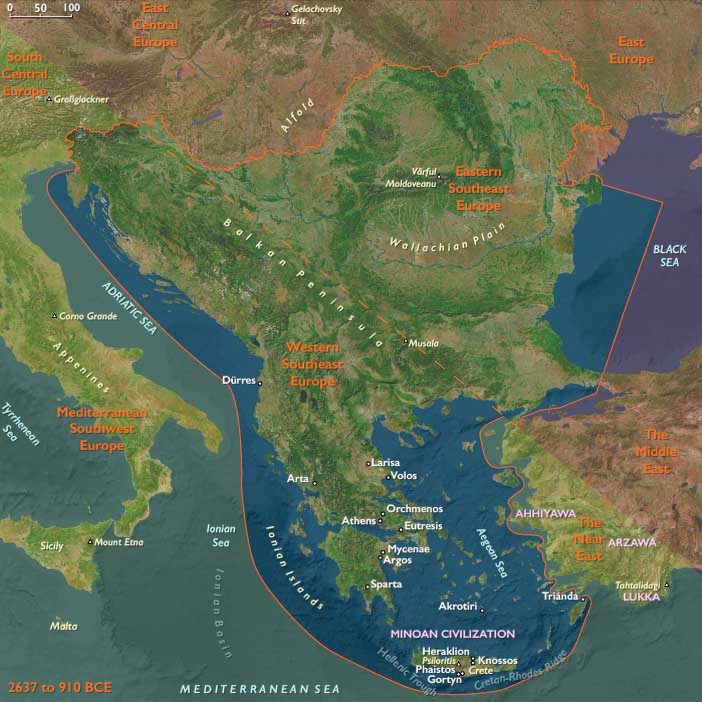
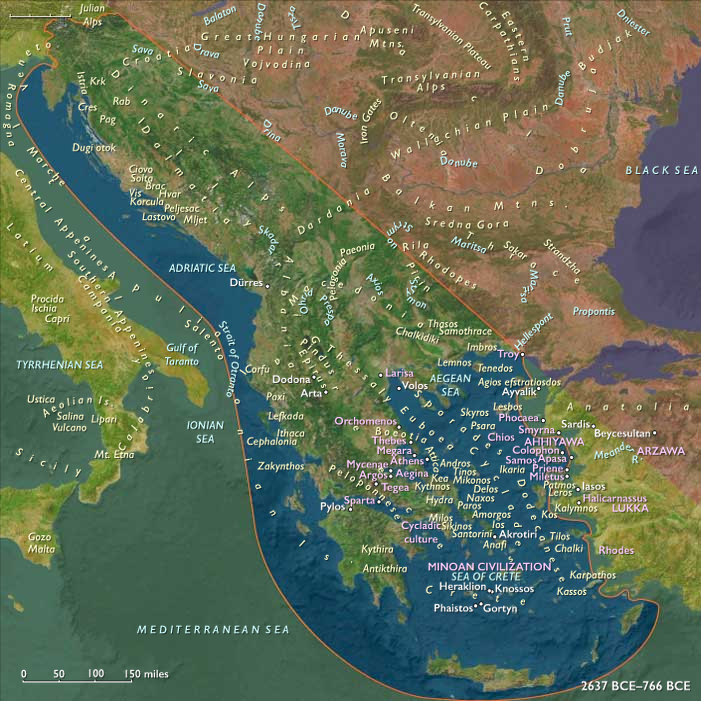
…Akrotiri on Thera (Thira), adorn the walls …
Years: 1629BCE - 1486BCE
…Akrotiri on Thera (Thira), adorn the walls of houses with paintings in a Cretan style.
There are in almost every house fairly well-preserved frescoes displaying wonderful, flat, brightly colored scenes of boxers, fishermen, antelopes, birds, and blue monkeys.
The “naval” or “miniature” frescoes from the West House, among the most dramatic, show themes of war and peace in a seaside-and-country setting with whole towns watching elaborate ships.
Another, the elegantly drawn set in Xeste 3, shows girls and women picking saffron crocus, wearing their finest gold and rock crystal jewelry and elegant costumes; blue monkeys accompany them.
These works follow the conventions of Minoan art, but their provinciality, freshness, and vigor implies the work of native artists.
One of the largest volcanic eruptions known occurs on Thera, burying the island's Minoan settlements beneath several feet of pumice. (Subsequent collapse of the magma chamber forms a large sea-filled caldera and leaves three small islands in place of the previous large one. Some scholars think the eruption occurred about 1500 BCE, although, based on evidence obtained during the 1980s from a Greenland ice-core and from tree-ring and radiocarbon dating, other scholars believe that it occurred earlier, during the 1620s BCE. Ash and pumice from the eruption are found as far away as Egypt and Israel, and there has been speculation that the eruption was the source of the Greek legend of Atlantis set down by Plato in two dialogues, the “Timaeus,” and the “Critias,” and of stories in the Old Testament book of Exodus. The earliest excavations by the French School at Athens [1869] uncovered a Middle Minoan, or Cycladic [circa 2000-c. 1570 BCE], city beneath the pumice at the northern tip of Thirasía. Of even greater significance was the excavation begun by Marinatos during the 1960s south of Akrotíri village, which revealed a rich Minoan city buried under the volcanic debris just as it stood at the time of the eruption. The city, still being excavated, consisted of large, well-built, multi-story houses that contain some of the finest Minoan frescoes found in the Mediterranean. The discoveries show that strong links existed during the Bronze Age between Crete and Thera, some seventy miles [one hundred and ten kilometers] north.)
According to several researchers, tsunamis caused by pyroclastic flows and caldera collapse destroyed the navy, merchant vessels and ports of the Minoans on the north side of Crete.
As the Minoans were a sea power and depended on their naval and merchant ships for their livelihood, the Thera eruption caused significant economic hardship to the Minoans.
Whether these effects were enough to trigger the downfall of the Minoans is under intense debate.
Locations
Groups
Topics
Commodoties
Subjects
Regions
Subregions
Related Events
Showing 10 events out of 67677 total
Years: 1629BCE - 1486BCE
Locations
Groups
Topics
Commodoties
Subjects
Regions
Subregions