
Ahmed bin Ismail bin Ahmed had become …
Years: 914 - 914
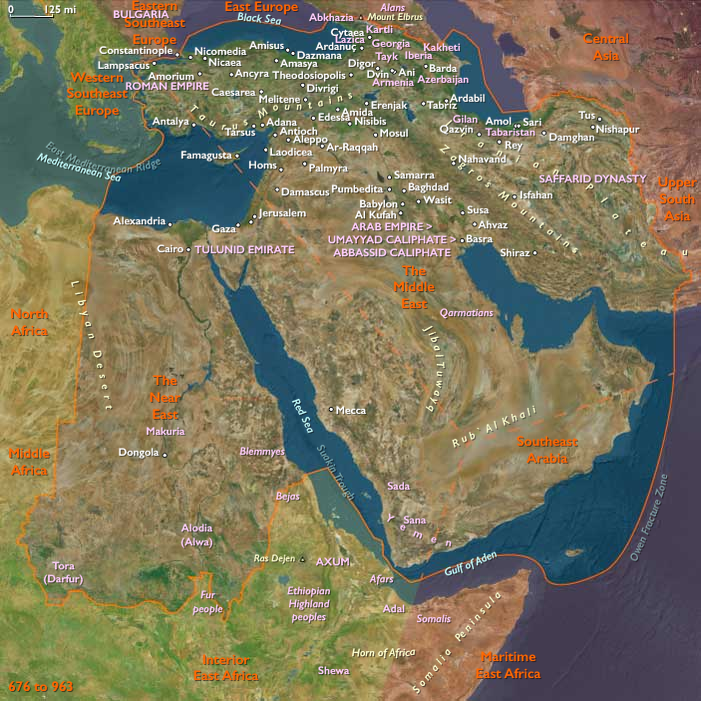
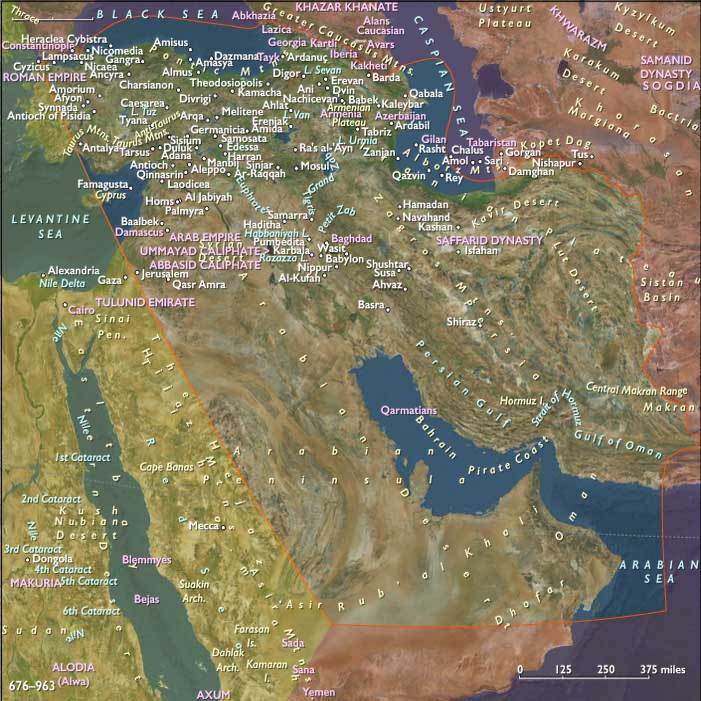
Ahmed bin Ismail bin Ahmed had become amir of the Samanids upon his father's death in late 907.
Some time afterwards, he had been granted the rights to Sistan, the heart of the Saffarid realm, by Caliph al-Muqtadir.
The Saffarids' infighting made the job much easier.
Ahmad's army had traveled from Farah to Bust, where they meet little resistance.
At the same time, Simjur al-Dawati is now installed as the Samanid governor of Sistan, Tabaristan and Gurgan; however, he soon revolts against Samanid authority as well, and before Ahmad can deal with the rebellion, he is decapitated while sleeping in his tent near Bukhara by some of his slaves on January 12, 914.
After his death, he is brought to Bukhara and buried in Naukanda.
Some of the slaves who had killed the Amir are caught and executed, while others flees to Turkestan.
He is designated as the "Martyred Amir".
Ahmad may have become unpopular among his subjects for his order to change the language of the court from Persian to Arabic; this order was soon rescinded.
He is succeeded by his young son Nasr II.
Due to his youth, his prime minister Abu ’Abd-Allah al-Jaihani undertakes the regency.
Almost immediately, a series of revolts breaks out within the state, the most serious being the one led by his great-uncle Ishaq ibn Ahmad.Ishaq’s sons take part in the rebellion; one son, Mansur, takes control of Nishapur and several other cities in Khurasan.
Eventually, Ishaq is captured, while Mansur dies in Nishapur.
The Abbassids try to benefit from the turmoil of the interregnum to reconquer Sistan, in vain.
Locations
People
Groups
- Khorasan, Greater
- Islam
- Zaidiyyah
- Samanid dynasty
- Saffarid dynasty
- Abbasid Caliphate (Baghdad)
- Alids of Tabaristan, Daylam and Gilan
Commodoties
Subjects
Regions
Subregions
Related Events
Filter results
Showing 10 events out of 10 total
The Rashtrakutans defeat the Cholans in a series of campaigns beginning in 948, taking the Vengi plain and in 949, dealing the expansionist Cholas a disastrous military setback.
The Struggle for Zeeland and the Union of Holland and Hainaut (1296–1299)
For much of the 13th century, Zeeland remained a contested territory between the Counts of Holland and Flanders, as both sought to control its valuable trade routes and strategic coastal position.
Floris V and the Franco-Flemish Conflict in Zeeland
- Count Floris V of Holland engaged in a prolonged conflict against Flanders to assert his claim over Zeeland.
- Seeking support against Flanders, Floris aligned himself with France, as the Capetian kings sought to undermine Flanders' growing power.
- However, Floris was assassinated in 1296 in a conspiracy involving disgruntled nobles and English agents, leaving his twelve-year-old son, John I of Holland, as his successor.
The Death of John I and the Union of Holland and Hainaut
- John I of Holland ruled for only three years, dying in 1299 without an heir.
- With all his siblings having died young, the nearest heirs to Holland were his cousins from Hainaut, the sons of his great-aunt, Adelaide of Holland.
- From 1299 onward, the County of Holland entered a personal union with Hainaut, as the Avesnes family took over Holland’s rule.
John II of Hainaut and the Ongoing Avesnes-Dampierre Rivalry
- John II of Hainaut, who had ruled since 1280, inherited Holland, continuing the long-standing conflict between the House of Avesnes (Hainaut-Holland) and the House of Dampierre (Flanders).
- His primary rival remained Count Guy of Flanders, with whom he contested control over imperial Flanders(Flemish lands within the Holy Roman Empire).
- The conflict was part of the broader Franco-Flemish wars, as France backed the Avesnes faction against the independent-minded Dampierres.
Impact and Legacy
- The union of Holland and Hainaut strengthened Avesnes influence in the Low Countries, but tensions with Flanders persisted.
- Zeeland remained a disputed frontier, with both sides seeking imperial and French support to advance their claims.
- The union lasted until Hainaut ceased to be an independent county, shaping Holland’s future role in the geopolitics of the region.
The 1299 shift in Holland’s leadership reflected the broader feudal struggles in the Low Countries, as dynastic unions and territorial disputes played a decisive role in the political landscape of late medieval Europe.
John II of Avesnes: The Union of Hainaut and Holland and the Defeat of Flanders (1299–1301)
John II of Avesnes (b. 1247) was the eldest son of John I of Avesnes and Adelaide of Holland, the daughter of Floris IV, Count of Holland. His inheritance and strategic alliances shaped the political landscape of the Low Countries in the late 13th and early 14th centuries.
The Personal Union of Hainaut and Holland (1299–1356)
- John became Count of Hainaut in 1280 upon the death of his father.
- In 1299, following the murder of his cousin, Floris V of Holland, John inherited Holland and Zeeland through his mother, Adelaide of Holland, who had acted as heiress and regent of the county.
- This created a personal union between Hainaut and Holland–Zeeland, which would endure for over half a century, strengthening the Avesnes family’s influence in the region.
The Ongoing War Against Flanders
- John II continued the long-running war between the House of Avesnes and the House of Dampierre, contesting imperial Flanders against Count Guy of Flanders.
- His cousin, Floris V of Holland, had also fought against Flanders for control of Zeeland, even seeking French support against Guy of Dampierre.
- After Floris V’s assassination in 1296, John II took up his cause, reinforcing Holland’s claims against Flanders.
Victory Over Flanders (1300–1301)
- In 1300–1301, French forces defeated the Flemish in a decisive campaign, strengthening John II’s position.
- The Flemish rebels in Zeeland were also crushed, securing Holland’s authority over the disputed region.
- His brother, Guy of Avesnes, was appointed Bishop of Utrecht, further consolidating Avesnes control over the Low Countries.
John II’s Triumph
By 1301, John II had eliminated his main rivals:
- Floris V’s murderers were defeated.
- The House of Dampierre suffered major setbacks.
- Flemish resistance in Zeeland was broken.
With Flanders temporarily subdued and Holland and Zeeland firmly under his rule, John II solidified the Avesnes dynasty’s power, laying the foundation for the continued dominance of his family in the Low Countries.
The Temporary Subjugation of Flanders (1300–1301) and the Rising Resentment Against France
Following the French victories over Flanders in 1300 and again in 1301, Philip IV of France and his allies, including John II of Avesnes, appeared to have successfully pacified the region. The rebels in Zeeland were also defeated, further strengthening French and Avesnes influence in the Low Countries.
Consolidation of Power
- John II of Avesnes had gained control of Holland and Zeeland, continuing the long struggle between the Houses of Avesnes and Dampierre for dominance in the region.
- His brother, Guy of Avesnes, was appointed Bishop of Utrecht, further consolidating Avesnes influence over the ecclesiastical and political affairs of the Low Countries.
- With Flemish forces weakened, direct French rule was imposed over Flanders, replacing the previous local autonomy under the Count of Flanders, Guy of Dampierre.
Growing Discontent with French Rule
Despite initial success, the French occupation of Flanders quickly became unpopular:
- The Flemish burghers, particularly in the major cities like Bruges, Ghent, and Ypres, found direct French administration far more oppressive than the rule of the Dampierre counts.
- Heavy taxation and restrictions on trade under the French crown alienated Flemish merchants and urban guilds, who had long enjoyed economic privileges and relative autonomy.
- The presence of French garrisons and the imposition of royal officials from France created widespread resentment among the local population.
Impending Revolt
Though Flanders seemed pacified in 1301, tensions continued to simmer beneath the surface. The Flemish cities, frustrated by French rule, would soon rise in rebellion, culminating in the Flemish uprising of 1302 and the decisive Battle of the Golden Spurs, where the French would suffer a crushing defeat.
The Bruges Matins (Brugse Metten) and the Flemish Revolt Against France (1302)
On the night of May 18, 1302, a Flemish insurrection, led by Pieter de Coninck and Jan Breydel, launched a coordinated attack against the French garrison in Bruges. This event, later known as the Bruges Matins (Brugse Metten), marked the beginning of the Flemish Revolt against French rule and played a pivotal role in the events leading to the Battle of the Golden Spurs.
The Attack on the French Garrison
- Under cover of darkness, Flemish rebels stormed houses where French troops were stationed.
- According to tradition, to distinguish between French occupiers and native Flemings, they forced suspected French speakers to pronounce a shibboleth:
- "Schild en vriend" ("Shield and friend")—a phrase difficult for French speakers to pronounce correctly.
- An alternative version suggests the phrase "Des gildens vriend" ("Friend of the guilds").
- French governor Jacques de Châtillon and a few survivors managed to escape, but the majority of the French troops in Bruges were slaughtered.
Aftermath and Flemish Resistance
- The massacre galvanized popular support for the Count of Flanders, Guy of Dampierre, who had been imprisoned by Philip IV of France since 1299.
- In response to the insurrection, Philip IV sent a large army to crush the rebellion, leading to the Battle of the Golden Spurs (July 11, 1302), where the Flemish forces decisively defeated the French knights.
- The Bruges Matins drew comparisons to the Sicilian Vespers (1282), another popular uprising against foreign rule.
Legacy and Commemoration
- Jan Breydel and Pieter de Coninck became celebrated as national heroes in Flanders for their role in the rebellion.
- Their statues, commissioned through the efforts of Julius Sabbe, were erected in the market square of Bruges in 1887, symbolizing Flemish resistance and independence.
- The Bruges Matins remains a defining moment in Flemish history, symbolizing the struggle against foreign domination and the assertion of regional autonomy.
The Bruges Matins of 1302 was not just a violent insurrection but a turning point in Flemish resistance against French rule, laying the groundwork for one of the most significant battles in medieval European history.
The Battle of the Golden Spurs (July 11, 1302): A Flemish Victory Over French Cavalry
In response to the Bruges Matins (May 18, 1302), King Philip IV of France sought to punish the Flemish rebels, sending a powerful army led by Count Robert II of Artois. The battle that followed near Kortrijk on July 11, 1302, known as the Battle of the Golden Spurs, marked a historic victory for Flemish urban militias over a heavily armored French feudal cavalry force.
The Flemish Forces: A Well-Organized Infantry Army
- The Flemish army, numbering about 9,000 men, was composed primarily of town militias, including:
- 3,000 Bruges militia led by William of Jülich (grandson of Count Guy) and Pieter de Coninck, a leader of the Bruges uprising.
- 2,500 men from Bruges suburbs and coastal regions, commanded by Guy of Namur, the younger son of Count Guy of Dampierre.
- 2,500 men from Ghent, led by Jan Borluut.
- 1,000 men from Ypres, led by Jan van Renesse from Zeeland.
- The Flemish infantry were highly disciplined and well-armed, using:
- The Goedendag, a spiked club with a spear-like tip, effective against armored cavalry.
- The Geldon, a long spear, ideal for repelling mounted attacks.
- Unlike most medieval armies, the Flemish had no cavalry, relying entirely on foot soldiers who were regularly trained in urban militias.
The French Army: A Classic Feudal Force
- The French army, numbering around 8,000 men, was a traditional feudal force, comprising:
- 2,500 noble cavalry, including knights and squires.
- 1,000 crossbowmen.
- 1,000 spearmen.
- Up to 3,500 other infantry.
- Military doctrine at the time held that one knight was worth ten infantrymen, reinforcing the belief in cavalry supremacy.
The Battle: July 11, 1302
After failed Flemish attempts to take Kortrijk (July 9–10), the two armies met in open battle on July 11, 1302.
The Battlefield and Initial Engagement
- The battlefield was crisscrossed by ditches and streams, making it difficult for cavalry charges.
- The French attempted to improve conditions by having their servants place wooden planks over the streams, but they did not wait for this to be completed before attacking.
- The initial attack was led by the French infantry, who made good progress, but Count Robert II of Artois recalled them, wanting the noble cavalry to claim the victory.
The Decisive Cavalry Charge and the Flemish Response
- The French knights, hindered by their own retreating infantry, launched a disorganized charge into the Flemish ranks.
- The Flemish militia, firmly positioned and using their long spears and Goedendags, cut down the charging knights in large numbers.
- The French cavalry was completely overwhelmed, and when they realized the battle was lost, the survivors attempted to flee—only to be pursued for over 10 km (6.2 miles) by the Flemish.
- Count Robert II of Artois was surrounded and killed on the battlefield.
The No-Prisoners Policy
- The Flemish had either been ordered to take no prisoners or did not understand the custom of capturing knights for ransom.
- A modern theory suggests that Flemish commanders forbade taking prisoners while the battle was undecided, to prevent their ranks from breaking when soldiers attempted to escort captives away from the fight.
The Aftermath: The End of Cavalry Supremacy
- At least 1,000 French knights were killed, including many high-ranking nobles.
- The golden spurs of the fallen French knights were collected and hung in the Church of Our Lady in Kortrijk, giving the battle its name: the Battle of the Golden Spurs (Guldensporenslag).
- Contemporary estimates place total French casualties at over 10,000 dead and wounded.
- The French later recaptured the golden spurs in 1382 after the Battle of Westrozebeke, but the memory of the Flemish victory endured.
Legacy and Military Significance
The Battle of the Golden Spurs was a watershed moment in medieval military history, proving that:
- Disciplined and well-equipped infantry could defeat heavily armored cavalry, challenging the long-standing supremacy of the knightly charge.
- Urban militias with regular training were a formidable force, influencing the rise of professional armies in the later Middle Ages.
- The battle shocked military leaders across Europe, leading to a reevaluation of military tactics.
The Flemish victory at Kortrijk in 1302 was not just a military triumph, but a defining moment in the struggle for Flemish independence from French domination, influencing regional politics for generations.
The Flemish Counteroffensive After the Battle of the Golden Spurs (1302–1303)
Following the Battle of the Golden Spurs (July 11, 1302), where the Flemish militias dealt a crushing defeat to the French knights, Philip IV of France briefly released Count Guy of Dampierre in an attempt to negotiate a settlement. However, his subjects refused to compromise, emboldened by their unexpected military success.
Guy of Namur’s Zeeland Campaign
- Guy of Namur, son of Count Guy of Dampierre, emerged as a popular military leader after the victory at Kortrijk.
- Claiming the title "Count of Zeeland," he led an invasion of Zeeland, where discontented local populations welcomed his forces.
- His Flemish troops, supported by Zeelanders, engaged the forces of William, son of Duke John II of Brabant, in battle on the island of Duiveland.
Victory and the Capture of the Bishop of Utrecht
- Guy of Namur’s army defeated William’s forces, securing a strategic victory in the region.
- In the aftermath, Guy of Avesnes, Bishop of Utrecht, a key ally of John II of Brabant and Philip IV of France, was taken prisoner.
Consequences of the Flemish Expansion
- The victory extended Flemish influence into Zeeland, intensifying the conflict between Flanders, France, and the Avesnes-controlled territories.
- Philip IV, unwilling to tolerate further Flemish advances, prepared for a renewed campaign to crush the rebellion.
- The struggle between Flanders and France would continue, culminating in further battles and political maneuvering in the coming years.
Legacy
Guy of Namur’s invasion of Zeeland and subsequent victory demonstrated that the Flemish resistance against French rule was far from over. His success further challenged French and Brabantine control in the region, ensuring that the conflict between Flanders and its enemies would continue.
Philip IV’s Retaliation After the Battle of the Golden Spurs: The Flemish War Continues (1302–1304)
The Battle of the Golden Spurs (1302) had dealt a devastating blow to the French nobility, with about 40% of France’s knights and noblemen slain at Courtrai. This deep crisis among the nobility paradoxically strengthened the authority of King Philip IV, as the surviving nobles became more reliant on royal leadership for military and political stability.
Determined to avenge the humiliation and restore French control over Flanders, Philip IV launched a renewed military campaign, culminating in:
- The destruction of a Flemish fleet under Guy of Namur at the Battle of Zierikzee (1304).
- The Battle of Mons-en-Pévèle (August 17, 1304), where Philip personally fought the Flemish forces to a bloody draw.
The Battle of Zierikzee (August 10, 1304): The Destruction of the Flemish Fleet
- Guy of Namur, son of Count Guy of Dampierre, had led a Flemish fleet to Zeeland, hoping to extend Flemish influence into the coastal regions controlled by Holland.
- Philip IV, with the aid of John II of Holland (Avesnes dynasty), launched a coordinated naval assault.
- The Flemish fleet was decisively defeated, cutting off Flanders’ ability to reinforce its rebellion by sea.
The Battle of Mons-en-Pévèle (August 17, 1304): A Hard-Fought Draw
- Philip IV personally led his forces into battle at Mons-en-Pévèle, facing a formidable Flemish army.
- The battle was brutal and inconclusive:
- The Flemish inflicted heavy casualties, showing their continued military strength.
- However, the French held the battlefield, forcing the Flemish to withdraw.
- Both sides claimed victory:
- The Flemish had proven their resilience, but
- Philip IV had reasserted royal authority, preventing a complete Flemish triumph.
Aftermath: The Fall of Guy of Namur and the Weakening of Flemish Resistance
- Following his defeat at Zierikzee and Mons-en-Pévèle, Guy of Namur was recaptured and sent back to prison, where he soon died.
- His father, Count Guy of Dampierre, was already a prisoner of Philip IV.
- Although Flanders remained defiant, the rebellion had been weakened, and peace negotiations followed in 1305.
The Balance of Power After 1304
- While Flanders remained resistant to French rule, Philip IV had avenged the 1302 humiliation, stabilizing France’s military and political standing.
- The Flemish cities maintained autonomy, but the war demonstrated that the French Crown, despite setbacks, remained a dominant force.
- The conflict foreshadowed future struggles between France and Flanders, culminating in later revolts and conflicts with Burgundy in the 14th and 15th centuries.
Philip IV’s military resilience in 1304 ensured that France remained a leading power in medieval Europe, despite the heavy cost of the Flemish war.
he Death of John II of Holland and the Continuation of the War with Flanders (1304)
By August 1304, John II of Holland had largely restored his authority in the Low Countries after his victories against Flanders. His most significant achievement was the capture of Guy of Namur, a leading figure in the Flemish resistance. However, just as he had secured his position, he died in August 1304, leaving his son William I of Hainaut as his successor.
Succession of William I of Hainaut (1304)
- Upon his father’s death, William inherited multiple titles:
- Count of Hainaut (William I)
- Count of Holland (William III)
- Count of Zeeland (William II)
- Count of Avesnes (William III)
- As ruler of these territories, he continued the personal union of Hainaut and Holland, which had begun with his father’s reign.
Continuation of the War with Flanders (1304–1323)
- Although Philip IV of France had weakened Flanders militarily, the Flemish refused to accept French or Hollandic rule, keeping the conflict in Zeeland and the Low Countries alive.
- William I continued his father’s war with Flanders, determined to secure Zeeland against Flemish claims.
- The war finally ended with the Treaty of Paris in 1323, where the Count of Flanders renounced all claims to Zeeland, securing it as a permanent part of Holland.
Legacy of John II and William I
- John II’s military success in 1304, including the capture of Guy of Namur, strengthened Holland’s position against Flanders, laying the groundwork for future stability.
- William I’s continued war efforts led to the eventual resolution of the Zeeland dispute, ensuring Holland’s dominance in the region.
- The union of Hainaut and Holland remained intact, reinforcing the Avesnes dynasty’s influence in the Low Countries.
John II’s timely victories and his son’s persistence in the war ultimately secured Zeeland for Holland and ended Flemish territorial ambitions there, shaping the region’s political boundaries for centuries to come.
Years: 914 - 914
Locations
People
Groups
- Khorasan, Greater
- Islam
- Zaidiyyah
- Samanid dynasty
- Saffarid dynasty
- Abbasid Caliphate (Baghdad)
- Alids of Tabaristan, Daylam and Gilan
