The relationship between coast and interior is …
Years: 1684 - 1827
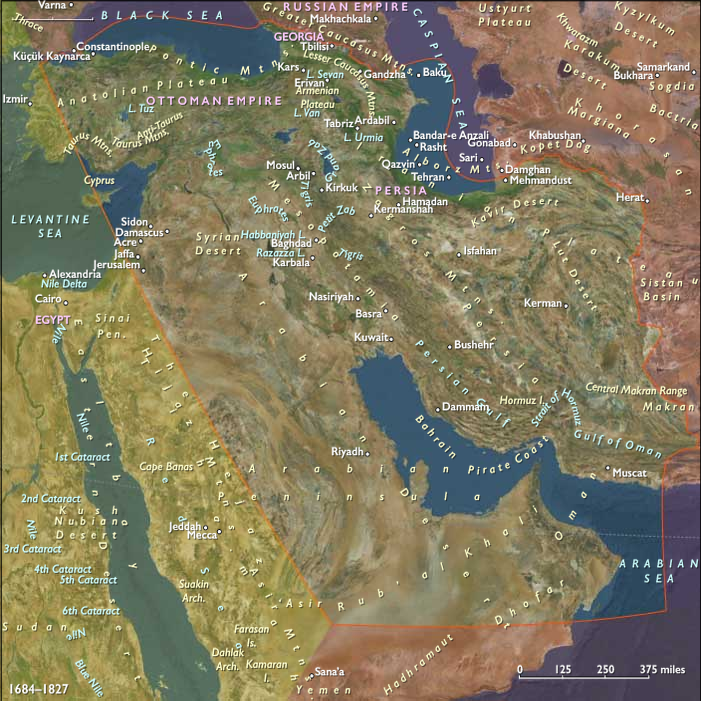
The relationship between coast and interior is becoming a major feature within the gulf.
Tribes from the interior increasingly begin to move and settle into the coastal centers in the eighteenth century.
The economy on the Arab side of the gulf does not match past prosperity, but coastal conditions remain better than those in central Arabia.
Limited agriculture exists, and the gulf waters are the site of rich oyster beds for harvesting pearls.
The area's easy access to India, a major market for pearls, makes the pearling industry particularly lucrative, and this draws the attention of tribes in the interior.
The tribal migrations that occur around 1800 put in place the tribes and clans that in the early twenty-first century will control Kuwait, Bahrain, Qatar, and the UAE.
Groups
- Iranian peoples
- Arab people
- Omanis
- Persian people
- Islam
- Muslims, Sunni
- Muslims, Kharijite
- Muslims, Shi'a
- Muslims, Ibadi
- Ismailism
- Qarmatians
- Persia, Safavid Kingdom of
- Yaruba dynasty
- Abu Dhabi, Emirate of
- Ra's al-Khaymah, or Ras al-Khaimah, Emirate of
- Al Khalifa family
- Sharjah (ash-Shariqah), Emirate of
- Ajman, or 'Ujman, Emirate of
- Umm al-Qaywayn, or Umm al-Quwain, Emirate of
- Dubai, Emirate of
- al-Fujayrah, or Fujairah, Emirate of
Commodoties
Subjects
Regions
Subregions
Related Events
Filter results
Showing 10 events out of 46 total
Southwest Europe (1684 – 1827 CE)
Enlightenment, Revolution, and Imperial Decline
Geography & Environmental Context
Southwest Europe united two complementary subregions: Mediterranean Southwest Europe—southern and eastern Spain and Italy (from Catalonia and Valencia through Naples, Sicily, Sardinia, and Malta, including Andorra and Monaco)—and Atlantic Southwest Europe—northern Spain (Galicia, Asturias, Cantabria, León) and central–northern Portugal, including Lisbon and the Douro Valley. The region encompassed contrasting worlds: Mediterranean coasts and olive-clad uplands, Atlantic-facing rías and mountain pastures, and the global imperial hubs of Madrid, Lisbon, and Naples.
Climate & Environmental Shifts
The Little Ice Age’s final pulses brought cooler winters, erratic rains, and droughts punctuated by floods. The Tambora eruption (1815) caused the “Year Without a Summer” (1816–1817), producing harvest failures and famine across Iberia and Italy. In the Mediterranean, drought and locusts struck Sicily and Valencia; Atlantic coasts endured storms and failed fisheries. Yet maize, introduced earlier, spread widely and improved subsistence resilience, while the Douro and Ebro valleys sustained wine and olive production even in lean years.
Subsistence & Settlement
-
Agriculture & trade: Wheat, rye, and maize anchored highland diets; olives, vines, and citrus defined Mediterranean valleys; the Douro terraces produced port wine for export; Andalusian and Neapolitan estates exported olive oil and citrus; inland herders raised sheep and goats across the Meseta and Apennines.
-
Fisheries & maritime life: Sardines, cod, and tuna sustained Atlantic coasts; coral and sponge fishing remained profitable in the Mediterranean.
-
Urban networks: Madrid, Lisbon, Barcelona, Valencia, Naples, Palermo, Porto, Bilbao, A Coruña, and Genoa served as hubs of administration and commerce; Lisbon rebuilt after its 1755 earthquake with wide boulevards and Pombaline architecture; Monaco and Andorra survived as enclaved principalities amid continental warfare.
Technology & Material Culture
-
Agrarian reform: The Enlightenment era promoted new crops, irrigation, and land surveys; Charles III’s Spain (1759–1788) fostered rational agronomy and economic societies.
-
Urban reconstruction: Post-1755 Lisbon embodied neoclassical town planning; Naples, Turin, and Barcelonaadopted Enlightenment grids and academies.
-
Industrial stirrings: Mining, silk weaving (Valencia, Lyon–Turin), shipyards on the Tagus and Bay of Biscay, and Lisbon’s arsenals foreshadowed later industrialization.
-
Material life: Mix of peasant implements, maritime tools, and luxury imports from the Americas—Brazilian gold, sugar, coffee, and tobacco funded rococo palaces and religious art.
Movement & Interaction Corridors
-
Imperial arteries:
-
Lisbon remained Europe’s bridge to Brazil, channeling sugar, gold, diamonds, and coffee.
-
Seville–Cadiz shifted to Atlantic trade after 1717; Barcelona–Valencia retained Mediterranean shipping to Italy and the Levant.
-
The Douro–Porto corridor tied vineyards to Britain under the Methuen Treaty (1703), fostering Anglo-Portuguese mercantile ties.
-
-
War and diplomacy:
-
War of the Spanish Succession (1702–1714): Reshaped European alliances; Austria gained Italian territories, Savoy took Sardinia.
-
Peninsular War (1808–1814): French occupation of Spain and Portugal brought devastation but also nationalist mobilization and guerrilla warfare; Lisbon survived under British naval protection.
-
Congress of Vienna (1815): Reinstated monarchies—Bourbon Spain, Sardinian Savoy, Naples/Bourbon Two Sicilies—yet could not erase revolutionary legacies.
-
Cultural & Symbolic Expressions
-
Religion & reform: Catholic devotion persisted but came under scrutiny; Enlightened monarchs curbed monastic orders and seized church lands; the Jesuit expulsion (1767) marked a decisive shift toward state control.
-
Intellectual ferment: Universities in Coimbra, Madrid, Naples, Barcelona, and Bologna hosted reformist thinkers; Spanish and Italian Enlightenments circulated through learned societies and journals.
-
Art & literature: Neoclassicism flourished in Rome and Madrid; Goya’s paintings captured both Enlightenment optimism and Napoleonic horror; Jacques-Louis David’s Roman studies influenced European art.
-
Popular culture: Pilgrimages to Santiago de Compostela, Galician bagpipes (gaita), Portuguese fado, and Neapolitan song embodied enduring vernacular identities.
Environmental Adaptation & Resilience
Diversified economies—grain, vines, olives, livestock, and fisheries—softened climatic shocks. Parish relief and monastic charity mitigated famine. Terracing and irrigation expanded arable land; maize and potatoes became famine crops. Coastal shipping distributed grain between famine and surplus ports.
Political & Military Shocks
-
Spanish decline: After Charles III’s reforms, misrule under Charles IV and Manuel de Godoy drew Spain into Napoleonic wars; the Peninsular War wrecked the economy and precipitated loss of nearly all American colonies by 1825, leaving only Cuba and Puerto Rico.
-
Revolutionary upheavals: The Constitution of Cádiz (1812) heralded liberalism; Riego’s revolt (1820)reinstated it briefly before French intervention (1823) restored absolutism.
-
Italian and Sardinian reorganization: Austrian dominance over Lombardy–Venetia and Savoyard expansion into Piedmont–Sardinia laid foundations for 19th-century nationalism.
-
Portuguese transition: The royal family’s flight to Brazil (1807) and return (1821) transformed Lisbon’s empire; Brazilian independence (1822) ended Portugal’s golden age.
Transition
Between 1684 and 1827 CE, Southwest Europe evolved from Baroque monarchy to a crucible of Enlightenment reform, revolution, and imperial loss. Lisbon and Madrid, once capitals of world empires, faced contraction as Brazil and Spanish America broke free. Napoleonic invasion, liberal constitutions, and restorations alternated in dizzying succession. Yet from Porto’s terraces to Naples’ quays and Andorra’s valleys, resilient agrarian and maritime communities sustained cultural continuity. The age ended with monarchies restored but Enlightenment ideals—and Atlantic winds of change—irreversibly reshaping the destiny of Southern Europe.
Mediterranean Southwest Europe (1684–1827 CE): Enlightenment, Revolution, and Imperial Decline
The period 1684–1827 CE in Mediterranean Southwest Europe encompasses significant political, social, and economic transformations marked by Enlightenment reforms, revolutionary movements, and shifting imperial dynamics, profoundly influencing the future course of the region.
Shifts in Power and the Enlightenment
In the early eighteenth century, the War of the Spanish Succession (1702–1714) drastically reshapes the political landscape. Austria emerges as the dominant foreign power in Italy, replacing Spain, and the House of Savoy expands its influence into Piedmont and Sardinia. Despite these territorial adjustments, Spain retains its internal unity and much of its colonial empire, although its political power in Europe is significantly reduced.
Under Charles III of Spain (r. 1759–1788), Spain experiences a period of enlightened despotism, promoting economic and governmental reforms inspired by Enlightenment ideals. However, anticlericalism and aggressive state centralization provoke social and political tensions, and reforms falter without sustained royal patronage.
Spanish Decline and Colonial Losses
Spain’s economic and military decline accelerates under Charles IV (r. 1788–1807), whose rule is overshadowed by Manuel de Godoy, the influential and unpopular chief minister. Godoy's shifting alliances embroil Spain in the Napoleonic Wars, draining resources and weakening internal stability.
The Peninsular War (1808–1814) significantly disrupts Spanish governance. Napoleon’s imposition of his brother, Joseph Bonaparte, as King of Spain provokes widespread resistance and guerrilla warfare, severely undermining French control and galvanizing Spanish nationalism. Following the war, Ferdinand VII regains the throne but struggles to reestablish authority, especially amidst attempts to reconquer rebellious American colonies.
By 1825, nearly all Spanish colonies in the Americas have achieved independence, leaving only Cuba and Puerto Rico under Spanish control. Spain’s failed military efforts to suppress these independence movements exacerbate its economic strain and internal divisions.
Revolutionary Turmoil and Liberal Aspirations
In 1820, Major Rafael de Riego leads a successful pronunciamiento, reinstating the liberal Constitution of 1812 and ushering in the Constitutional Triennium (1820–1823). The liberal reforms introduced during this period, advocating equality, centralized governance, and economic liberalism, face fierce conservative opposition.
In 1823, a French intervention, requested by Ferdinand VII and supported by European conservative powers, crushes the liberal government, restoring royal absolutism. Despite this setback, liberal ideals continue to influence Spain’s political discourse and revolutionary activities throughout the nineteenth century.
Italy's Evolving Political Landscape
Following the Congress of Vienna (1814–1815), Italian regions undergo substantial territorial and political reorganizations. Northern and central Italy, previously part of Napoleonic client states, revert to traditional rulers, with Austria maintaining significant influence. Genoa’s integration into the Kingdom of Sardinia marks the end of its historic independence, reinforcing the House of Savoy’s regional power.
In southern Italy, regions that briefly flourished under Joachim Murat as king of Naples revert to Bourbon control, yet revolutionary sentiments and the influence of French Revolutionary ideals persist, sowing seeds for future conflicts and nationalist movements.
Stability in Andorra
Andorra maintains its traditional co-principality status, experiencing relative stability despite broader regional upheavals. The principality briefly experiences changes under Napoleonic rule but quickly reasserts its historical autonomy and economic independence in 1814.
Cultural and Intellectual Developments
Throughout this period, cultural and intellectual life flourishes, notably in Italy, where Enlightenment and neoclassical ideas profoundly impact the arts. The painter Jacques-Louis David exemplifies the neoclassical revival, influencing European art through his studies and experiences in Rome.
Conclusion: A Region Transformed
From 1684 to 1827, Mediterranean Southwest Europe witnesses profound changes—Enlightenment reforms, revolutionary upheavals, and shifting imperial structures redefine political boundaries and cultural landscapes. These transformations set the stage for ongoing struggles between liberal and conservative forces, significantly shaping the region’s subsequent history.

As a result of those reforms, the Quito audiencia is transferred in 1720 from the authority of the Peruvian vice royalty to the newly created Viceroyalty of Nueva Granada, whose capital is in Bogotá.
In the process, the quiteno authorities gain jurisdiction over their own political and military affairs, while the audiencia's southern and eastern boundaries are delineated more specifically and retracted.
A royal decree (cedula) in 1802 further shrinks the area of the audiencia by transferring the provinces of Quijos and Mainas in the Oriente to Peru.
Another decree by Charles IV in 1803 transfers the port of Guayaquil to Peru, but resistance by port citizens lead to its being returned to the jurisdiction of Quito in 1819.
The eleven-year period of civil war that marks the Mexican wars of independence is largely a byproduct of the crisis and breakdown of Spanish royal political authority throughout the American colonies.
A successful independence movement in the United States has demonstrated the feasibility of a republican alternative to the European crown.
For most politically articulate criollos, however, a strong cultural affinity with the mother country, a preference for stability and continuity, and alienation from Mexico's native and poor mestizo populations are significant disincentives to a radical break with the established order.
Dissatisfaction with peninsular administrative practices and anti-criollo discrimination at many levels of the colonial government and society are important foci of discontent, but beyond small pockets of radical conspirators, these grievances have not yet spawned a pronounced wave of pro-independence criollo sentiment at the beginning of the nineteenth century.
The French occupation of Spain and the overthrow of the Iturrigaray junta creates a vacuum of legitimacy, as it is no longer clear that the ad hoc peninsular administration represents any authority or interests other than its own.
A revolt will no longer necessarily be a challenge to the paternal crown and the faith that it ostensibly defends, but will instead shake off the rule of the increasingly despised gachupines, as the peninsulares are derisively called.
It is in this context that a radical criollo parish priest, Miguel Hidalgo y Costilla, is able to lead the first truly widespread insurrection for Mexican independence.
From Guanajuato, the independence forces march on to Mexico City after having captured Zacatecas, San Luis Potosf, and Valladolid.
They encounter resistance at Monte de las Cruces on October 30, 1810, and, despite a rebel victory, lose momentum and do not take Mexico City.
After a few more victories, the revolutionary forces move north toward Texas.
The insurgents are ambushed in March of the following year and taken prisoner in Monclova (in the present-day state of Coahuila).
Hidalgo is tried as a priest by the Holy Office of the Inquisition and found guilty of heresy and treason.
He is later condemned to death.
Hidalgo is executed by firing squad on July 31, 1811.
His body is mutilated, and his head is displayed in Guanajuato as a warning to other would-be insur- gents.
Jose Maria Morelos Pavon assumes the leadership of the revolutionary movement after the death of Hidalgo.
Morelos takes charge of the political and military aspects of the insurrection and further plans a strategic move to encircle Mexico City and to cut communications to the coastal areas.
In June 1813, Morelos convokes a national congress of represen tatives from all of the provinces, which meets at Chilpancingo in the present-day state of Guerrero to discuss the future of Mexico as an independent nation.
The major points included in the document prepared by the congress are popular sovereignty, universal male suffrage, the adoption of Roman Catholicism as the official religion, abolition of slavery and forced labor, an end to government monopolies, and an end to corporal punishment.
Despite initial successes by Morelos's forces, however, the colonial authorities break the siege of Mexico City after six months, capture positions in the surrounding areas, and finally invade Chilpancingo.
Morelos is captured in 1815 and meets the same fate as Hidalgo.
Napoleon Bonaparte invades the Iberian Peninsula in 1808.
The Habsburg king, Charles IV, abdicates when French troops enter Madrid, and Napoleon names his brother Joseph Bonaparte as the new king.
Many Spanish patriots in unoccupied parts of Spain declare Ferdinand VII, son of Charles IV, as the new monarch.
When the news of Charles IV's abdication reaches New Spain, considerable turmoil arises over the question of whether Ferdinand VII or Joseph is the legitimate ruler of the colony.
Viceroy Jose de Iturrigaray, hoping to be named king of a newly independent country, supports the criollos of New Spain when they propose a junta to govern the colony.
Peninsulares realize the danger of such an association between criollos and the administration and thus orchestrates a coup d'etat in 1808 to defend their privileges and standing in colonial society.
Iturrigaray is replaced after the coup by a senile puppet Spaniard, Pedro de Garibay, much to the despair of the criollos.
Ferdinand had lost his devoted wife, Infanta Barbara of Portugal, in August 1758 and had fallen into deep mourning for her.
He named his half-brother Charles, Duke of Parma and Piacenza, his heir presumptive on December 10, 1758 before leaving Madrid to stay at Villaviciosa de Odón, where he died on August 10, 1759.
At that point, Charles had been proclaimed King of Spain under the name of Charles III of Spain, respecting the third Treaty of Vienna, which states he will not be able to join the Neapolitan and Sicilian territories to the Spanish throne.
He is later given the title of Lord of the Two Sicilies.
The Treaty of Aix-la-Chapelle, which Charles has not ratified, foresees the eventuality of his accession to Spain; thus Naples and Sicily go to his brother Philip, Duke of Parma, while the possessions of the latter are divided between Maria Theresa (Parma and Guastalla) and the King of Sardinia (Plaisance).
Determined to maintain the hold of his descendants on the court of Naples, Charles had undertaken lengthy diplomatic negotiations with Maria Theresa, and in 1758 the two had signed the Fourth Treaty of Versailles, by which Austria formally renounced the Italian Duchies.
Charles Emmanuel III of Sardinia, however continued to pressure on the possible gain of Plaisance and even threatened to occupy it.
In order to defend the Duchy of Parma from Charles Emmanuel's threats, Charles deployed troops on the borders of the Papal States.
Thanks to the mediation of Louis XV, Charles Emmanuel renouncea his claims to Plaisance in exchange for financial compensation.
Charles thus assures the succession of one of his sons and, at the same time, reduces Charles Emmanuel's ambitions.
The eldest son of Charles, Infante Philip, Duke of Calabria, has learning difficulties and is thus taken out of the line of succession to any throne; he will die in 1777 in Portici where he had been born in 1747.
The title of Prince of Asturias is given to Charles, the second-born.
The right of succession to Naples and Sicily is reserved for his third son, Ferdinand; he will stay in Italy while his father is in Spain.
Charles' formally abdicates the crowns of Naples and Sicily on October 6, 1759 in favor of Ferdinand.
Charles leaves his son's education and care to a regency council composed of eight members; this council will govern the kingdom until the young king is 16 years old.
Charles and his wife arrive in Barcelona on October 7, 1759.
Years: 1684 - 1827
Groups
- Iranian peoples
- Arab people
- Omanis
- Persian people
- Islam
- Muslims, Sunni
- Muslims, Kharijite
- Muslims, Shi'a
- Muslims, Ibadi
- Ismailism
- Qarmatians
- Persia, Safavid Kingdom of
- Yaruba dynasty
- Abu Dhabi, Emirate of
- Ra's al-Khaymah, or Ras al-Khaimah, Emirate of
- Al Khalifa family
- Sharjah (ash-Shariqah), Emirate of
- Ajman, or 'Ujman, Emirate of
- Umm al-Qaywayn, or Umm al-Quwain, Emirate of
- Dubai, Emirate of
- al-Fujayrah, or Fujairah, Emirate of