Ahmad ibn Fadlan, in his travelogue, circa …
Years: 930 - 930
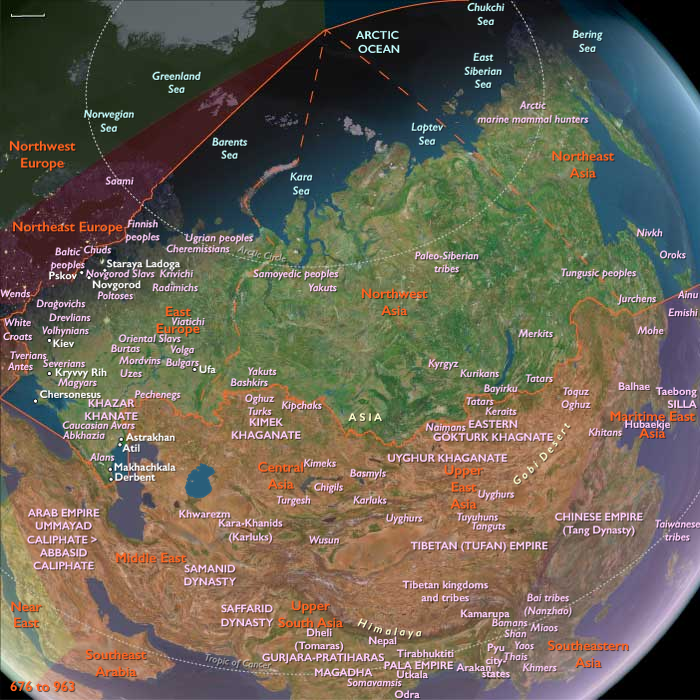
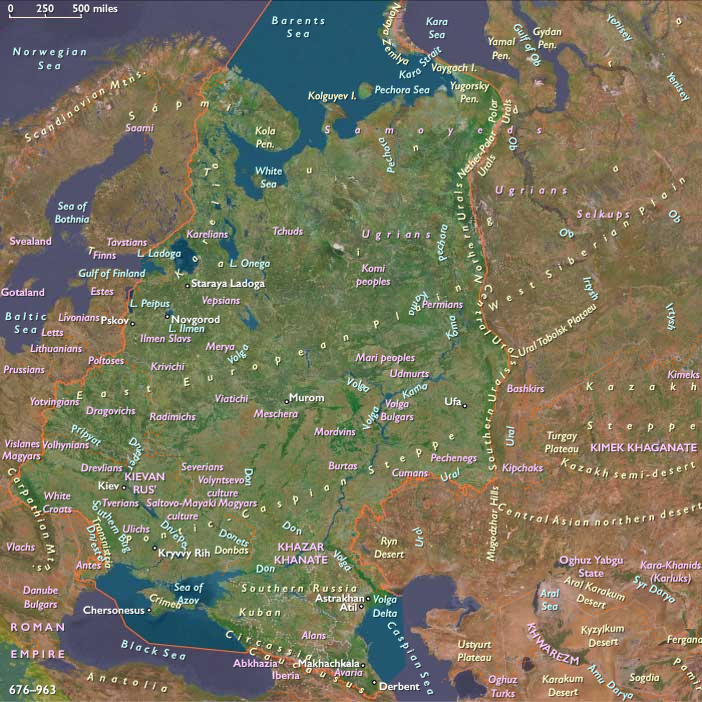
Ahmad ibn Fadlan, in his travelogue, circa 922, had written “The Khazars and their king are all Jews”.Persian historian and geographer Ibn al-Faqih, writes in his famous Mukhtasar Kitab al-Buldan ("Concise Book of Lands"), circa 930, “All of the Khazars are Jews.
But they have been Judaized recently.”
Locations
People
Groups
Topics
Subjects
Regions
Subregions
Related Events
Filter results
Showing 10 events out of 53172 total
Usan-guk, or the State of Usan, occupies Ulleung-do and the adjacent islands during the Korean Three Kingdoms period.
According to the Samguk Sagi, it was conquered by the Silla general Kim Isabu in 512.
He is said to have used wooden lions or tigers to intimidate the residents into surrendering.
Usan-guk rarely enters into historical records, but appears to have continued a largely autonomous existence until its annexation to Goryeo in 930.
Ibn Muqla was born in Baghdad, the capital of the Abbasid Caliphate, in 885/886.
His career in public service had begun in Fars, where he had served as tax collector.
His rise to power in the central government had come in 908, under the patronage of the powerful vizier Abu 'l-Hasan Ali ibn al-Furat, who had given him charge of official dispatches.
It is at this time, under the ineffectual rule of Caliph al-Muqtadir, that the civil bureaucracy reaches its apex of power in the Abbasid court, but at the same time the achievements of previous reigns in restoring the Caliphate's fortunes collapse due to chronic financial shortages.
Throughout the period, the political scene in Baghdad is dominated by Ibn al-Furat and his faction (the Banu 'l-Furat), his rival Ali ibn Isa al-Jarrah and the faction gathered around him (the Banu 'l-Jarrah), and the powerful chief of the military, Mu'nis al-Khadim.
Despite his close ties to Ibn al-Furat, which had been reaffirmed during the latter's second tenure in 917–918, Ibn Muqlahad had eventually turned against him.
His next promotion had come during the de facto 918–928 vizierate of Ali ibn Isa, when he assumed the important department (diwan) of the public estates.
By cultivating the friendship of the powerful chamberlain (hadjib) Nasr, Ibn Muqla had managed to secure the post of vizier for himself after Ali's disgrace in 928.
His vizierate, however, is marked by extreme internal instability, including a short-lived coup in 929, instigated by Mu'nis, which had deposed al-Muqtadir in favor of his brother al-Qahir.
Despite the coup's failure, Mu'nis and his close ally Ali ibn Isa now dominate the government, which leads to Ibn Muqla's dismissal in 930.
Abd ar-Rahman, in his new role of caliph, obtains the surrender of Badajoz, the seat of an effectively autonomous rebel state for over fifty years, in 930.
The age of settlement in Iceland is considered to have begun with Ingólfur's settlement, for he was the first to sail to Iceland with the express purpose of settling the land.
He has been followed by many others—within about sixty years, all the usable land has been taken.
Landnámabók manuscripts mention fifteen hundred farm and place names as well as more than thirty-five hundred people.
The material is arranged in a geographical fashion and seems to give a relatively complete picture of how the country was settled.
It is difficult to estimate with any great precision the number of the migrants to the country during the Age of Settlement, but scholars estimate that it was between fifteen thousand and twenty thousand people.
The age of settlement is considered to have ended in the year 930 with the establishment of Alþingi, when almost all land in the country had been claimed by settlers.
The site of the palace complex of the Anglo-Saxon kings of Wessex, a wooden hall, outbuildings, and an elaborate drainage system are in place at Cheddar (in present Somerset county, England) before 930, after which time a new hall, stone chapel, and additional outbuildings are constructed.
A wooden stockade and a ditch surround the complex.
The village of Cheddar had been important during the Roman and Saxon eras.
There is a royal palace at Cheddar during the Saxon period, which is used on three occasions in the tenth century to host the Witenagemot, an assembly of the ruling class whose primary function is to advise the king and whose membership is composed of the most important noblemen in England, both ecclesiastic and secular.
Abu Tahir, in 931, turns over the Qarmatian state to the Mahdi-Caliph, who institutes the worship of fire and the burning of religious books during an eighty-day rule, which culminates in the Mahdi ordering the execution of members of Bahrain’s notable families, including those of Abu Tahir’s family.
Fearing for his own life, Abu Tahir announces that he had been wrong and denounces the Madhi as ‘false’.
Begging forgiveness from the other notables, Abu Tahir has the Mahdi executed.
Mardāvīj arrives in Isfahan on December 2, 931, names himself the Amir of Iran, and makes Isfahan his capital.
From the advent of Islam until Mardāvīj's arrival, Isfahan has been under the jurisdiction of the Arabs.
Mardāvīj plans to conquer Baghdad, remove the caliphate, be crowned in Ctesiphon and restore the Persian empire.
Charles-Constantine had gained complete control of Vienne by 930, but a year later Rudolph of France is claiming suzerainty over the Viennois and Lyonnais.
In light of these reverses in his transalpine policy, Hugh turns his attention towards securing his rule in Italy and receiving the imperial crown.
He induces the Italian nobility to recognize his son Lothair as their next king and crowns him in April 931.
That same year, he accuses his half-brother Lambert of Tuscany of conspiring for the crown—perhaps with the support of a faction of nobles—and deposes him, bestowing the March of Tuscany on his brother Boso.
Hugh, however, has other reasons for deposing Lambert, who presents an obstacle to his second marriage to Marozia.
Lambert's supporters call in Rudolph of Burgundy, whom Hugh bribes off with the gift of the Viennois and Lyonnais, which Rudolph successfully occupies.
Both Leo VI and Stephen VII, the popes following John X, have been Mazovia’s puppets.
Stephen, a Roman by birth, the son of Theodemundus, had been elected—probably handpicked—by Marozia from the Tusculani family, as a stopgap measure until her own son John was ready to assume the chair of Saint Peter.
Prior to his election, Stephen had been the cardinal-priest of St. Anastasia in Rome.
Very little is known about Stephen’s pontificate.
During his two years as pope, Stephen had confirmed the privileges of a few religious houses in France and Italy.
As a reward for helping free Stephen from the oppression of Hugh of Arles, Stephen had granted Cante di Gabrielli the position of papal governor of Gubbio, and control over a number of key fortresses.
Stephen is also noted for the severity with which he treats clergy who stray in their morals.
He is also, apparently, according to a hostile Greek source from the twelfth century, the first pope who goes around clean shaven while pope.
Stephen dies around March 15, 931, and is succeeded as Pontiff by Mazovia’s twenty-one-year-old son, under the name of John XI.
The parentage of John XI is still a matter of dispute.
According to Liutprand of Cremona (Antapodosis, ii. c. 48) and the Liber Pontificalis, he was the natural son of Pope Sergius III (904–911), (Johannes, natione Romanus ex patre Sergio papa, Liber Pont. ed. Duchesne, II, 243).
Ferdinand Gregorovius, Ernst Dümmler, Thomas Greenwood (Cathedra Petri: A Political History of the great Latin Patriarchate), Philip Schaff, and Rudolf Baxmann agree with Liutprand that Pope Sergius III fathered Pope John XI by Marozia.
If that is true, John XI would be the only known illegitimate son of a Pope to have become Pope himself. (Silverius was the legitimate son of Pope Hormisdas).
On the other hand, Horace Kinder Mann, Reginald L. Poole, Peter Llewelyn (Rome in the Dark Ages), Karl Josef von Hefele, August Friedrich Gfrörer, Ludovico Antonio Muratori, and Francis Patrick Kenrick maintain that Pope John XI was sired by Alberic I of Spoleto, Count of Tusculum.

The Partition of León and the Rise of Ramiro II (929 CE)
After deposing Alfonso Fróilaz, the three sons of Ordoño II, with the support of the Kingdom of Pamplona, divide the realm among themselves:
- Sancho Ordóñez rules in Galicia,
- Alfonso IV governs León, and
- Ramiro II controls the newly conquered lands to the south, with Ibn Hayyan identifying his court at Coimbra.
Ramiro II Seizes Power
When Sancho Ordóñez dies in 929, his kingdom is absorbed by Alfonso IV, reuniting the territories. However, soon after, a power struggle erupts.
In a swift turn of events in León and Zamora, Ramiro II forces Alfonso IV to abdicate. To secure his rule, Ramiro has both Alfonso IV and Fruela II’s three sons blinded, rendering them incapable of claiming the throne.
This brutal consolidation of power establishes Ramiro II as the undisputed ruler of the Kingdom of León, marking the beginning of a reign that will define Christian resistance against Al-Andalus.