
Agrippa’s last public service is his beginning …
Years: 12BCE - 12BCE
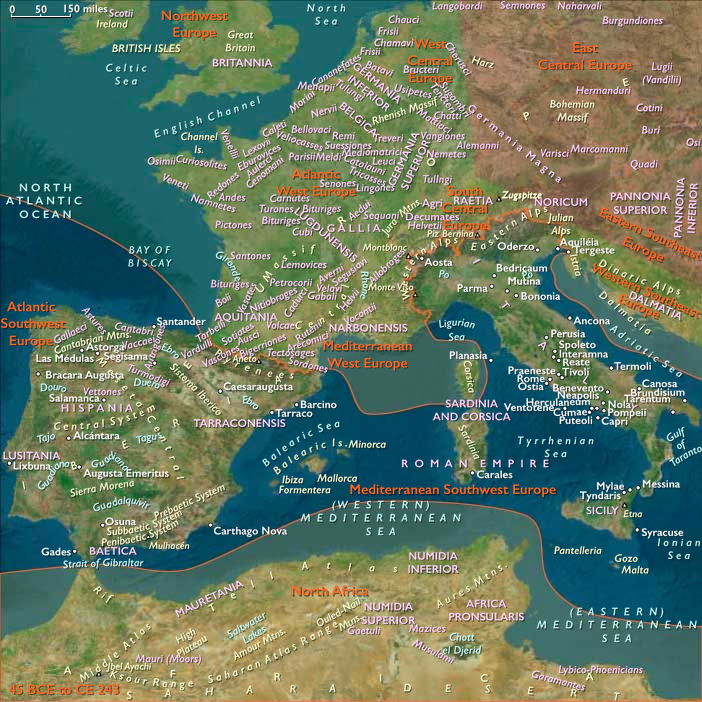
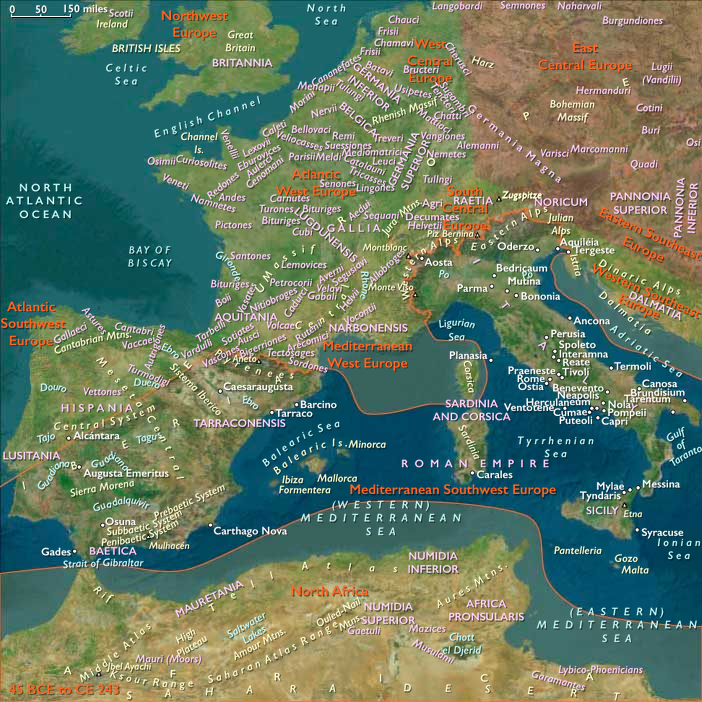
Agrippa’s last public service is his beginning of the conquest of the upper Danube River region, which becomes the Roman province of Pannonia.
He dies at Campania in March, 12 BCE, at the age of fifty-one.
His posthumous son, Marcus Vipsanius Agrippa Postumus, is named in his honor.
Augustus delivers a funeral oration in honor of his colleague (a fragment of that oration, in Greek translation, has recently become known).Although Agrippa had built a tomb for himself, Augustus has Agrippa's remains placed in Augustus' own mausoleum.
Honoring his friend’s memory by a magnificent funeral, Augustus spends over a month in mourning.
He will personally oversee the education of all Agrippa's children.
One of Agrippa's five children (not all survive) by Augustus' daughter Julia, Agrippina the Elder, is to become the mother of one emperor (Caligula) and the grandmother of another (Nero).
The Theater of Marcellus, named after Augustus's nephew, who died five years before its completion, is an open-air theater in Rome, is built in the closing years of the Roman Republic.
At the theater, locals and visitors alike are able to watch performances of drama and song.
Space for the theater was cleared by Julius Caesar, who was murdered before it could be begun; the theater was so far advanced by 17 BCE that part of the celebration of the ludi saeculares took place within the theater.
Completed in 13 BCE , it is formally inaugurated in 12 BCE by Augustus.
The theater, one hundred and eleven meters in diameter, can hold eleven thousand spectators.
It is an impressive example of what is to become one of the most pervasive urban architectural forms of the Roman world.
The theater is built mainly of tuff, and concrete faced with stones in the pattern known as opus reticulatum, completely sheathed in white travertine.
The network of arches, corridors, tunnels and ramps that give access to the interiors of such Roman theaters is normally ornamented with a screen of engaged columns in Greek orders: Doric at the base, Ionic in the middle.
It is believed that Corinthian columns were used for the upper level but this is uncertain as the theater was reconstructed in the Middle Ages, removing the top tier of seating and the columns.
Like other Roman theaters in suitable locations, it has openings through which the natural setting can be seen, in this case the Tiber Island to the southwest.
The permanent setting, the scaena, also rises to the top of the cavea as in other Roman theaters.
Today, the ancient edifice in the rione of Sant'Angelo provides one of the city's many popular spectacles or tourist sites.
Locations
People
Groups
Topics
Commodoties
Subjects
Regions
Subregions
Related Events
Showing 10 events out of 62136 total
Years: 12BCE - 12BCE
Locations
People
Groups
Topics
Commodoties
Subjects
Regions
Subregions