Agrippa had accepted an invitation from King …
Years: 15BCE - 15BCE
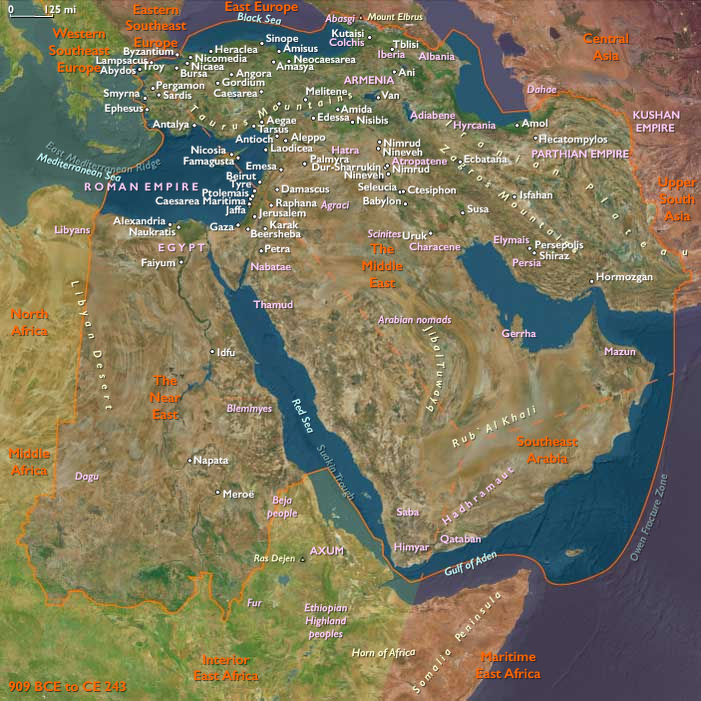
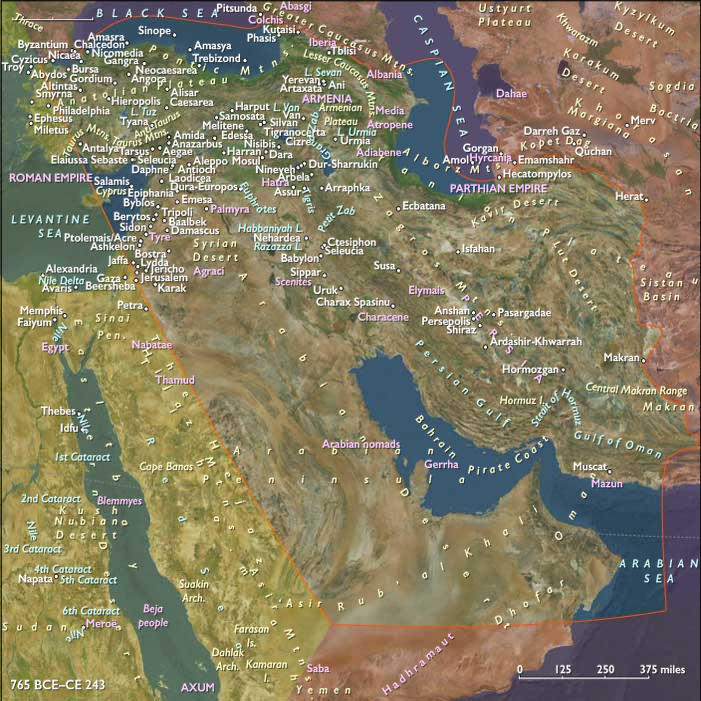
Agrippa had accepted an invitation from King Herod to visit Judaea in 15.
While in the East, Agrippa establishes colonies of veterans at Berytus and …
Locations
People
Groups
Topics
Commodoties
Subjects
Regions
Subregions
Related Events
Filter results
Showing 10 events out of 62147 total
Vindelicia, in the pre-Roman geography of Europe, identifies the country inhabited by the Vindelici, a region bounded on the north by the Danube and (later) the Hadrian's Limes Germanicus, on the east by the Oenus (Inn), on the south by Raetia and on the west by the territory of the Helvetii.
It thus corresponds to the northeast portion of Switzerland, the southeast of Baden, and the south of Württemberg and Bavaria.
The material culture of its inhabitants, the Vindelici, is La Tène.
The ethnic origin of the Vindelici is not certain.
Whether they spoke a Celtic (i.e.
Gaulish), Germanic, or other Indo-European language is unclear.
(A possible etymology of their name includes a Celtic element *windo-, cognate to Irish find- 'white'.)
However, according to a classical source, Servius' commentary on Virgil's Aeneid, the Vindelicians were Liburnians, themselves most probably related to the Veneti.
(A reference in Virgil seems to refer to the Veneti as Liburnians, namely that the "innermost realm of the Liburnians" must have been the goal at which Antenor is said to have arrived.)
Thus, it seems that the ancient Liburnians may have encompassed a wide swathe of the Eastern Alps, from Vindelicia, through Noricum, to the Dalmatian coast.
Together with the neighboring tribes they are subjugated by Tiberius in 15 BCE.
The Augustan inscription of 12 BCE mentions four tribes of the Vindelici among the defeated.
The present city of Augsburg, located at the confluence of the Wertach and Lech rivers in Bavaria, in southern Germany, appears in Strabo as Damasia, a stronghold of the Licatii; in 14 BCE, Drusus and Tiberius, on the orders of their stepfather Emperor Augustus, establish a Roman colony on the site known as Augusta Vindelicorum ("Augusta of the Vindelici").
This garrison camp soon becomes the capital of the Roman province of Raetia.

The Romans take the Celtic region of Styria (German: Steiermark), a mountainous, mostly forested province in southeastern Austria, bordering on present Slovenia in the south.
After its conquest by the Romans in about 15 BCE, the eastern part of what is now Styria is part of Pannonia, while the western portion is included in Noricum.
In this year, Tiberius discovers the sources of the Danube, and soon afterwards the bend of the middle course.
The brothers have thereby extended the imperial frontier from Italy to the upper Danube in 16–15.
Tiberius has not only conquered the enemy but so distinguishes himself by his care for his men that he finds himself popular and even loved; when he returns to Rome, he is awarded a triumph.
…Heliopolis, a town in the Beqaa Valley of Lebanon situated east of the Litani River.
After Alexander the Great conquered the Near East in 334 BCE, the existing settlement at Baalbek had been renamed Heliopolis, from helios, Greek for sun, and polis, Greek for city.
Heliopolis (there is another Heliopolis in Egypt) becomes part of the territory of Berytus on the Phoenician coast in 15 BCE.
The city retains its religious function as a pilgrimage site to the sanctuary of the Heliopolitan Jupiter-Baal.
Augustus’ nephews, the brothers Drusus and Tiberius, in annexing to the Roman domains the Celtic lands of Noricum and Rhaetia (in modern Austria), have ended the prehistoric Iron Age in the Alpine region, bringing into the borders of the empire Poetovio (modern Ptuj, Slovenia), and …
…Emona (Ljubljana, Slovenia), together with the portion of the tribe of the Taurisci that lives near the source of the Sava River.
Twenty eight Roman legions, each representing three thousand to six thousand fighting men, now exist.
Tiberius' first military command at twenty-one, resulting in the recovery of the lost standards of the Roman legions in Parthia, had vindicated Roman honor and brought him great personal acclaim.
As a reward, he had asked for another active command and in 16 BCE had been given the assignment of pacifying the province of Pannonia on the Adriatic Sea.
When he returns to Rome the following year, he is awarded a triumph.
Marcus Vinicius, born the son of a Roman knight at Cales in Regio I (Latium et Campania) of Italia, had distinguished himself as legatus Augusti pro praetore (governor) of the Roman province of Gallia Belgica in 25 BCE, when he led a successful campaign into Germania.
At some point, Vinicius may also have served as governor of the Roman province of Achaea; an inscription from Corinth, dated to 18-12 BCE and honoring his fellow-general, and the Emperor's right-hand man, Agrippa, reveals that an administrative division of the city had been named the tribus Vinicia, apparently in Vinicius' honor.
In recognition of his services, Vinicius, the archetypal homo novus, had been appointed suffect consul in 19 BCE, replacing C. Sentius Saturninus and holding the office together with Q. Lucretius Vespillo.
After his consulship, Vinicius continues to be entrusted with important military commands.
Starting in 14 or 13 BCE, Vinicius serves as governor of Illyricum where he is in charge of the early stages of the Roman conquest of Pannonia (the bellum Pannonicum, 14 - 9 BCE) until Augustus' stepson and future successor as Emperor, Tiberius, assumes overall command.
With the Scordisci as allies, Vinicius takes Sirmium.
During or shortly after this war, he becomes the first Roman general to campaign on the far side of the river Danube: he routs an army of Dacians and Bastarnae and subjugates the Celtic tribes of the Hungarian Plain.
Throughout his life, Vinicius seems to have enjoyed a close friendship with the emperor: the historian Suetonius quotes a letter by Augustus in which he talks about playing dice with Vinicius and his fellow homo novus, Publius Silius Nerva.
Herod supports the Jews in Anatolia and Cyrene: in 14 BCE, owing to the prosperity in Judaea, he waives a quarter of the customary taxes.
The Pyramid of Cestius, built about 18–12 BCE as a funerary monument for Gaius Cestius, a magistrate and member of one of the four great religious corporations in Rome, the Septemviri Epulonum, is the first (and, for centuries to come, the only) European structure built in imitation of the pyramids of ancient Egypt.
It stands at a fork between two ancient roads, the Via Ostiensis and another road that runs west to the Tiber along the approximate line of the modern Via della Marmorata.
It is constructed of brick-faced concrete covered with slabs of white marble standing on a travertine foundation, measuring one hundred Roman feet (29.6 meters) square at the base and standing one hundred and twenty-five Roman feet (thirty-seven meters) high.
In the interior is the burial chamber, a simple barrel-vaulted rectangular cavity measuring 5.95 meters long, 4.10 meters wide and 4.80 meters high.
It stands today near the Porta San Paolo and the Protestant Cemetery.
Due to its incorporation into the city's fortifications, it is today one of the best-preserved ancient buildings in Rome.
When it was (re)discovered in 1660, the chamber was found to be decorated with frescoes, which were recorded by Pietro Santi Bartoli, but only scant traces of these now remain.
There was no trace left of any other contents in the tomb, which had been plundered in antiquity.
The tomb had been sealed when it was built, with no exterior entrance; it is not possible for visitors to access the interior, except by special permission typically only granted to scholars.
Horace works on a final book of Odes until 13 BCE, and publishes two additional longer Epistles on literary matters.
Publius Ovidius Naso, who passed his youth in his native Sulmo, untouched by the civil wars, and went to Rome to continue his education shortly after peace resumed, quietly rebels against the political career intended for him by his father.
Spectacularly talented and unable to resist the literary temptations of the now-peaceful capital, he is drawn into writing poetry.
By 23 BCE, Ovid—the name by which he is commonly known—not yet twenty, was reading his works to appreciative audiences.
By the time he turns thirty in 13, he Rome’s most successful poet.
Agrippa had been appointed governor of the eastern provinces a second time in 17 BCE, where his just and prudent administration have won him the respect and goodwill of the provincials, especially from the Jewish population.
Agrippa has also restored effective Roman control over the Cimmerian Chersonnese (modern-day Crimea) during his governorship.
Agrippa's tribunicia potestas is renewed in 13 BCE, and at this time, without doubt he receives (or had renewed) a grant of imperium majus.
At the death of Lepidus toward the end of the year, Augustus adds to his own string of honorifics his former partner’s title of high priest (pontifex maximus), head of the Roman state religion.