
Agriculture and Neolithic settlement begins at Mehrgarh, …
Years: 7101BCE - 6958BCE
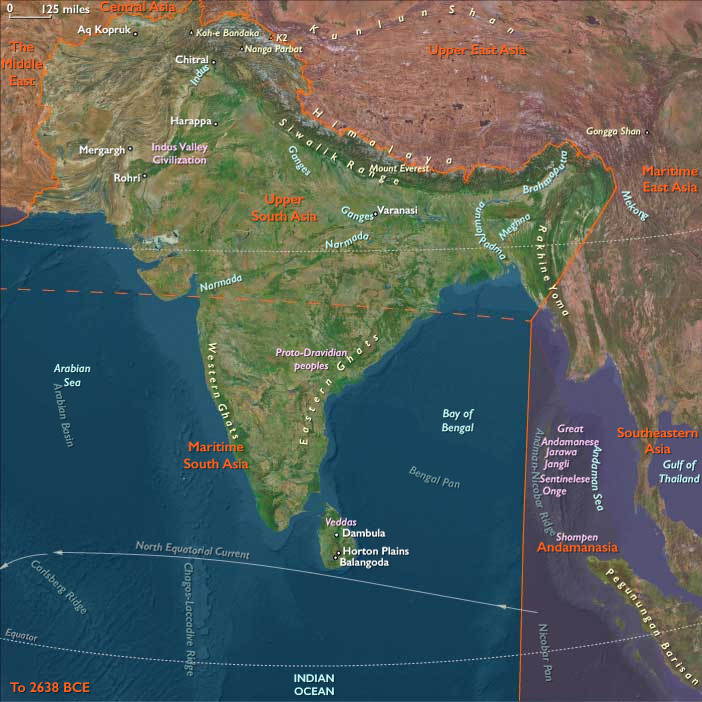
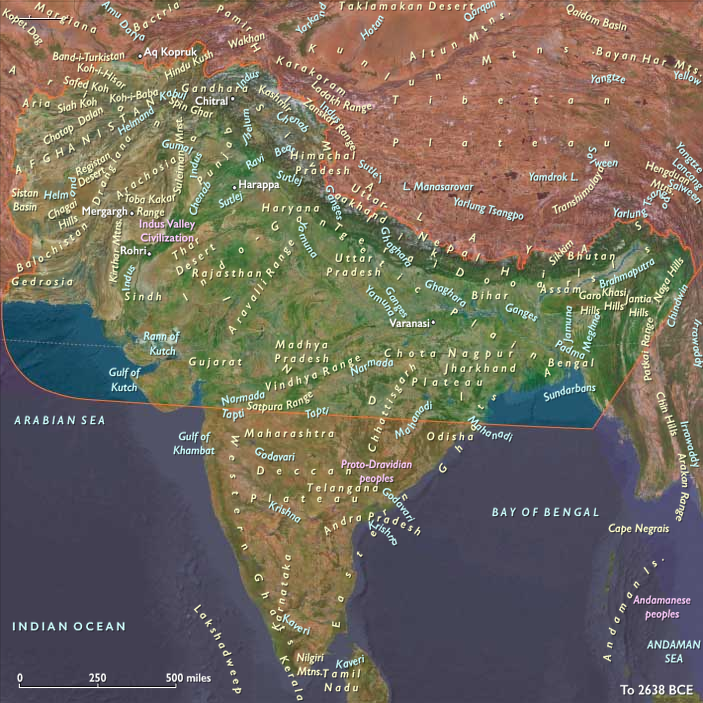
Agriculture and Neolithic settlement begins at Mehrgarh, in present Baluchistan, Pakistan, about fifty kilometers west of Sibi, at the foot of the Bolan Pass, in about 7000 BCE.
Archaeologists divide the occupation at the site into several periods.
Mehrgarh Period I, 7000 BCE–5500 BCE, was Neolithic and aceramic (i.e., without the use of pottery).
Early Mehrgarh residents live in mud brick houses with four internal subdivisions.
They have an extremely well developed agricultural system, storing their grain in granaries, fashioning tools with local copper ore, and lining their large basket containers with bitumen.
They cultivate six-row barley, einkorn and emmer wheat, jujubes and dates, and herd sheep, goats and cattle.
Numerous burials have been found, many with elaborate goods such as baskets, stone and bone tools, beads, bangles, pendants and occasionally animal sacrifices, with more goods left with burials of males.
Ornaments of seashell, limestone, turquoise, lapis lazuli, sandstone, and polished copper have been found, along with simple figurines of women and animals.
Sea shells from far seashore and lapis lazuli found far in Badakshan, Afghanistan shows good contact with those areas.
A single ground stone ax was discovered in a burial, and several more were obtained from the surface.
These ground stone axes are the earliest to come from a stratified context in the South Asia.
Mehrgarh is now seen as a precursor to the Indus Valley Civilization.
Locations
Groups
Topics
- Neolithic Revolution
- Boreal Period
- Neolithic Subpluvial, or Holocene climatic optimum, or Holocene Wet Phase
Commodoties
Subjects
- Origins
- Commerce
- Sculpture
- Environment
- Labor and Service
- Decorative arts
- Conflict
- Faith
- Government
- Technology
- Anthropology
- Archaeology
Regions
Subregions
Years: 7101BCE - 6958BCE
Locations
Groups
Topics
- Neolithic Revolution
- Boreal Period
- Neolithic Subpluvial, or Holocene climatic optimum, or Holocene Wet Phase
Commodoties
Subjects
- Origins
- Commerce
- Sculpture
- Environment
- Labor and Service
- Decorative arts
- Conflict
- Faith
- Government
- Technology
- Anthropology
- Archaeology
Regions
Subregions